
A logistics firm runs six Policy Service nodes that the switches address individually, and peak authentication volume already saturates one node during shift change. The security lead also requires that authentication continue automatically if a node fails. Which RADIUS distribution design meets both requirements?
Select an answer to reveal the explanation.
Short Explanation
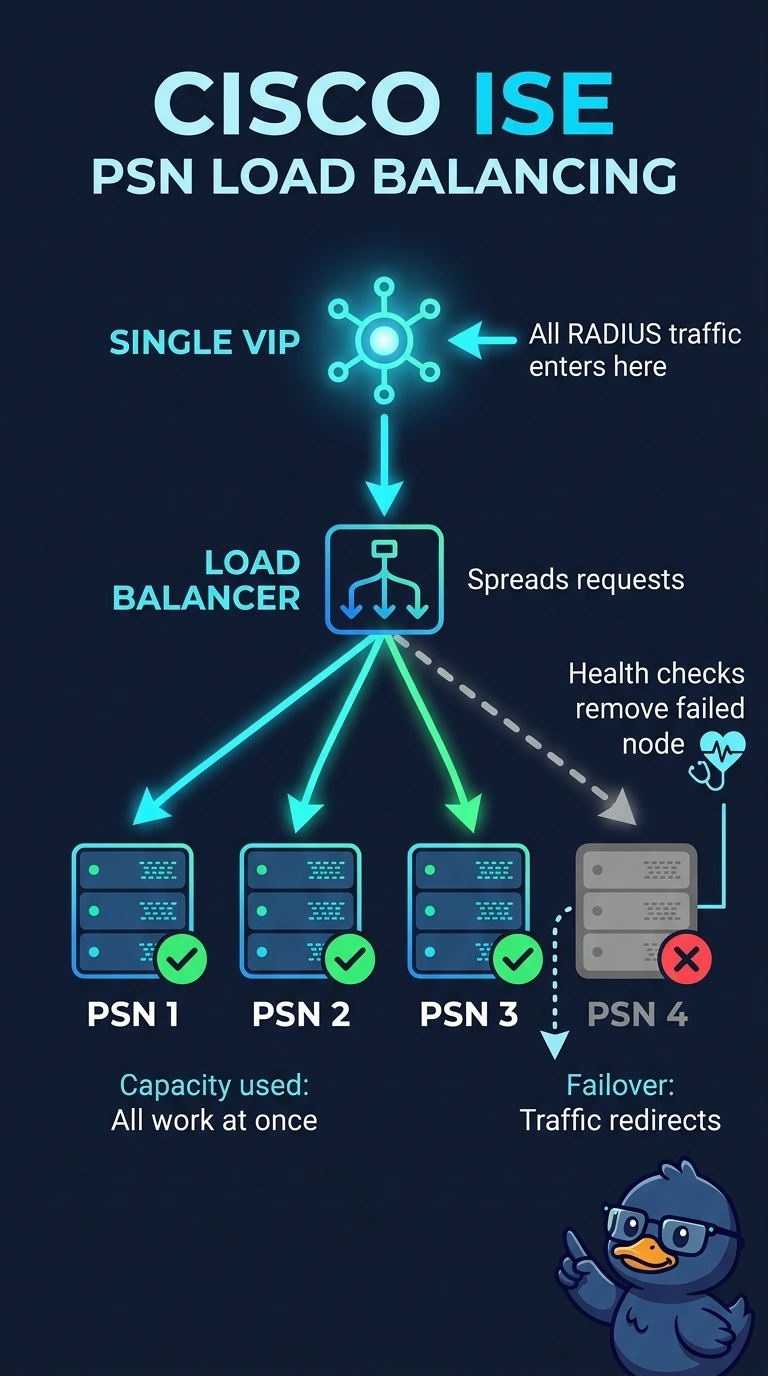
You need capacity at shift change and automatic recovery if a node fails, so a virtual IP in front of your PSN pool gives you both. With the same primary and backup on every switch, or switches assigned to site-local PSNs without alternates, you still leave peak load concentrated or lose service after a failure; DNS round-robin does not ensure health-based failover. A load balancer distributes requests across the nodes and redirects them when one fails.
Full Explanation
A load-balanced virtual IP gives switches one common RADIUS destination while distributing authentication requests across the available Policy Service nodes. This addresses saturation at shift change, and health checks let the load balancer detect an unavailable node and redirect requests automatically, meeting the failover requirement. Configuring every switch with the same primary PSN and a backup provides a recovery path if the primary fails, but normal requests still concentrate on that single primary, so the backup does not relieve its peak load. DNS round-robin can spread requests among PSNs, but without health-based failover, cached answers may continue directing clients to a failed node; it therefore does not ensure authentication continues automatically. Assigning switches across site-local PSNs can distribute demand, but a switch assigned to a failed PSN has no alternate node in this design, so its authentication cannot automatically continue. Exam caveat: a virtual IP provides both benefits only when its distribution and node-health failover are configured correctly; merely presenting a shared address does not guarantee either behavior. Practical check: during peak load, verify requests reach multiple nodes, then take one node out of service and confirm that new authentications continue through the remaining nodes.