
Profiling logs in a campus building show no DHCP data from the client VLANs, whose SVIs relay only to the corporate server, and nothing at all from a legacy segment of static scanners that emit CDP and HTTP. The switch there supports only port mirroring. Which change gives ISE both missing feeds?
Select an answer to reveal the explanation.
Short Explanation
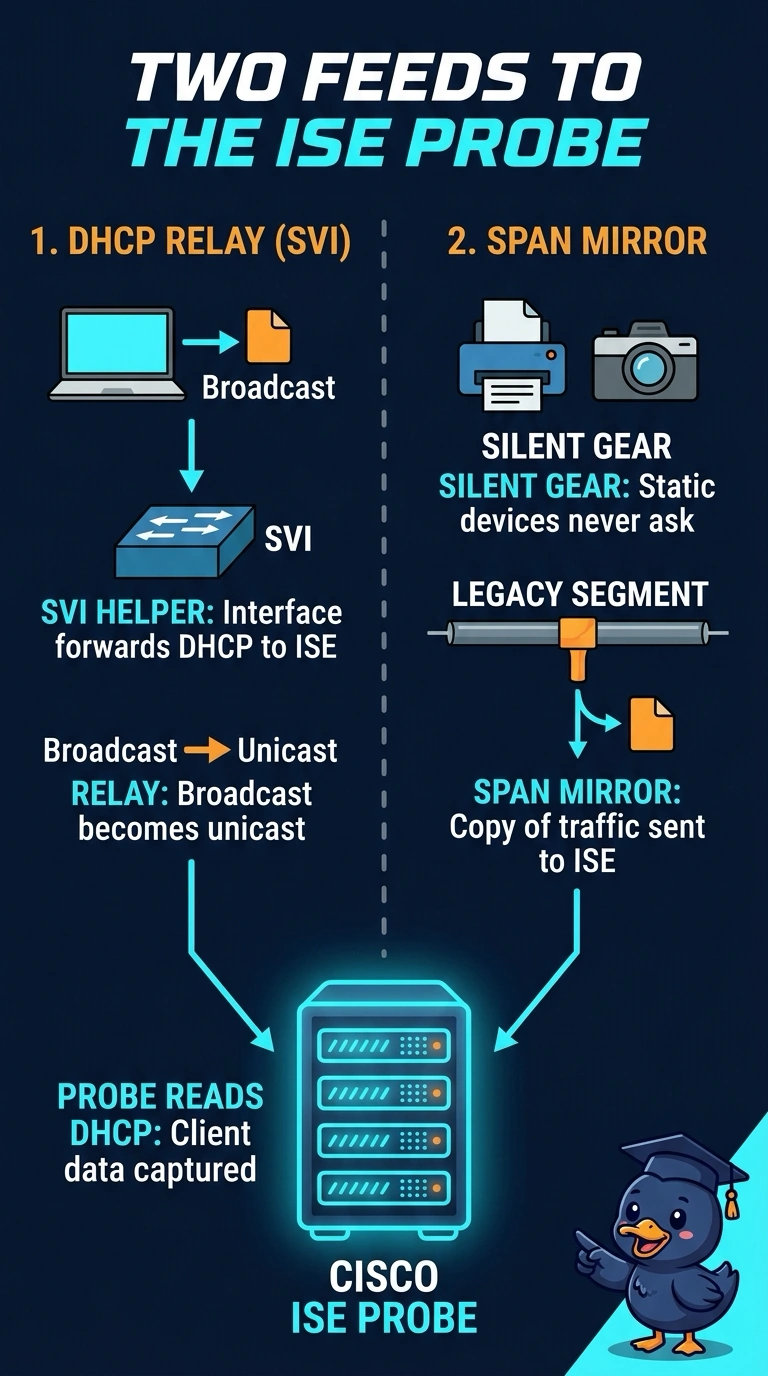
Relayed DHCP broadcasts reach only the destinations configured as helpers, so add ISE to the helper list on each client SVI. Since the static scanners never request an address, you also need a SPAN session that sends legacy-segment traffic directly to ISE.
Full Explanation
Adding ISE as a helper destination on each client SVI lets ISE receive relayed DHCP information from the client VLANs, while SPAN sends legacy-segment traffic to ISE for profiling. Together, these changes provide both missing feeds. Adding ISE as a helper and mirroring only HTTP would still omit the scanners’ CDP observations, so it would not provide both stated legacy feeds. Adding ISE as a helper and sending mirrored traffic to a packet broker would not, by itself, deliver that traffic to ISE; no onward feed is specified. Adding ISE as a helper and using active NMAP scans would provide DHCP information, but probing does not supply the passive CDP and HTTP observations needed from the legacy segment. Exam caveat: a helper address is a relay destination for DHCP packets, not a replacement DHCP server, so preserve the existing server destination when adding ISE. Practical check: verify that ISE’s profiler receives DHCP events from each client VLAN and CDP and HTTP observations from the legacy segment after testing the relay and SPAN paths. Successful visibility depends on compatible SPAN source, destination, and ISE interface configuration.