
A factory floor runs 200 badge printers on a single VLAN. The access switches relay DHCP to two Microsoft DHCP servers, so ISE's DHCP probe never receives a copy, and profiling must settle from the first lease. Which switch change will deliver the DHCP probe data that ISE needs to profile these printers?
Select an answer to reveal the explanation.
Short Explanation
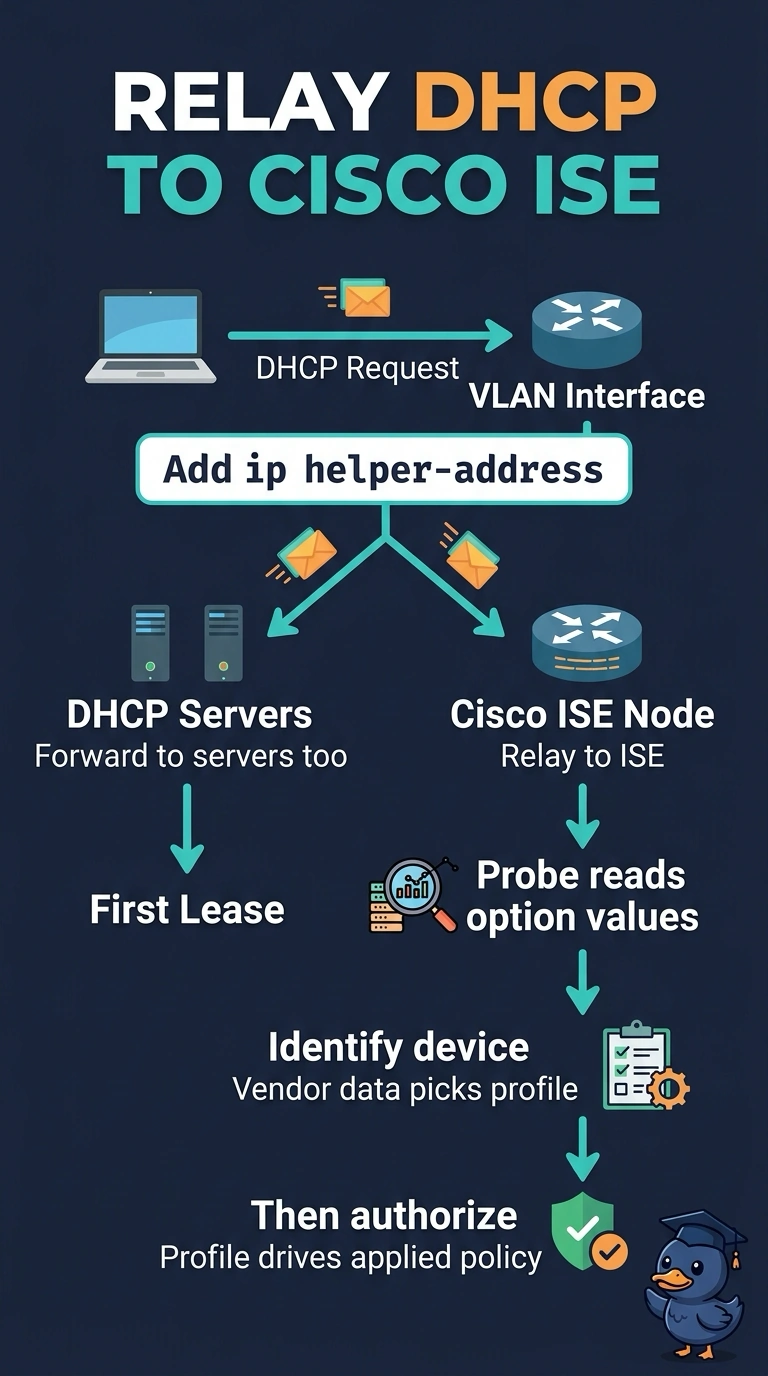
You add ISE to the helper list so the relay hands it a copy of every request, and the probe reads the lease options from the first grant. DHCP relay is the hook here, because without it ISE stays blind until the printer generates other traffic. The other designs either keep ISE off the relay or send flow and web data, none of which carries DHCP option values.
Full Explanation
ISE identifies most printers from DHCP option values such as the vendor class identifier, the parameter request list and the requested hostname, and the DHCP probe can only read them when those packets actually reach the node, which is exactly what a relay does once you add the ISE address to the helper list beside the two Microsoft servers. The client configuration never changes, so the profile lands the moment the first lease is granted and authorization can follow right away. Switch-based addressing with a local pool on the VLAN interface hands out leases locally, so no relayed copy ever leaves the switch and the DHCP probe still hears nothing. Option 82 tagging only enriches the relay agent's own record with circuit identifiers, which locates the switch port but puts no DHCP payload in front of ISE, and NetFlow export supplies flow statistics such as byte and packet counts that simply lack vendor data. The HTTP probe reads User-Agent strings from web traffic, so it stays quiet until a printer starts talking, well after the first lease. Exam caveat: keep the real DHCP servers in the helper list alongside ISE, or leases stop being issued. Practical check: renew a lease on a test printer, then confirm it shows up in ISE with the printer profile.