
A plant's security team is standing up posture for 500 Windows laptops that must show full-disk encryption and current Windows security updates. They want the requirement definitions and compliance checks offered for their ISE release to be the newest published ones. Which ISE source supplies that current posture content?
Select an answer to reveal the explanation.
Short Explanation
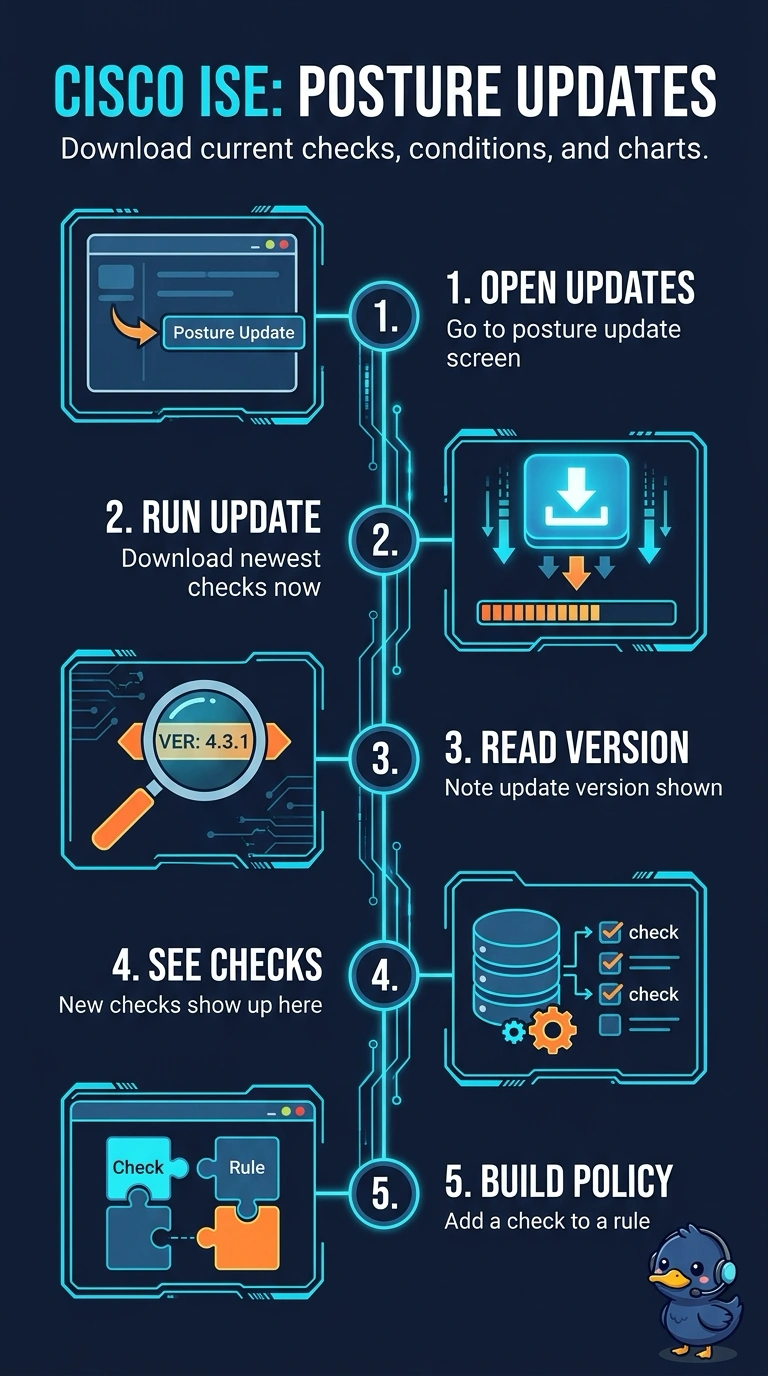
The posture update feed is the source ISE uses to refresh its posture content, including checks, conditions, and support charts. After the update, you can use available checks in a posture policy.
Full Explanation
A posture update is the ISE mechanism for obtaining the vendor-published posture content applicable to that ISE release, including checks, conditions, and support charts. Those definitions let ISE assess whether endpoints meet requirements such as full-disk encryption and current Windows security updates; downloading the update makes the current content available in the ISE library. Client provisioning is a legitimate way to deploy or update the posture agent, but the agent provides endpoint assessment capability rather than the release-specific library of checks and conditions. The profiler feed refreshes device-classification data, which can help identify or group Windows endpoints, but classifications do not verify encryption state or patch compliance. Configuring and publishing posture-policy checks can enforce the requested controls, yet manually authored policy content is not thereby the newest published content supplied for the ISE release. Exam caveat: distinguish posture content updates from agent deployment, profiling feeds, and policy configuration; all may be relevant to a working posture deployment, but they serve different functions. Practical check: after running a posture update, confirm the update status and inspect ISE’s available posture checks and supported products before building or validating the laptop policy.