
A hospital network spans twelve VLANs served by one central DHCP server, and ISE in the data center must profile those endpoints for device-based policy. Operations has ruled out SPAN sessions that mirror uplink traffic because the collector links are already saturated. Which configuration delivers DHCP probe data to ISE on every subnet?
Select an answer to reveal the explanation.
Short Explanation
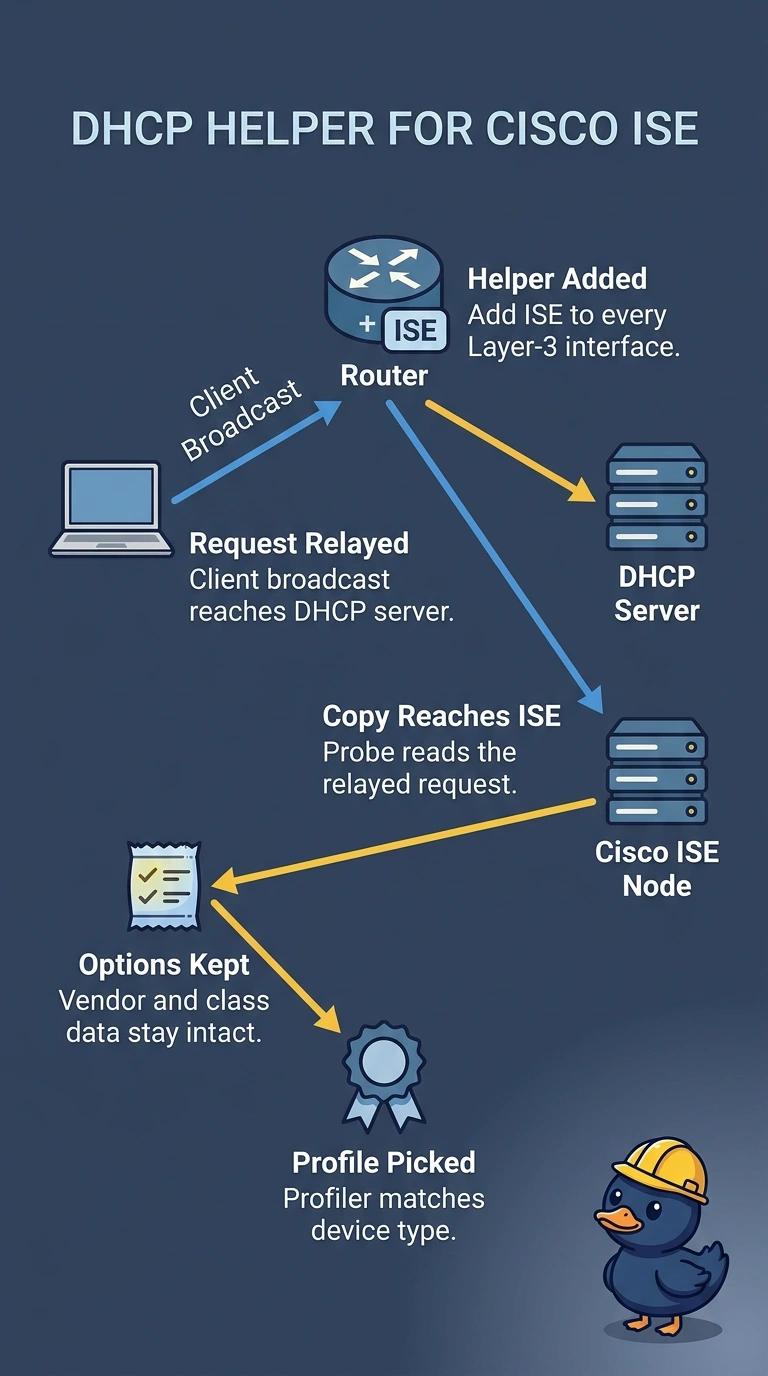
You can add ISE as a helper address on every Layer-3 interface that relays DHCP, giving it probe data from all twelve subnets. Option 82 adds context but does not send DHCP traffic to ISE, and RADIUS probing uses authentication evidence instead of DHCP, so profiling still needs the DHCP relay destination.
Full Explanation
Adding ISE as an additional DHCP helper address on every Layer-3 interface that relays requests to the central server delivers DHCP probe data from all twelve subnets while preserving the existing relay path. ISE can use DHCP attributes in those messages to profile endpoints for device-based policy. Adding ISE only to user-VLAN SVIs at the distribution pair leaves routed VLANs on other switches without a relay path to the ISE probe, so it cannot meet the every-subnet requirement. Enabling DHCP option 82 adds circuit or switch context to relayed requests, which can help identify where a client is connected, but it does not itself forward DHCP messages to ISE. Using the RADIUS probe can provide profiling evidence from authentication requests and authorization attributes, but it does not deliver DHCP probe data and may not cover endpoints that have not authenticated. Exam caveat: distinguish metadata added to a DHCP exchange from a mechanism that transports the exchange to a profiler. Practical check: inspect the helper-address configuration on every routed VLAN interface, then verify in ISE that DHCP probe events arrive for clients from all twelve subnets.