
A regional hospital rolled out dozens of new biomedical monitors and digital displays this quarter, and ISE keeps dropping them into the Unknown profile because their MAC OUI prefixes and HTTP user-agent strings are new. The team edits profiling rules every week and wants updated vendor fingerprint data to arrive on its own while the switch configuration stays untouched. Which ISE capability should the team enable to keep that fingerprint data current?
Select an answer to reveal the explanation.
Short Explanation
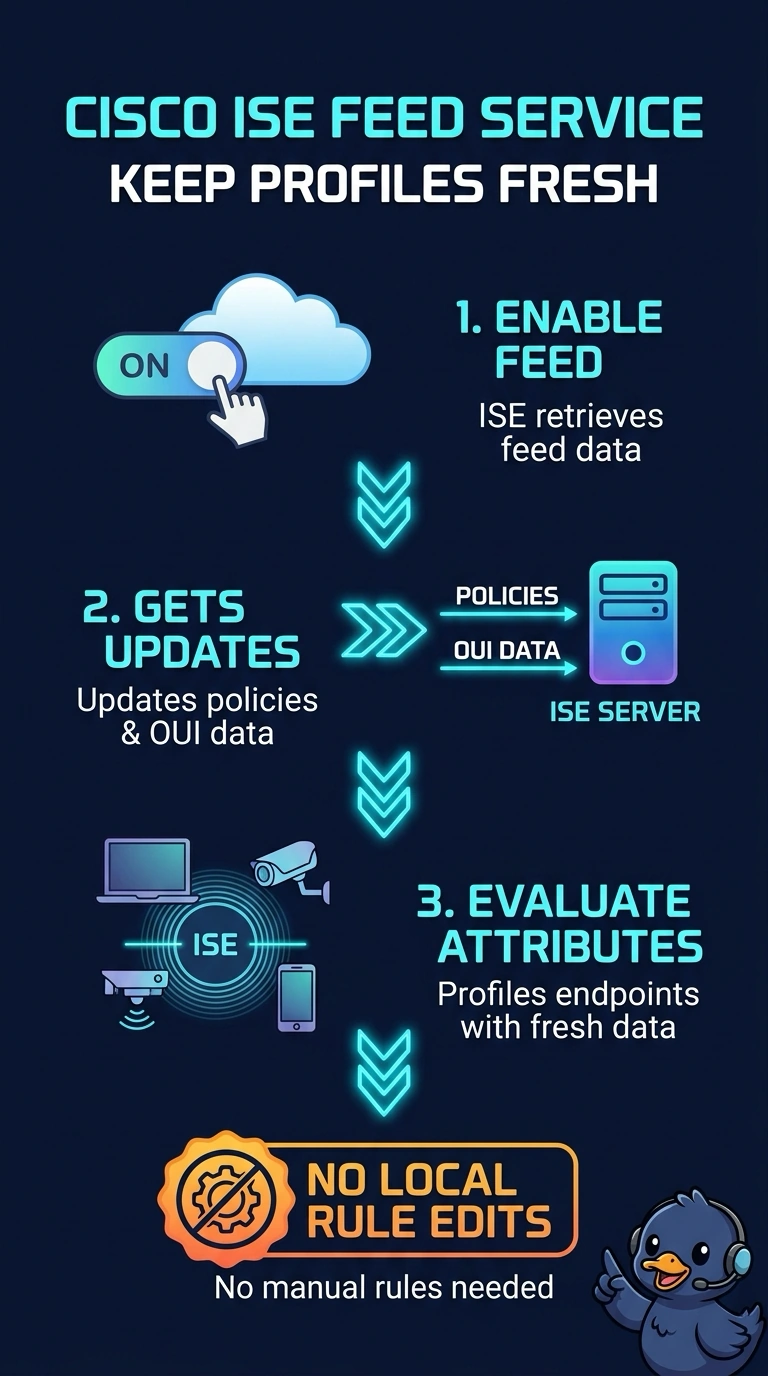
Nice work — the profiler feed service periodically retrieves Cisco-supplied profiling policies and OUI data. When the feed includes relevant information, ISE can profile endpoints without you adding local rules. Manual rules remain an option, but you need to keep them updated.
Full Explanation
Cisco’s profiler feed service periodically retrieves Cisco-supplied profiling policies and OUI data for ISE, allowing ISE to use current vendor fingerprints when profiling endpoints. This directly addresses the need to keep fingerprint data current without changing switch configuration or manually adding rules. The feed does not guarantee that every new model, MAC prefix, or user-agent string will be recognized; ISE can still place an endpoint in the Unknown profile if relevant information is unavailable. Adding local profiling rules for each new user-agent string and MAC prefix can address specific attributes, but the team must maintain those rules as devices appear, creating the ongoing work described in the scenario. Polling each endpoint with SNMP system-description queries depends on the endpoint responding with useful SNMP information; it does not update Cisco’s profiling policies or OUI data. Enabling DHCP, HTTP, and NetFlow probes can give the PSN more observed attributes from unknown endpoints, but gathering attributes is different from refreshing the profiling policies or OUI database. As an exam caveat, more endpoint attributes or a newly updated feed can improve recognition but cannot guarantee a match for every device. As a practical check, verify that ISE can reach Cisco’s feed server and confirm that the feed has successfully updated its profiling policies and OUI data.