
A media studio's AV network has 40 static-addressed devices: mixers, lighting desks and display screens. They authenticate with MAB, run without SNMP, and stay silent on DHCP and HTTP. Profiling falls back to the MAC OUI and groups them as unknown, yet each device answers connection attempts on its control port. Which probe should be enabled to collect attributes that separate these device types?
Select an answer to reveal the explanation.
Short Explanation
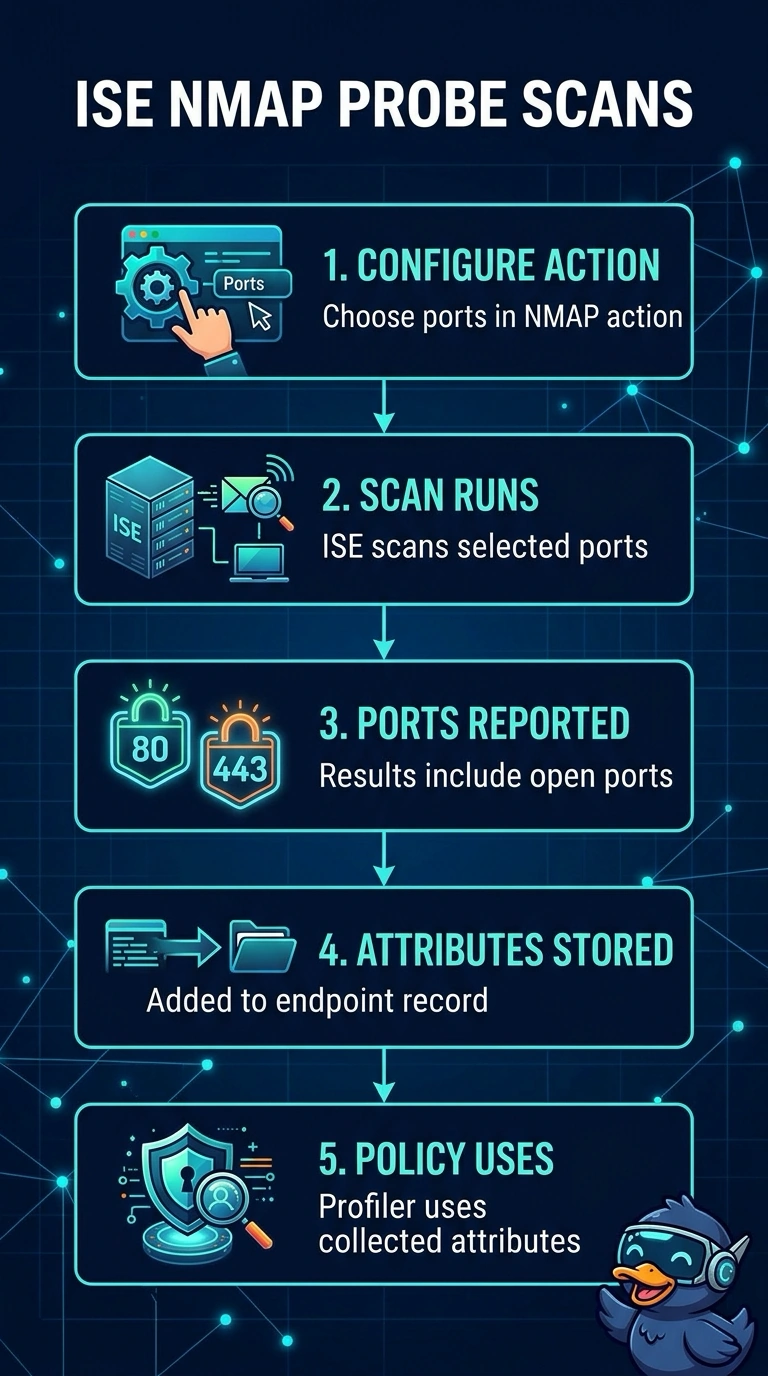
Enable the NMAP probe and include the devices’ control ports in its scan action, so you can collect port-related attributes even though the devices are silent on DHCP and HTTP. You can use those attributes to distinguish devices that OUI-based profiling groups as unknown; RADIUS, NetFlow, and DNS do not provide the requested control-port data.
Full Explanation
The NMAP probe is the best fit because these endpoints answer connection attempts on their control ports. Configuring a scan action for those ports lets ISE collect port-related attributes that can help distinguish device types, without depending on DHCP, HTTP, or SNMP responses that the scenario says are absent. The RADIUS probe can provide profiling data for MAB endpoints, but authentication and session records principally identify endpoints and their network access; they do not provide the service-port attributes needed to distinguish these device types. The NetFlow probe can support profiling by revealing communication patterns, but it reports observed traffic rather than actively probing reachable control ports, so it does not meet the port-attribute objective. The DNS probe can associate an address with a hostname when useful records exist, but a hostname is not a reliable source of the requested control-port attributes. Exam caveat: enabling a probe does not guarantee useful classification; endpoints must expose relevant data, and ISE needs the corresponding configuration and profiling policy. Practical check: verify that the scan action reaches the intended control ports from the ISE profiling node, then inspect the collected endpoint attributes and confirm that the resulting policy distinguishes the device types.