
A retail chain is rolling out 802.1X to 4,000 access ports holding legacy printers and IP phones that will initially fail authentication. For 60 days the team wants every attempt logged to ISE while every host keeps its current connectivity untouched, and enforcement will follow later. Which IBNS 2.0 mode fits this observation phase?
Select an answer to reveal the explanation.
Short Explanation
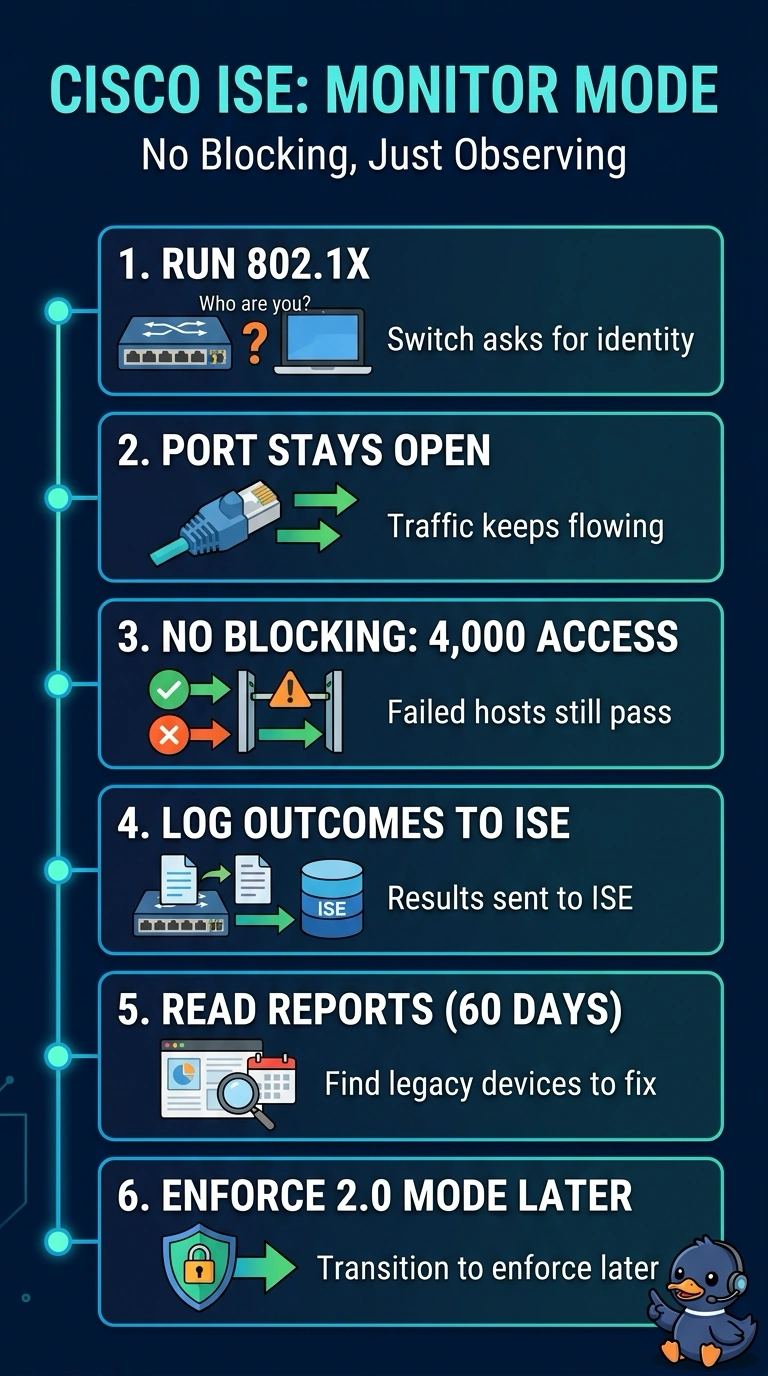
Monitor mode lets you log authentication outcomes to ISE while your legacy devices keep their current connectivity. You can observe what’s happening without changing how hosts use the network.
Full Explanation
Monitor mode is the right fit because it lets the team observe 802.1X and MAB authentication outcomes in ISE without using those outcomes to change the ports’ existing forwarding behavior. Deploying it across all 4,000 ports for the full 60 days meets the scope, logging, connectivity, and duration requirements while postponing enforcement. Low-impact mode is a familiar migration approach: pre-authentication ACLs permit selected printer and phone services before authorization, and authentication activity can be logged. However, those ACLs constrain what hosts can reach, so connectivity is no longer untouched. Closed mode with MAB fallback and device-specific profiles can authenticate and classify endpoints before granting access. It fails here because unauthenticated or unsuccessful endpoints are denied normal access; MAB does not make closed mode transparent to legacy devices that fail authentication. Monitor mode on selected ports preserves traffic on those ports and can log outcomes, but it does not cover every access port, as required for this observation phase. Exam caveat: monitor mode is distinct from an open-authentication policy, and platform configuration details can affect which events are reported or how authorization is handled. Practical check: verify ISE receives successes and failures from representative printers and phones, and compare their permitted traffic before and during the change to confirm it remains unchanged.