
A bank applies ISE posture to Windows and macOS laptops. Endpoints whose agent satisfies every required check reach the corporate VLAN, and endpoints whose agent reports a failed check go to a remediation VLAN. Endpoints with no agent installed or with no posture assessment completed must get that same remediation access but be flagged for an onboarding ticket. Which posture result fits that third case?
Select an answer to reveal the explanation.
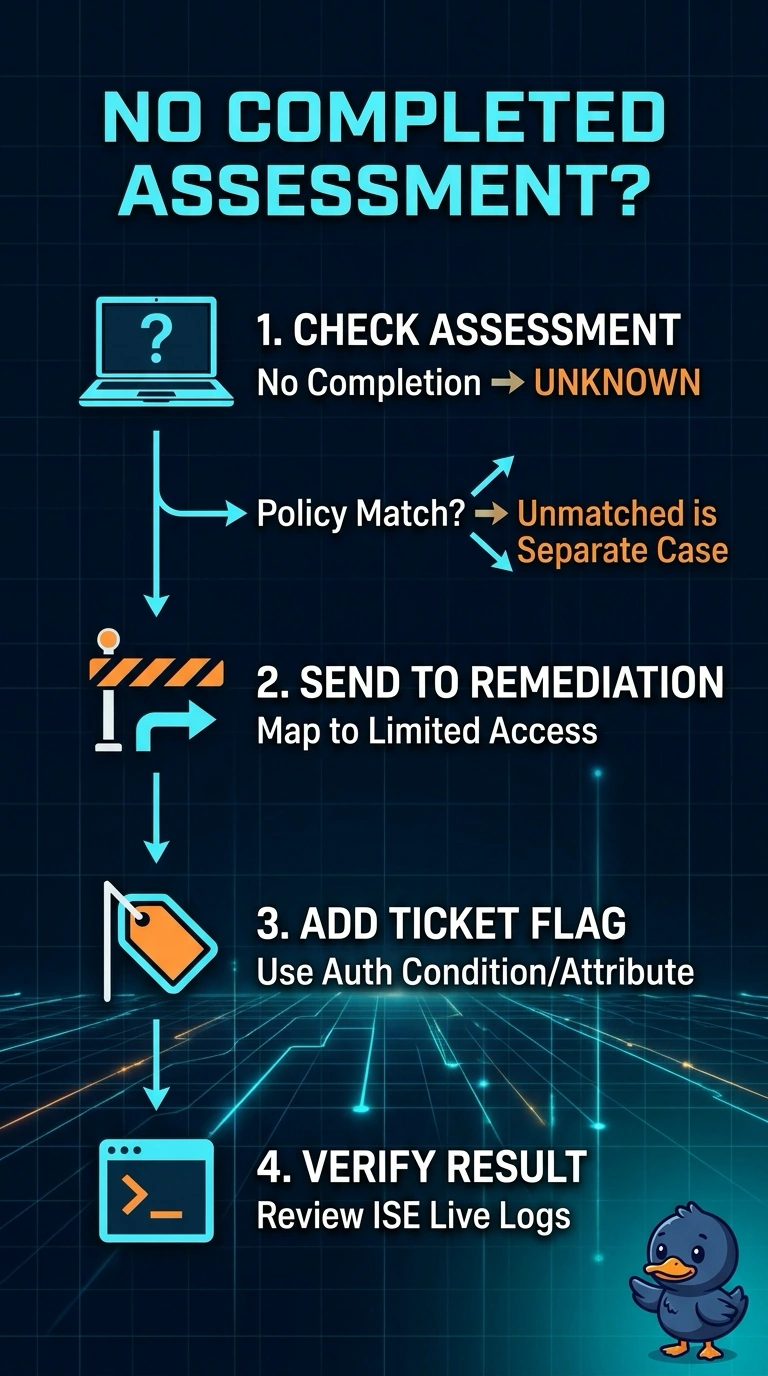
Short Explanation
Unknown means a posture assessment has not produced a verdict; it differs from an agent reporting a failed check. A posture policy that does not match is a separate case and can result in Not Applicable. You can map the relevant posture results to remediation access and use authorization conditions to flag endpoints for onboarding.
Full Explanation
ISE posture results distinguish endpoints that pass evaluated requirements (Compliant), fail an evaluated requirement (Non-Compliant), and have no completed assessment (Unknown). A missing agent or an assessment that has not completed can leave the endpoint Unknown. A posture policy that does not match is a separate case and can produce a Not Applicable result; do not assume it is Unknown. Configure authorization rules and profiles to grant the required remediation access for the relevant result or results, and use an authorization condition or attribute to flag onboarding work. A Non-Compliant result identifies an assessed failure, while Unknown identifies the absence of a completed assessment. Verify the actual posture status and authorization result in the ISE live logs for the deployed version and configuration.