
A regional hospital must place clinical laptops on the app VLAN only when an EDR service is running and the OS patch level meets the current baseline. Laptops failing either check must be sent to a remediation page offering the EDR installer and the patch download. Which ISE posturing design produces that single pass or fail decision?
Select an answer to reveal the explanation.
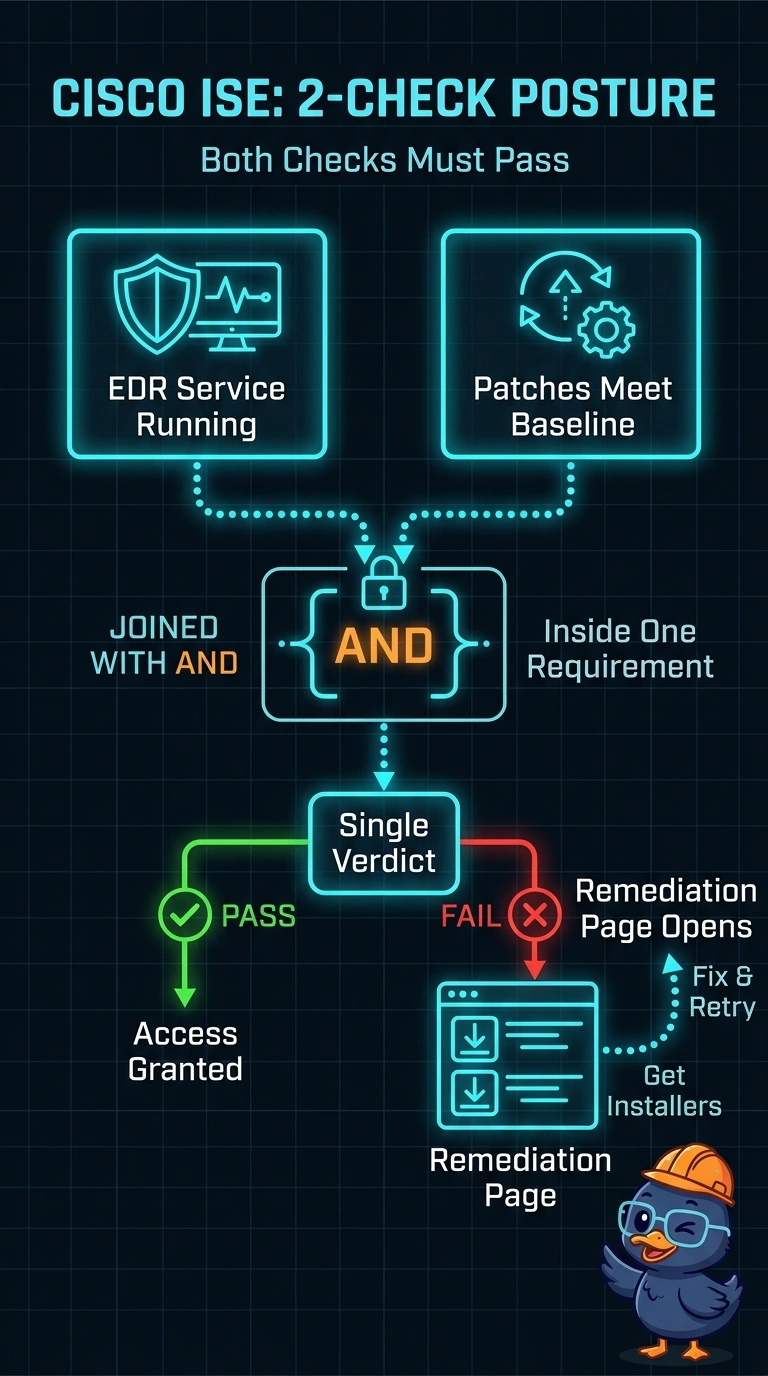
Short Explanation
Posture builds from conditions up into a requirement, and the operator inside that requirement decides the verdict. Here both checks must pass, so you need one requirement joined with AND before any remediation is offered. It's a bouncer checking both the invite and the ID, not just one.
Full Explanation
A posture condition tests one attribute of an endpoint, a requirement combines conditions with a Boolean operator, and the posture policy carries the remediation the user sees when that requirement fails. Joining the EDR check and the patch check with AND inside a single requirement gives you one verdict that feeds cleanly into an authorization rule, and the attached remediation gives failing users a self-service route to the page offering the installer and patch download. Two requirements allowed to pass independently fail the requirement, because either check alone would open the VLAN even with a missing patch. Trusting an external patch management tool fails the requirement, because ISE only scores what its own posture condition reads, so that patch state never enters the single verdict. A requirement with no remediation fails the requirement, because the hospital wants failing endpoints routed to the installer and download page instead of a flat denial. An exam caveat: compliance only flips after the agent re-evaluates the endpoint post-fix, so expect a second assessment. A practical check: break a test laptop on purpose, then read the posturing report to see which individual condition it marked as failed.