
A hosting company brings four new ISE PSN appliances online in two regions and wants each node to configure itself at first boot instead of an engineer typing the setup script. Every node must come up with its own hostname, addressing, DNS, NTP and admin login already in place. Which ISE feature delivers this zero-touch initial provisioning?
Select an answer to reveal the explanation.
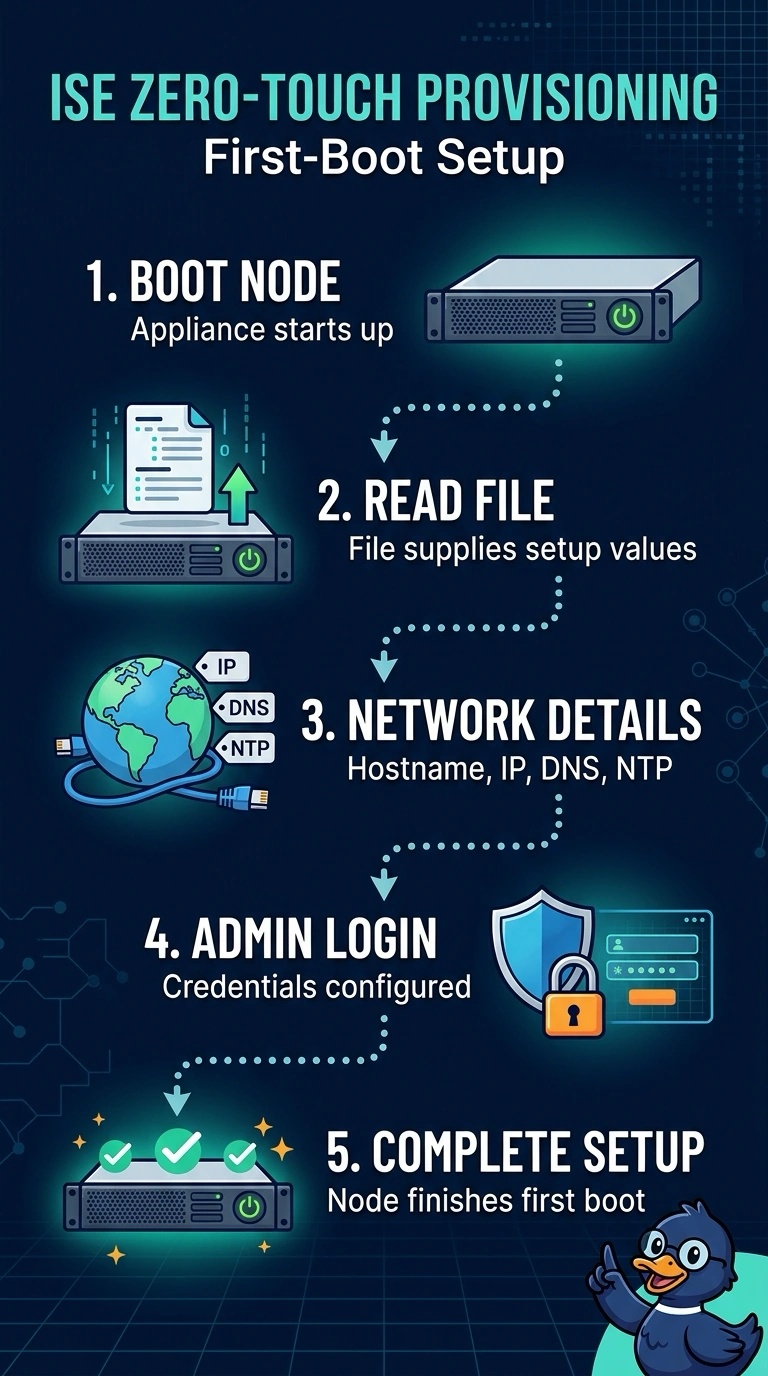
Short Explanation
With zero-touch provisioning (ZTP), each node applies its own configuration file during first boot, so you don’t have to enter setup details manually. It’s like giving every appliance its own prepacked setup kit, with its hostname, network settings, DNS, NTP, and admin login ready to go.
Full Explanation
ISE zero-touch provisioning (ZTP) is the right approach because it automates the initial setup script during a node’s first boot. A node-specific ZTP configuration file supplies that appliance’s required values—such as hostname, IP address, mask, gateway, domain, DNS name servers, NTP server, timezone, SSH setting and admin credentials—so each node can configure itself without an engineer entering the setup commands. Manual console bootstrap can set these values, but it requires an engineer to access and configure every appliance, so it is not zero-touch. Post-boot registration from the PAN is a different deployment step: it adds a reachable node to ISE, but does not provide the node’s first-boot network settings. Cloning a pre-configured VM template is also unsuitable because a shared configuration would not provide each appliance with its own required hostname and address. Exam caveat: ZTP automates initial setup, not deployment membership; registration with the PAN remains separate. Practical check: before booting each node, confirm its ZTP file is specific to that node and contains the intended network, DNS, NTP and admin values; afterward, verify the node is reachable and register it with the PAN.