
A hospital runs agent-based posture with Cisco Secure Client. Endpoints missing the mandated protection update must keep limited access for a short window while IT repairs them, users must see the repair steps, and the endpoint must be rechecked automatically once it is fixed. Which combination of posture and access settings delivers all three behaviours?
Select an answer to reveal the explanation.
Short Explanation
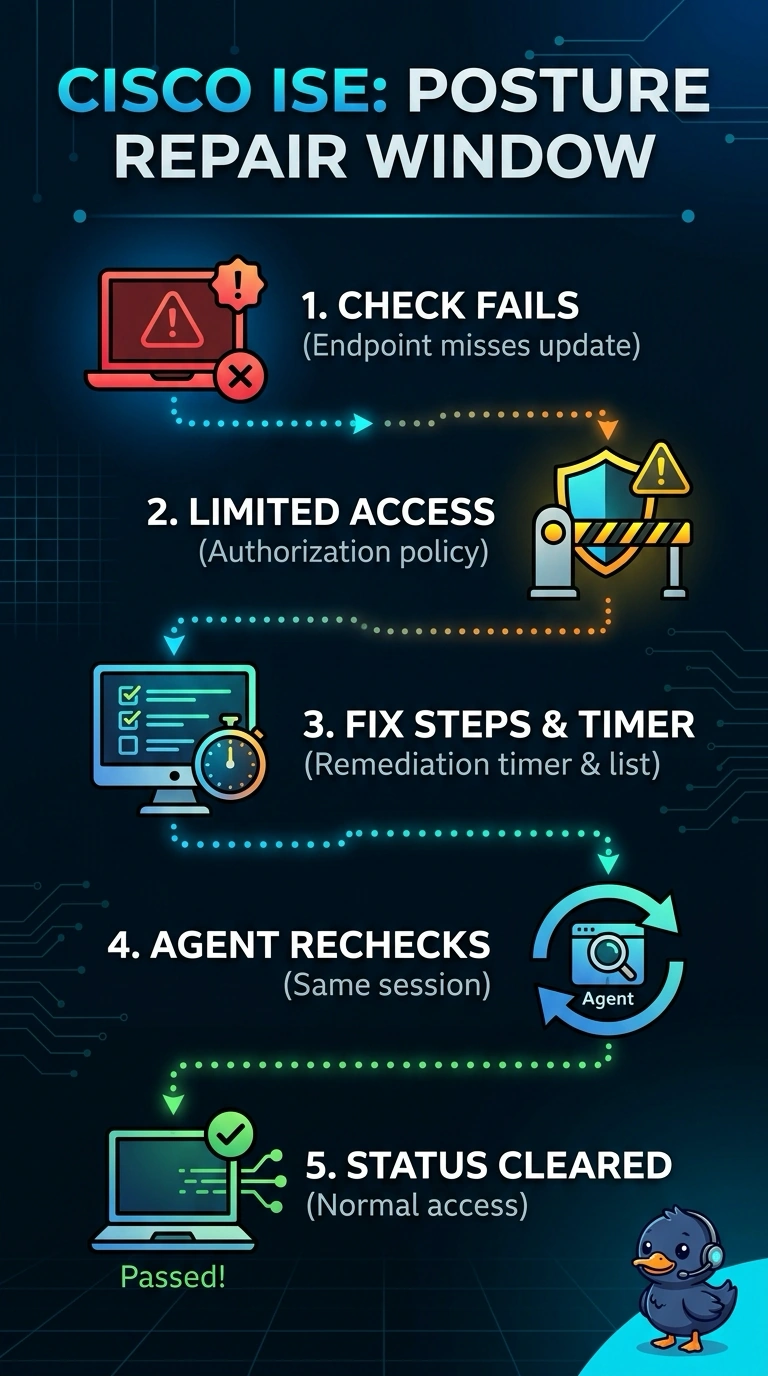
You can keep your endpoint connected with limited access while IT repairs it, and use a remediation timer to bound that window. Attach a remediation list to the failed requirement so you can follow the specific repair steps, then let the agent recheck automatically in the same session once the fix is applied.
Full Explanation
The required combination is limited access during remediation, a remediation timer, a remediation list attached to the failed requirement, and an automatic agent recheck in the same session. Limited access keeps a noncompliant endpoint connected while IT repairs it; the timer bounds that temporary state; and the remediation list gives the user specific repair steps. A same-session recheck can detect the fix without requiring a new login. Deferring the compliance recheck until the user starts a new session fails because the repair will not be recognized automatically in the current session. Providing only a generic support link fails because it does not attach the specific remediation guidance to the failed requirement. Leaving access in remediation mode without a time limit fails because it does not define the required short repair window. Exam caveat: a remediation timer is distinct from a session timeout or a scheduled posture scan; those controls are not interchangeable. Practical check: test an endpoint that fails the requirement, confirm the user sees the relevant repair steps, apply the update, and verify compliance is detected in the same session before the remediation window expires.