
A university research lab runs a temperature logger, a badge reader, and a student laptop off one wall jack, all needing the same lab VLAN. Each device must complete its own 802.1X or MAB exchange and appear as its own ISE session, so each can be deauthenticated while the others stay up. Which IBNS 2.0 host mode gives each device its own session on this port?
Select an answer to reveal the explanation.
Short Explanation
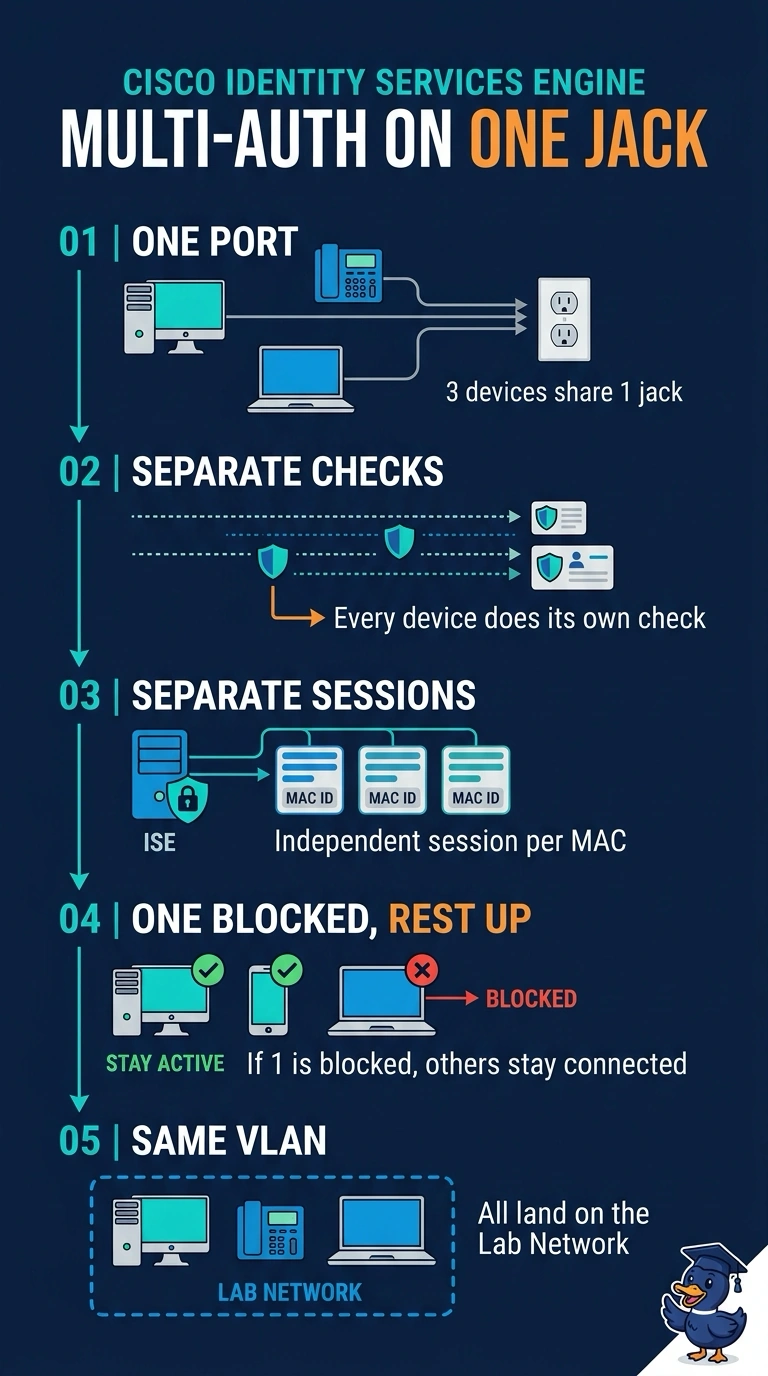
Multi-auth authenticates each MAC address one at a time, so every device earns its own verdict and its own session record. It's like a lineup where everyone shows ID instead of one person vouching for the group. You'll keep per-device control while the jack stays shared.
Full Explanation
Multi-auth host mode treats each device on the port as its own endpoint, so the switch runs a separate 802.1X or MAB exchange per MAC address and ISE records an independent session and authorization result for every one of them. That separation is what lets you deauthenticate a single device while the logger and reader keep running, and it matches the requirement that each device earn its own verdict. Multi-host mode fails because one successful authentication opens the port to every later MAC address, so the remaining devices join without ever being evaluated and no separate session exists. Single-host mode fails because it admits one device and does not permit additional devices. Multi-domain mode fails because it is built for a Cisco IP phone paired with one data device, separating a voice domain from a data domain rather than carrying three same-VLAN endpoints. Exam caveat: the switch interface must actually run multi-auth host mode with MAB enabled alongside 802.1X, or the logger and reader are never evaluated at all. Practical check: connect all three devices, confirm three live sessions, then deauthenticate one MAC and verify the other two stay up.