
A broadcaster's FTD has two equal-capacity uplinks, one to each of two routers that both advertise the default route. Today the team gives the second route a higher metric so it stays a warm backup, and they want outbound flows to use both links while each conversation stays on one path. Which routing design gives them equal-cost multipath forwarding?
Select an answer to reveal the explanation.
Short Explanation
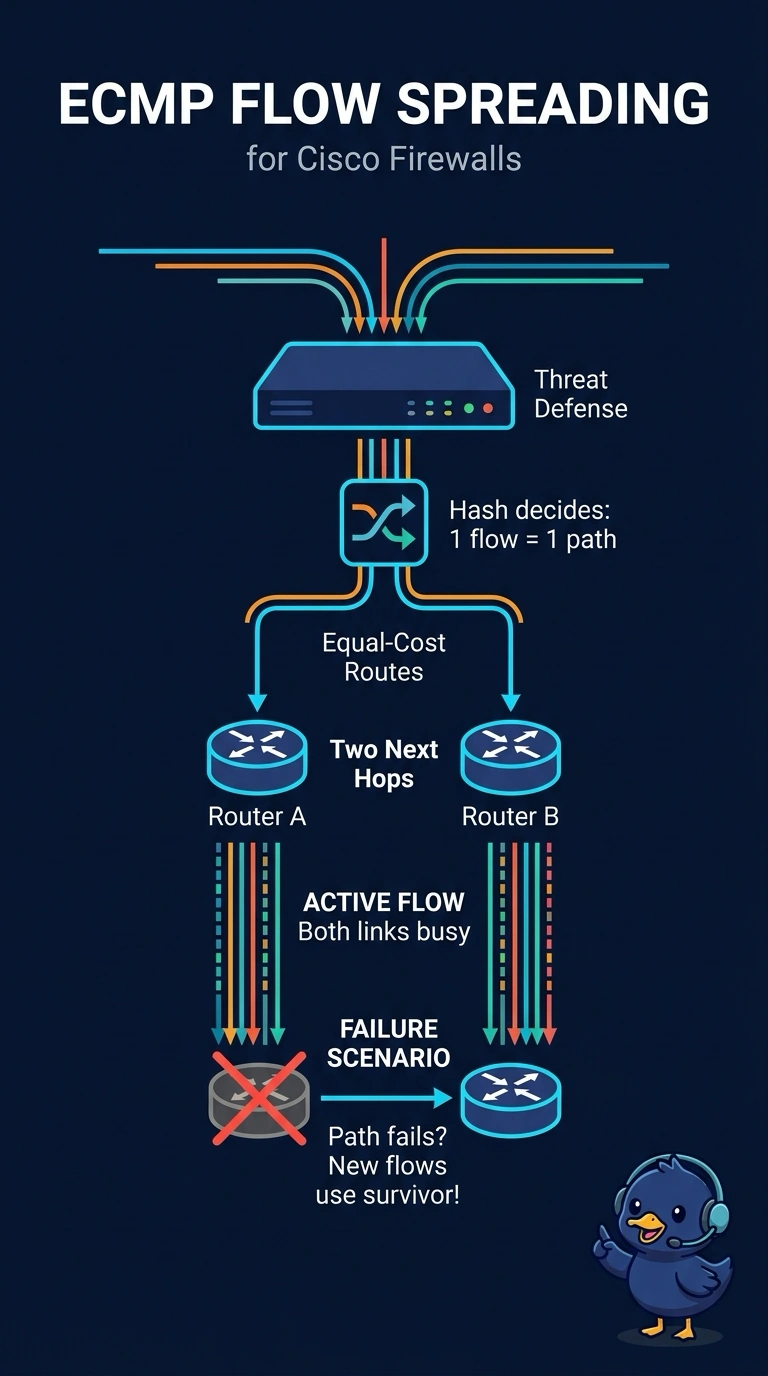
With ECMP, you install equal-cost default routes to both routers, and Threat Defense hashes each flow onto one path so your conversations stay together while both links carry traffic. It’s like sending each package by one truck while sharing the delivery load across the whole fleet.
Full Explanation
Equal-cost multipath forwarding engages when the routing table holds more than one path to the same destination with the same metric and the same administrative distance. Once that condition is met, Threat Defense hashes flow characteristics such as addresses and ports onto a next hop, so packets in a flow follow one path while different flows can spread across both uplinks. A floating backup route with a higher metric is not equal cost, so that link stays idle until the preferred route is unavailable. Dividing internal subnets between uplinks is per-destination path selection, not multipath forwarding for the same destination. Presenting both routers through a virtual gateway such as HSRP gives the firewall one next hop to choose, so the firewall cannot use that arrangement to select between the routers as ECMP next hops. Caveat: hashing does not split an individual flow, and unequal-cost paths are not spread this way. Practical check: confirm two equal default routes in the routing table; for static routes, configure the uplink interfaces in an ECMP zone. Then trace outbound flows and check whether they leave through different next hops.