
A university must inspect files arriving over SMB and HTTP before delivery. Its rule says the Management Center must query the cloud for every file's disposition and cut the connection when the verdict is malicious. Which file policy configuration meets both conditions?
Select an answer to reveal the explanation.
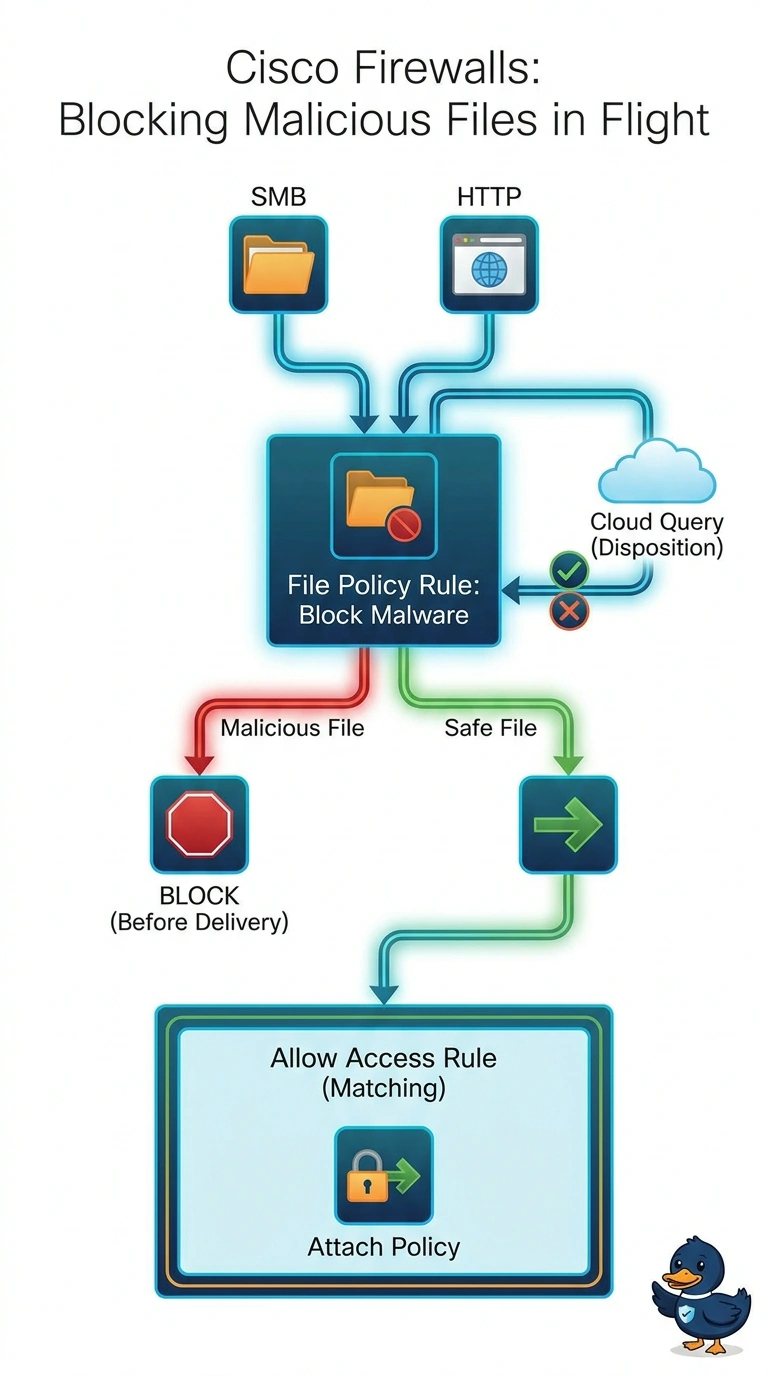
Short Explanation
You’ll want a Block Malware rule for SMB and HTTP, attached to the matching allow access rules, so the cloud can check each file and the connection is cut if it’s malicious. Malware Cloud Lookup can record a verdict, but it doesn’t block the file when that verdict is malicious.
Full Explanation
The required configuration is a Block Malware file rule covering both SMB and HTTP, attached to the matching allow access rules. This provides the required cloud disposition lookup for every file and cuts the connection when a file is identified as malicious. A Malware Cloud Lookup rule for SMB and HTTP can obtain and record cloud dispositions, but lookup alone does not enforce a malicious verdict, so files can still be delivered. A Block Malware rule using local analysis for SMB and HTTP can block detected malware, but local analysis alone does not query the cloud for every file. A cloud-backed Block Malware rule for HTTP can perform lookup and blocking for HTTP transfers, but it does not cover SMB, which the university also requires. Exam caveat: distinguish obtaining a cloud disposition from enforcing it, and check that the rule covers every required protocol. Practical check: inspect the deployed file policy and its attachments to the matching allow access rules, then test representative SMB and HTTP transfers with benign and known-malicious files; confirm cloud lookups, verdicts, and connection termination in the event logs.