
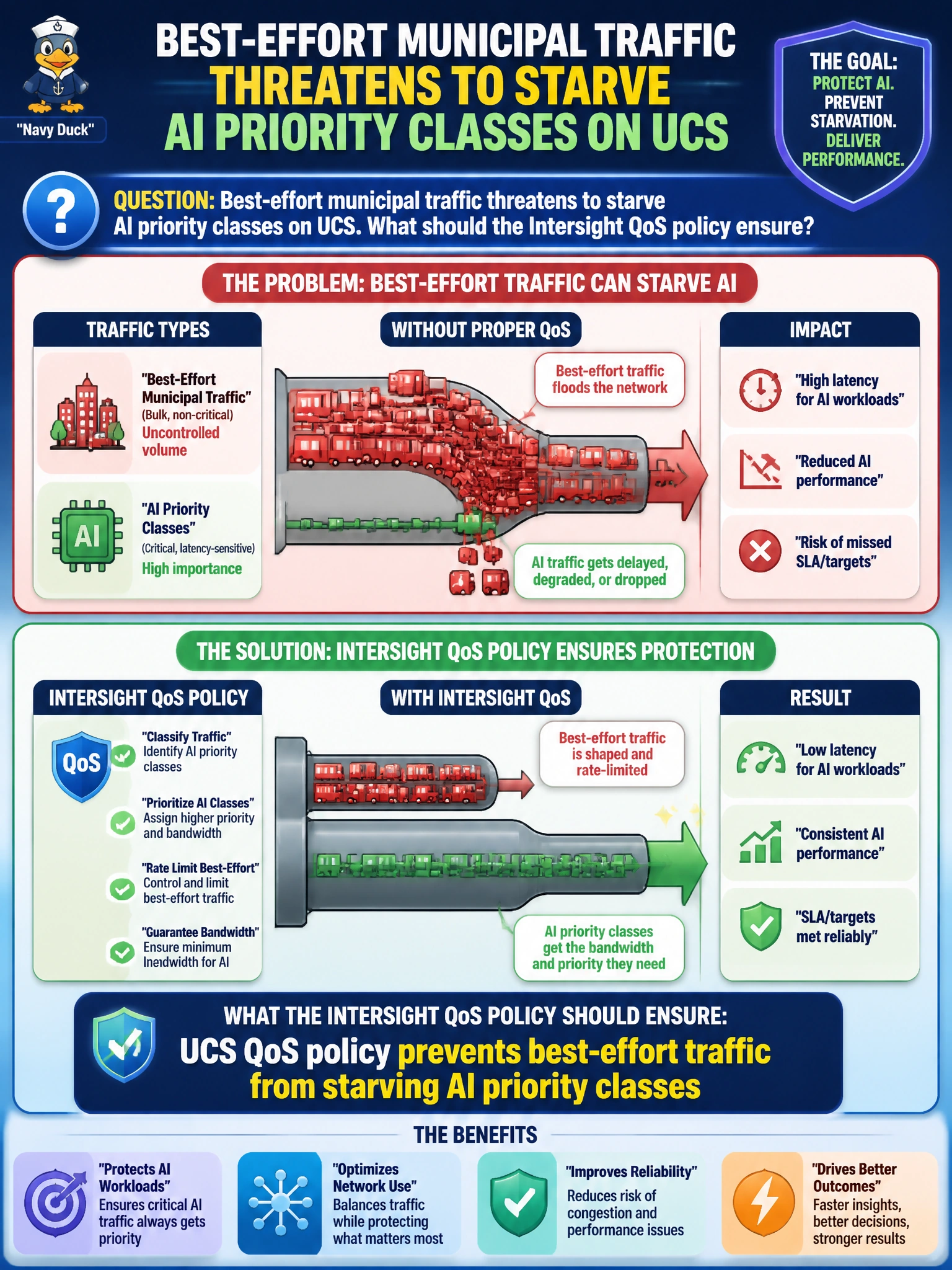
Best-effort municipal traffic threatens to starve AI priority classes on UCS. What should the Intersight QoS policy ensure?
Select an answer to reveal the explanation.
Short Explanation
Best-effort is the noisy neighbor—QoS policy has to keep it from eating the AI lanes. Protect priority and RDMA classes on purpose. You won't protect AI by isolating it in the Fibre Channel queue; you'll still let best-effort starve it.
Full Explanation
When best-effort municipal traffic threatens to starve AI priority classes on UCS, the Intersight QoS policy must ensure UCS QoS prevents best-effort traffic from starving AI priority classes. Bandwidth shares, scheduling, and class isolation exist specifically so backups, scans, and bulk civic traffic cannot consume the scheduler that RDMA and priority AI classes need. Domain 3.2.e expects that protection. Securing AI priority classes with CoS 3 PFC for RoCE traffic misapplies CoS 3, which is the Fibre Channel class, and fails to provide the Platinum/CoS 5 lossless priority RoCE needs to keep best-effort from starving AI. Guaranteeing AI class bandwidth with Bronze weight and 1500 MTU gives AI a low-priority Bronze scheduling share and a standard MTU that breaks jumbo RoCE, offering no bandwidth shares, scheduling, or class isolation to keep best-effort from consuming the AI scheduler. Isolating AI priority classes in Fibre Channel queue for lossless misapplies the Fibre Channel queue to Ethernet RDMA traffic and abandons the UCS QoS class protection the municipal design relies on. Exam caveat: isolating AI priority classes in Fibre Channel queue for lossless does not replace UCS/fabric class scheduling on the wire; exam answers keep QoS policy in place with explicit anti-starvation intent. Operational check: define UCS QoS policy shares that protect AI priority/RDMA classes from best-effort, generate competing best-effort load during a clinic inference or training window, measure RDMA/priority throughput and latency, and confirm best-effort cannot starve the AI classes before promoting the policy fleet-wide.
Prefer to study offline? Printable PDF study book + test engine ($7.50, unofficial). These questions stay free here.