
A municipal UCS design must isolate GPU RDMA traffic from management. What LAN connectivity approach is correct?
Select an answer to reveal the explanation.
Short Explanation
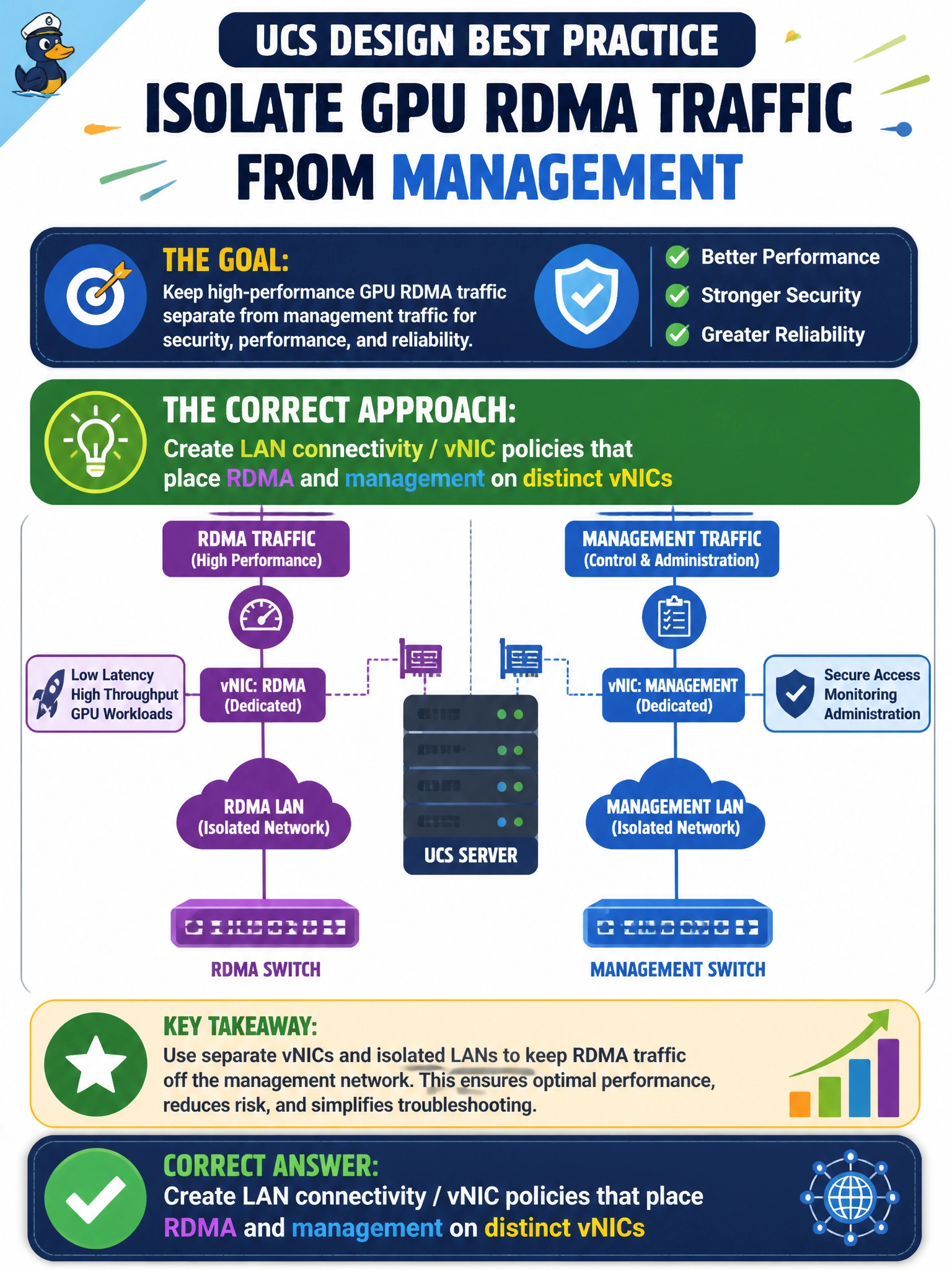
A municipal UCS design must isolate GPU RDMA traffic from management so management commands don't clog the RDMA path. Separate vNICs for each, separate LAN policies on the fabric, separate physical paths—isolation all the way through.
Full Explanation
A municipal UCS design must isolate GPU RDMA traffic from management. The answer is to create LAN connectivity / vNIC policies that place RDMA and management on separate paths end to end—separate vNICs on the NIC side and separate LAN policies on Nexus so frames never compete for the same fabric queue or uplink. That isolation keeps management commands from delaying drop-sensitive RDMA. Creating LAN connectivity policies that place RDMA and management on distinct vNICs at 1500 MTU leaves RDMA on standard MTU, so large RoCEv2 frames fragment and suffer higher latency and loss instead of using jumbo MTU for lossless performance. Creating LAN connectivity policies that place RDMA and management on distinct vNICs with failover enables fabric failover for the RDMA vNIC, so the RDMA flow can flap between fabrics, causing out-of-order delivery and drops that break lossless RDMA. Creating LAN connectivity policies that place RDMA and management on distinct vNICs with BE QoS puts drop-sensitive RDMA in the best-effort class with no PFC or no-drop priority, so management bursts can still cause congestion drops and delay the RDMA flow. Exam caveat: end-to-end isolation requires matching vNIC design (separate adapters or LAG groups) AND matching fabric design (separate Cos, separate ETS classes, or separate physical paths). Mismatched design on either side breaks the isolation. Operational check: configure separate vNICs for RDMA and management on UCS, create corresponding separate LAN policies on Nexus leafs, verify RDMA and management traffic use separate uplinks or separate Cos, and confirm a management burst does not increase RDMA latency.
Prefer to study offline? Printable PDF study book + test engine ($7.50, unofficial). These questions stay free here.