
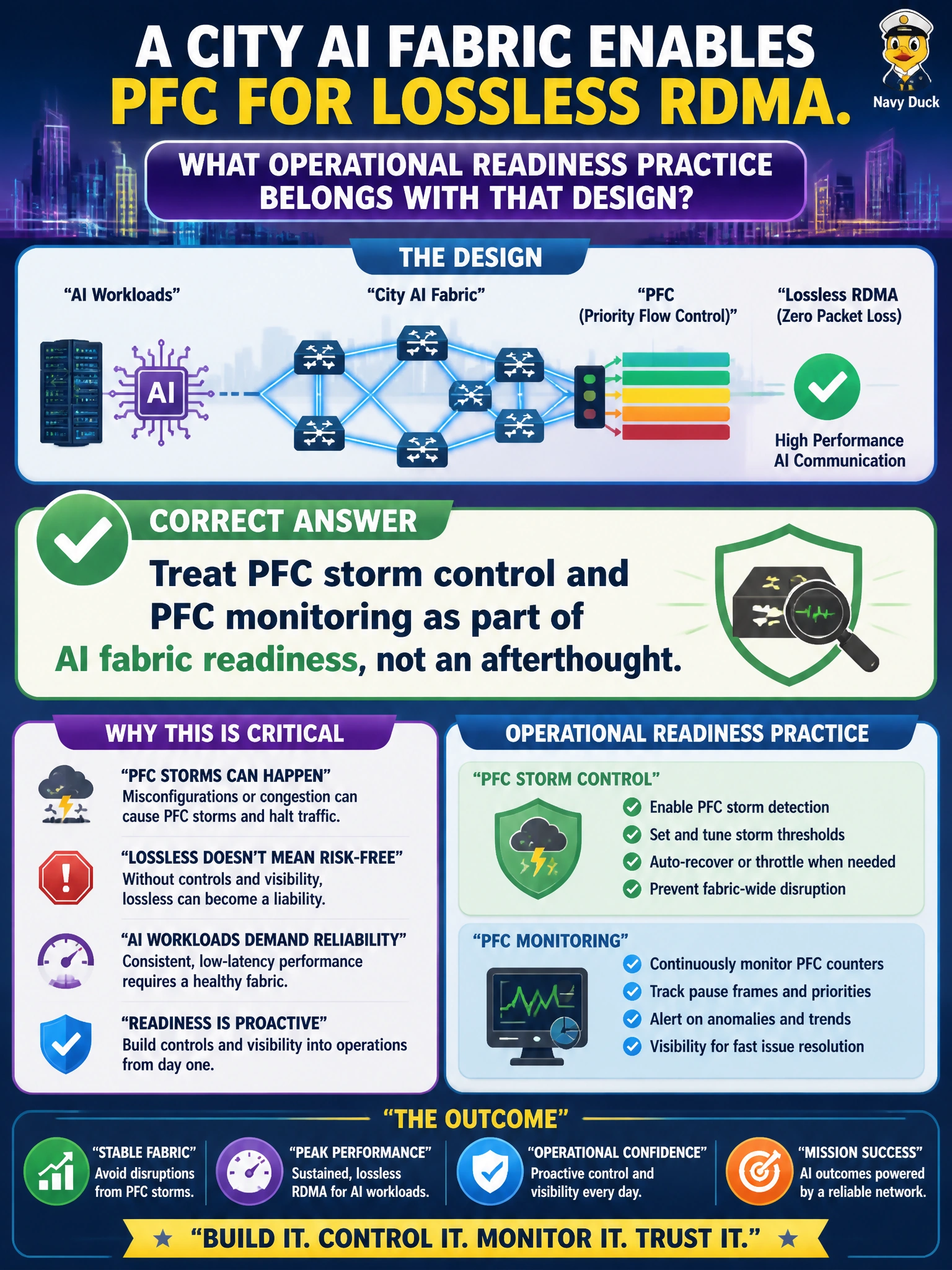
A city AI fabric enables PFC for lossless RDMA. What operational readiness practice belongs with that design?
Select an answer to reveal the explanation.
Short Explanation
PFC is enabled, so watch it. If pause counters are stuck high, something is deadlocked or misconfigured. You'll miss pause storms with five-minute SNMP polls, so use fast telemetry and alerts to check pause behavior — it's as critical to operational readiness as the fabric itself.
Full Explanation
A city AI fabric enables PFC for lossless RDMA. Operational readiness practices must include PFC storm control and PFC monitoring so the fabric team detects pause deadlocks or misconfiguration before they stall trainers. Storm control prevents pause storms from accidentally pausing all traffic (a self-inflicted DDoS), and monitoring lets the team see that pause behavior is correct—occasional pauses under congestion, not stuck or missing on the RDMA Cos. Enable PFC on multiple data priorities to support lossless behavior for AI collective flows is wrong because lossless RDMA requires a single dedicated lossless class – enabling PFC on multiple priorities propagates pauses across traffic classes, increases head-of-line blocking and PFC deadlock risk, and undermines storm control. Polling PFC pause counters with SNMP at five-minute intervals for AI fabric health checks is wrong because PFC pause storms and deadlocks stall collectives in milliseconds to seconds – five-minute polls miss transient but fatal events, and operational readiness requires continuous monitoring with streaming telemetry, syslog export, and threshold alerts. Assigning RoCEv2 traffic to a dedicated PFC priority while retaining enterprise ECN thresholds is wrong because the dedicated priority is correct but enterprise ECN thresholds tuned for TCP are too high and slow for bursty AI incast – lossless RDMA needs ECN thresholds tuned for DCQCN and collective traffic to trigger early congestion marking and limit PFC pauses. Exam caveat: PFC monitoring must include both pause counts (how often pause occurs) and pause duration (how long queues stay paused)—high pause duration signals a real problem, not just congestion. Operational check: enable PFC monitoring and storm control, set thresholds for pause alerts, run a collective under normal load, and confirm pause counters increment briefly and return to normal rather than staying stuck.
Prefer to study offline? Printable PDF study book + test engine ($7.50, unofficial). These questions stay free here.