
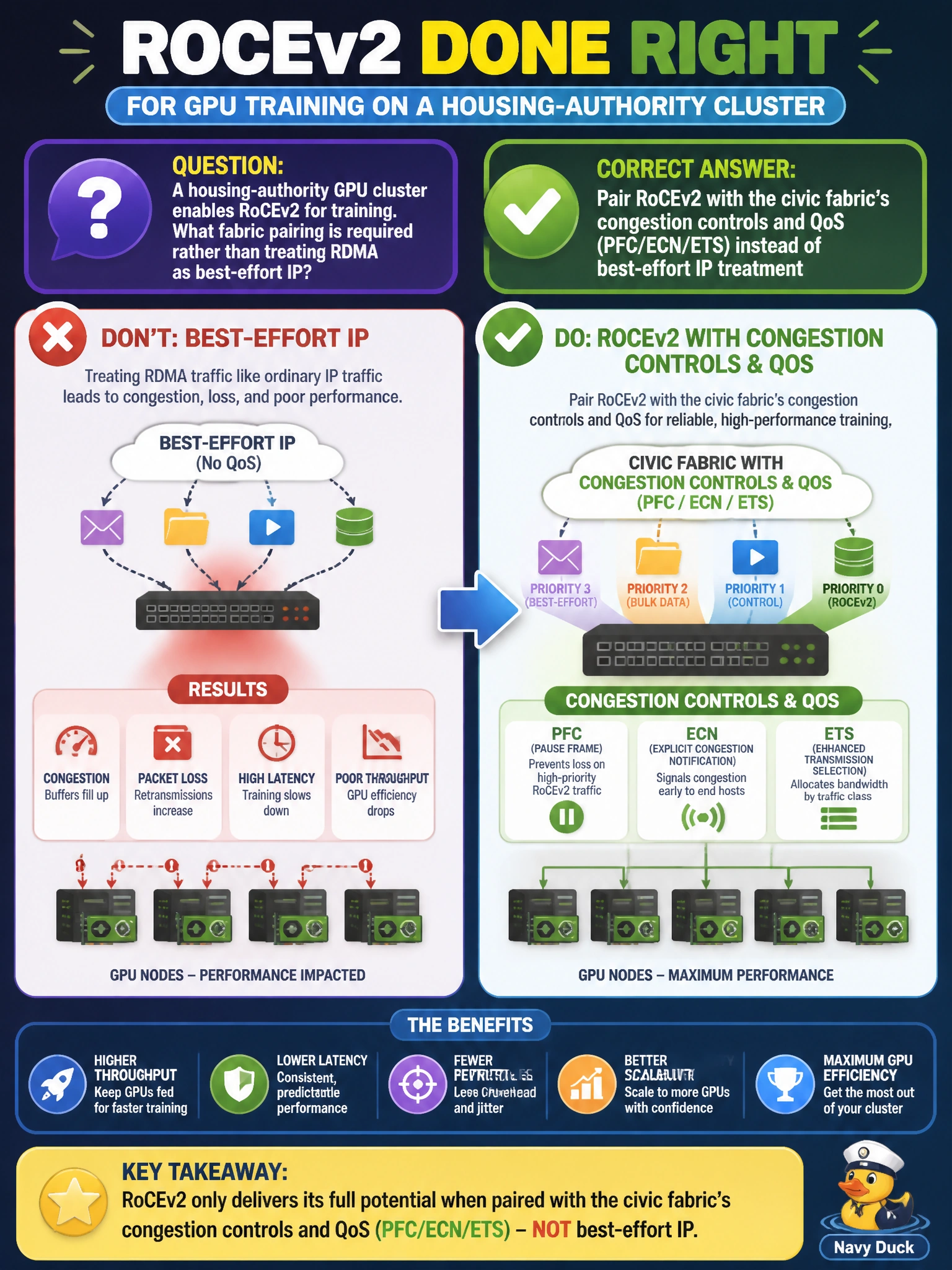
A housing-authority GPU cluster enables RoCEv2 for training. What fabric pairing is required rather than treating RDMA as best-effort IP?
Select an answer to reveal the explanation.
Short Explanation
RoCEv2 is not ‘just another IP app’ on best-effort. It needs the fabric’s PFC/ECN/ETS toolkit riding along. Skip those and RDMA performance falls apart like a bike without brakes.
Full Explanation
A housing-authority GPU cluster enabling RoCEv2 for training must pair RoCEv2 with the civic fabric’s congestion controls and QoS—PFC, ECN, ETS, and related class treatment—rather than treating RDMA as ordinary best-effort IP. RoCEv2 rides UDP/IP but assumes carefully managed Ethernet behavior so drops and congestion do not destroy completion performance. Domain 3.1.b requires that pairing on the municipal fabric. Relying on jumbo frames and ECMP load balancing across the civic Layer 3 fabric omits the lossless PFC/ECN/ETS tooling RoCEv2 depends on and treats congestion as ordinary IP forwarding. Strict priority queuing on leaf uplinks alone cannot substitute for the fabric’s PFC/ECN/ETS congestion controls and can starve other traffic while still leaving RDMA without lossless behavior. Trying to handle RoCEv2 reliability with host TCP retransmission and socket buffer tuning misunderstands RDMA, which relies on fabric lossless behavior and ECN signaling rather than end-host TCP recovery. Exam caveat: Exact PFC versus ECN-only recipes vary by vendor and scale, but “best-effort IP only” is never the RoCE readiness answer. Operational check: enable and verify PFC/ECN/ETS (or the vendor-prescribed RoCE QoS set) on housing-authority leaves and spines, confirm GPU vNICs mark into the RDMA class, run a RoCE bandwidth/latency test under load, and compare against a best-effort baseline to prove the fabric pairing is active.
Prefer to study offline? Printable PDF study book + test engine ($7.50, unofficial). These questions stay free here.