
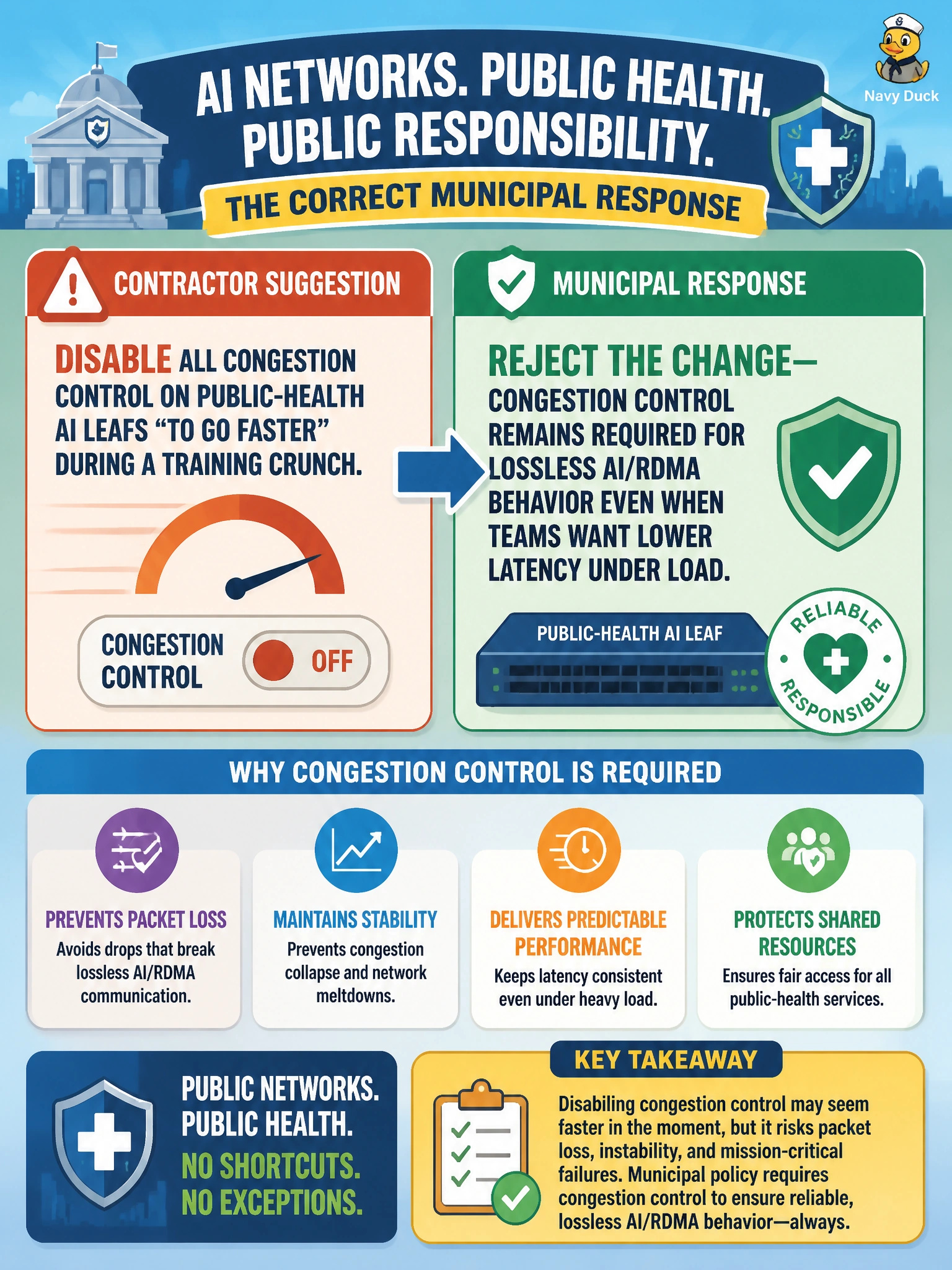
A contractor suggests disabling all congestion control on public-health AI leafs "to go faster" during a training crunch. What is the correct municipal response?
Select an answer to reveal the explanation.
Short Explanation
"Turn off the brakes to go faster" sounds clever until the first incast pile-up. Lossless RDMA on those public-health leafs still needs congestion control—you'll get drops and stalls if you reject PFC, even when you're relying on ECN.
Full Explanation
When a contractor proposes disabling all congestion control on public-health AI leafs "to go faster" during a training crunch, the correct municipal response is to reject the change. Congestion control—PFC, ECN, and aligned QoS—remains required for lossless AI/RDMA behavior even when teams want lower latency under load. Removing the brakes does not create sustainable speed; it creates drops, pause storms elsewhere, and stalled collectives once incast appears. Rejecting PFC activation on scheduled leafs during training windows while requiring ECN feedback for endpoint rate adjustment still removes an essential losslessness control and institutionalizes that risk across public-health jobs. Requiring spine buffering with larger thresholds for lossless forwarding while keeping leaf ECN response relaxed for training still breaks end-to-end behavior and can shift loss or pause pathology to another tier. Requiring expanded leaf buffering for incast absorption while keeping endpoint throttling deferred during peak training loads merely postpones discard into deeper latency and exhausted buffers without teaching senders to slow down. Exam caveat: latency tuning is done by threshold, buffer, and ECN/PFC calibration—not by deleting congestion controls wholesale. Operational check: refuse the disable request, instead review pause and ECN telemetry during the crunch, tune thresholds with a controlled test on a lab pair if needed, and keep PFC/ECN/QoS enabled on public-health AI leafs throughout production training.
Prefer to study offline? Printable PDF study book + test engine ($7.50, unofficial). These questions stay free here.