
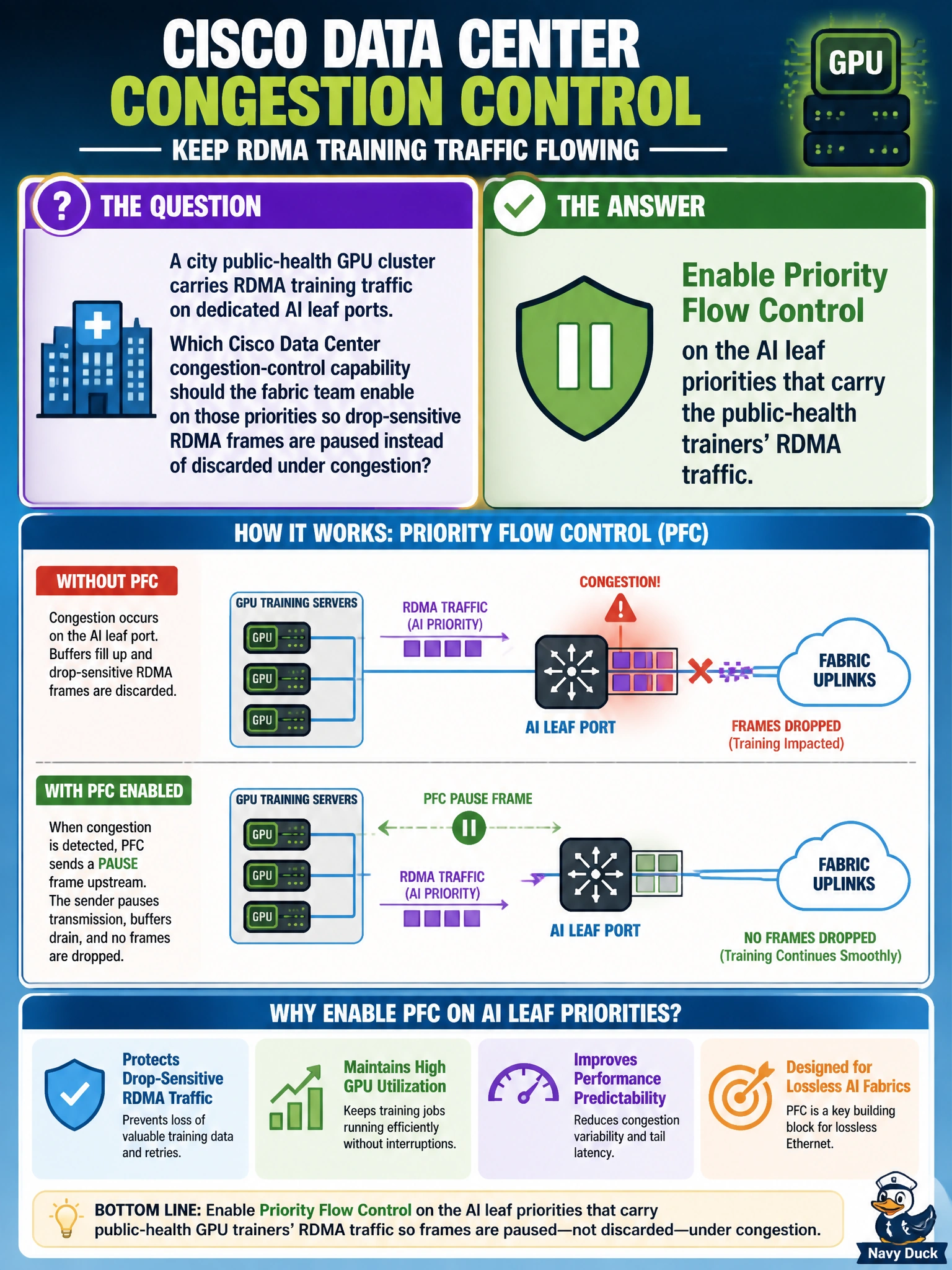
A city public-health GPU cluster carries RDMA training traffic on dedicated AI leaf ports. Which Cisco Data Center congestion-control capability should the fabric team enable on those priorities so drop-sensitive RDMA frames are paused instead of discarded under congestion?
Select an answer to reveal the explanation.
Short Explanation
Picture a crowded hallway where instead of shoving people over, a polite hand goes up and traffic waits its turn. PFC pauses the lossless priority so RDMA frames for those trainers don't get dropped when the leaf gets busy.
Full Explanation
Priority Flow Control (PFC) is the Cisco Data Center mechanism that provides per-priority pause so designated lossless classes stop ingress when downstream queues congest, instead of discarding frames. For the city's public-health GPU cluster, RDMA training on dedicated AI leaf ports is drop-sensitive: a single lost packet can stall collectives and waste GPU time. Enabling PFC on the Cos/priorities that carry those trainers lets the leaf pause only the lossless AI class under congestion while other civic traffic continues under normal drop behavior. That is the correct congestion-control capability when the requirement is pause-instead-of-discard for RDMA. Enabling IEEE 802.3x link-level pause on the AI leaf uplinks pauses the entire link rather than just the RDMA priority, so it blocks unrelated civic traffic and creates head-of-line blocking instead of the per-priority lossless pause RDMA requires. Enabling Explicit Congestion Notification marking on the AI leaf RDMA priorities only signals congestion to senders; it does not pause frames, so drop-sensitive RDMA traffic can still be discarded under congestion. Configuring Weighted Random Early Detection thresholds on the AI leaf RDMA queues manages queue depth by probabilistically dropping packets, which still discards RDMA frames instead of providing the lossless pause required. Exam caveat: PFC must be enabled consistently end to end on the same priorities—leaf-only pause without matching spine/NIC treatment still allows drops elsewhere on the path. Operational check: confirm PFC is enabled on the public-health RDMA Cos at AI leaf ports, verify pause frames appear under controlled congestion tests without silent discards on that priority, and document which Cos values are lossless versus best-effort on the municipal fabric.
Prefer to study offline? Printable PDF study book + test engine ($7.50, unofficial). These questions stay free here.