
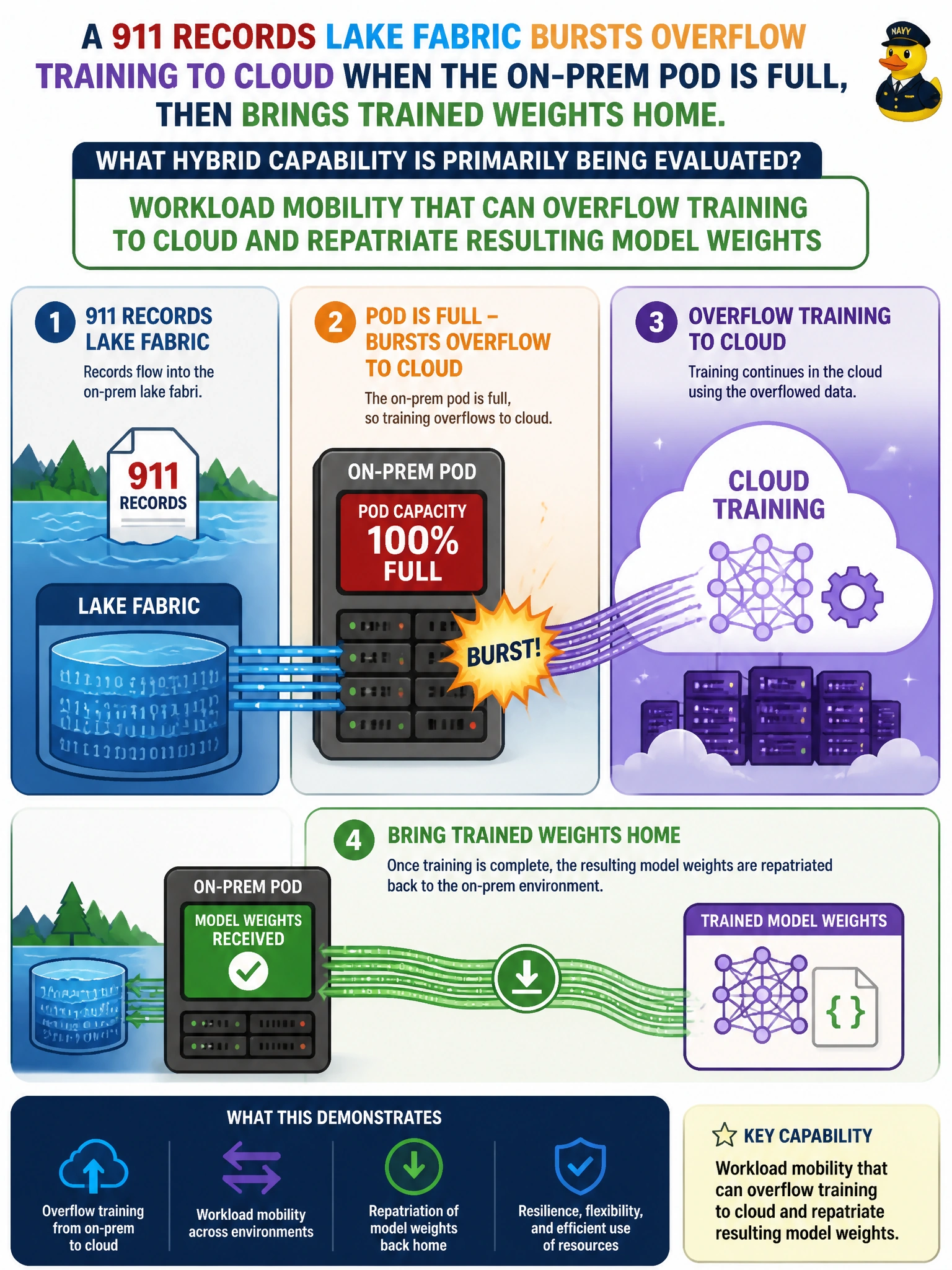
A 911 records lake fabric bursts overflow training to cloud when the on-prem pod is full, then brings trained weights home. What hybrid capability is primarily being evaluated?
Select an answer to reveal the explanation.
Short Explanation
When the civic pod is full, bursting training to cloud and bringing the weights home is workload mobility done right. It's a temporary overflow lane for you, and you'll bring weights home, not source datasets. Keep the return path.
Full Explanation
When a 911 records lake fabric bursts overflow training to cloud when the on-prem pod is full and then brings trained weights home, the hybrid capability under evaluation is workload mobility that can overflow training to cloud and repatriate resulting model weights. The pattern preserves municipal serving: temporary capacity in cloud, durable artifacts returned for local use, not a permanent hand-off of the civic AI stack.
Workload mobility that can overflow inference to cloud and repatriate resulting model weights moves the wrong phase to cloud, so it does not demonstrate burst training with weight repatriation. Workload mobility that can overflow training to cloud and repatriate resulting source datasets gets the return artifact wrong, bringing back source datasets rather than trained weights, so it is not burst training overflow with repatriated weights. Workload mobility that can overflow training to on-prem and repatriate resulting model weights reverses the burst direction, so it does not evaluate cloud overflow and repatriation.
Exam caveat: Domain 2.5 evaluates workload mobility including burst and return; designs that can train in cloud but cannot cleanly import weights back into the 911 lake serving path fail the mobility objective even if the cloud job "works."
Operational check: run a controlled overflow job, import weights into the on-prem registry or serving graph, and confirm inference uses the repatriated artifact without orphaning the municipal pod.
Workload mobility that can overflow inference to cloud and repatriate resulting model weights adds cloud dependence to serving; if connectivity fails, the city loses real-time inference for public-safety models. An on-prem return path ensures models can run locally when cloud is unavailable.
Prefer to study offline? Printable PDF study book + test engine ($7.50, unofficial). These questions stay free here.