
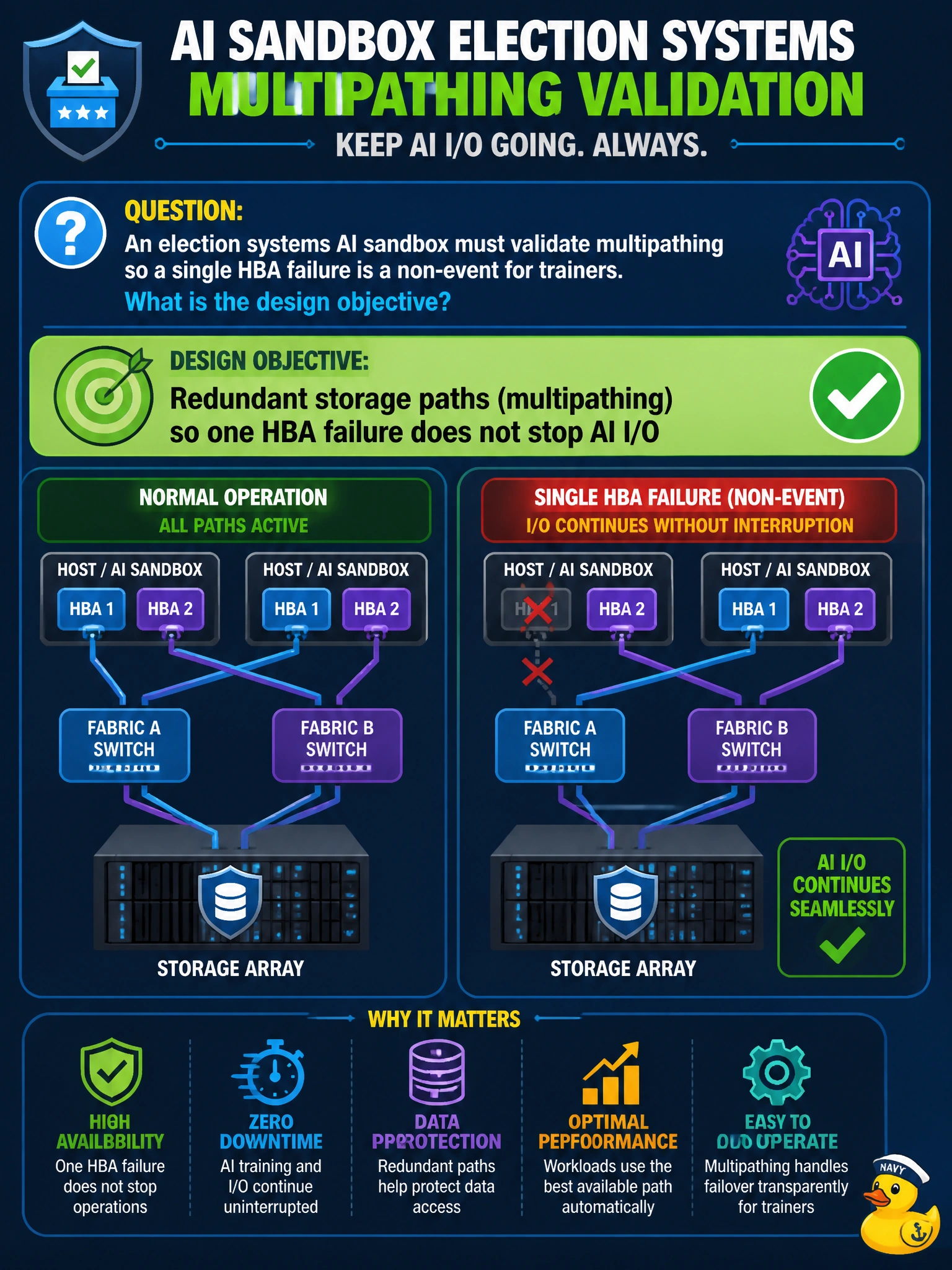
An election systems AI sandbox must validate multipathing so a single HBA failure is a non-event for trainers. What is the design objective?
Select an answer to reveal the explanation.
Short Explanation
Multipathing is a second driveway to the storage garage — if one HBA gate closes, trainers still get through. Dedicating separate HBA ports to datasets doesn't give you redundancy; one adapter failure can still kill its assigned traffic. Redundant paths make that failure a non-event.
Full Explanation
An election systems AI sandbox that validates multipathing so a single HBA failure is a non-event is pursuing redundant storage paths. Multipathing keeps AI I/O available when one host bus adapter, cable, or switch path fails, preventing a minor hardware blip from becoming a training outage during sensitive election-model work. Path redundancy is a core Domain 2.3 connectivity availability control.
Dedicating separate HBA ports to training and validation datasets fails the objective: it separates workloads but does not create redundant paths, so one HBA failure can still stop I/O for its assigned dataset. Zoning the HBA initiator to a specific storage target to profile fabric latency fails resilience: it fixes a path for baselining instead of providing alternate paths that survive an HBA failure. Updating HBA firmware and driver bundles across trainers fails high availability: it aligns with vendor support matrices but does not create multipath failover, so an HBA blip can still interrupt training.
Exam caveat: Multipathing must be correctly configured (policy, zoning/masking, failover timing). Extra cables without working multipath software still behave like a single path. The exam objective is redundant paths that mask HBA failure.
Operational check: fail one HBA or path under load in the election sandbox; confirm I/O continues without GPU farm reboot; monitor path flaps and asymmetric routing so trainers see a non-event rather than a cluster-wide interrupt.
Prefer to study offline? Printable PDF study book + test engine ($7.50, unofficial). These questions stay free here.