
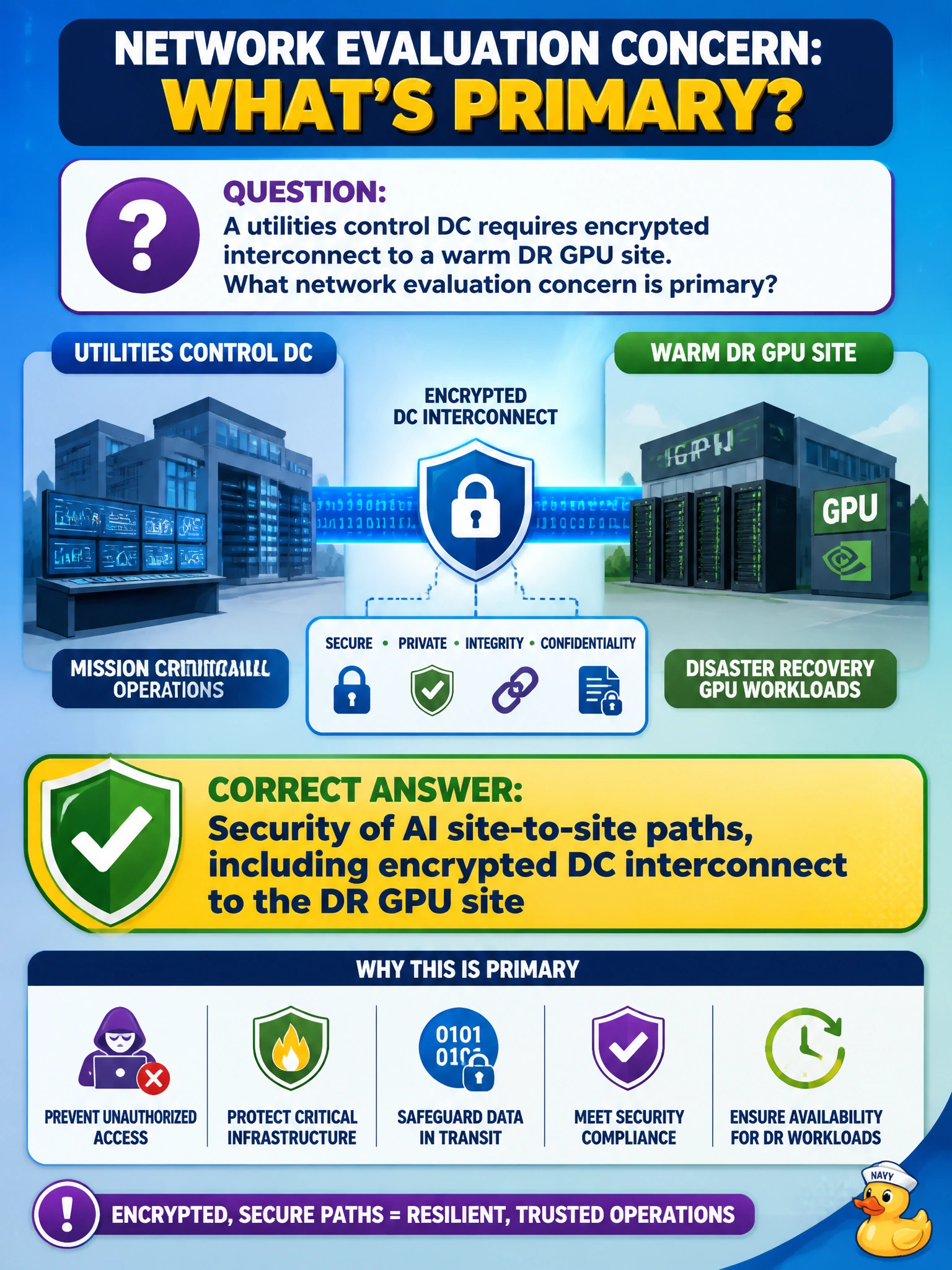
A utilities control DC requires encrypted interconnect to a warm DR GPU site. What network evaluation concern is primary?
Select an answer to reveal the explanation.
Short Explanation
Warm DR for GPU workloads still carries sensitive utility data—encrypt the pipe. You don't base the DR transport on metro latency, ring resilience, or shared-link QoS alone. Treat the site-to-site path like the asset it protects.
Full Explanation
A utilities control DC that requires encrypted interconnect to a warm DR GPU site must treat security of AI site-to-site paths, including encrypted DC interconnect to the DR GPU site, as the primary network evaluation concern. Warm DR still moves sensitive utility and model-related data across metro or WAN paths; encryption and controlled interconnect keep that replication from becoming an open lateral channel for attackers or accidental exposure. Latency and bandwidth of metro replication paths, including throughput for warm-site state sync, are performance factors but not the primary network evaluation concern when encrypted site-to-site security is required. Resilience of metro ring topology, including diverse fiber routing for DR failover capacity, supports availability but is secondary to securing the encrypted interconnect. Prioritization of control traffic on shared links, including QoS policies for GPU cluster sync, manages congestion but does not establish the required encrypted DC interconnect to the DR GPU site. Exam caveat: AI network evaluation includes security of site-to-site and DR paths—encrypted interconnect is expected when GPU workloads and sensitive utility data replicate to a warm site. Operational check: require encryption on the DC interconnect to the DR GPU site; treat metro latency and bandwidth, ring resilience, and shared-link QoS as secondary factors before declaring warm DR ready.
Prefer to study offline? Printable PDF study book + test engine ($7.50, unofficial). These questions stay free here.