
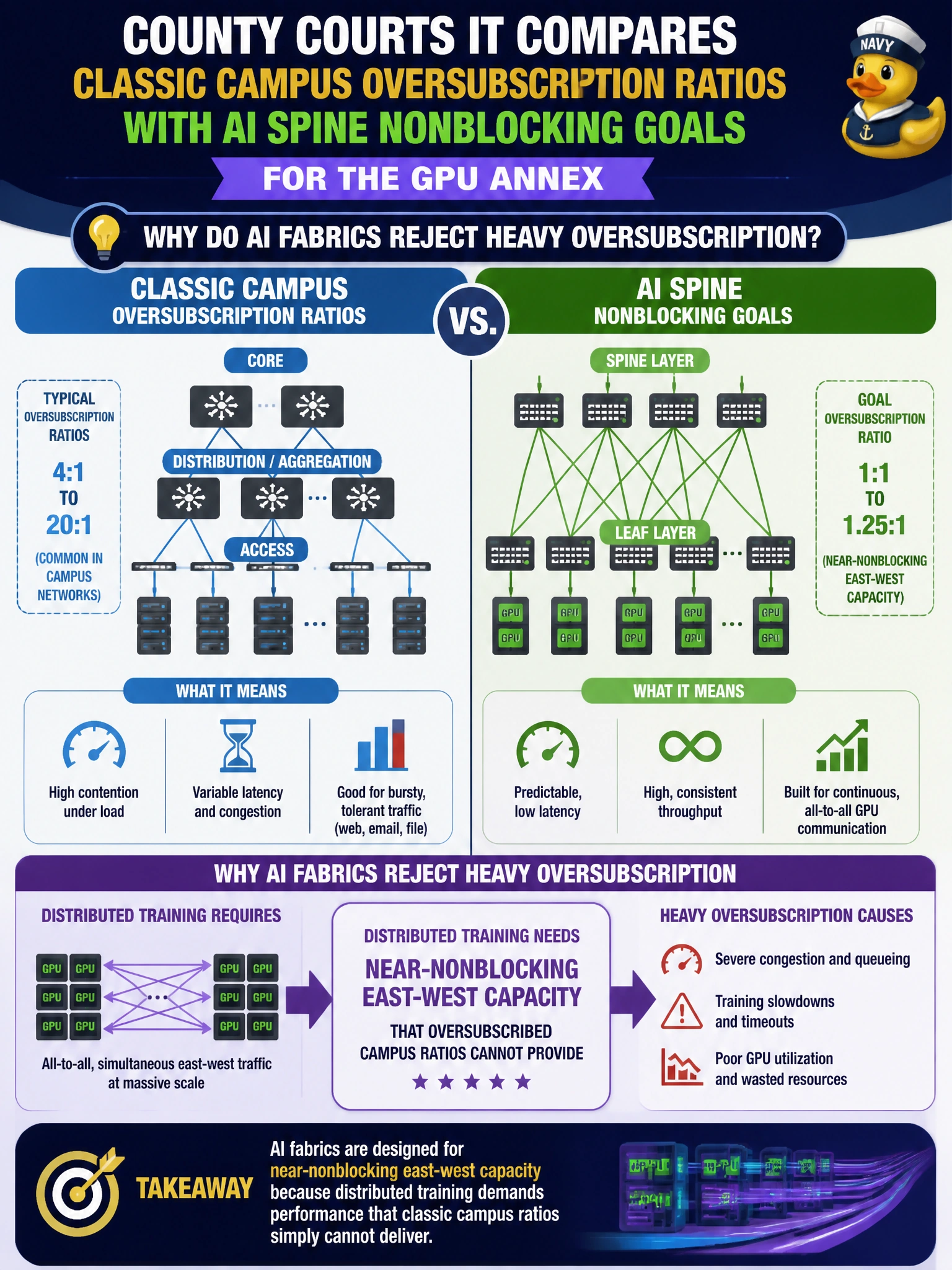
County courts IT compares classic campus oversubscription ratios with AI spine nonblocking goals for the GPU annex. Why do AI fabrics reject heavy oversubscription?
Select an answer to reveal the explanation.
Short Explanation
Campus oversubscription is fine for email; all-reduce is not email. AI spines aim closer to nonblocking so GPU chatter is not crushed in the uplinks. Borrowing 20:1 campus math for training is a classic mistake.
Full Explanation
County courts IT comparing classic campus oversubscription ratios with AI spine nonblocking goals should understand that AI fabrics reject heavy oversubscription because distributed training needs near-nonblocking east-west capacity that oversubscribed campus ratios cannot provide. Campus 20:1 style math works for bursty north-south user traffic; all-reduce and similar collectives need sustained fabric capacity closer to nonblocking so GPU chatter is not crushed in the uplinks.
Because AI fabrics never use Ethernet at any layer is false—modern AI fabrics commonly use high-speed Ethernet with RDMA. Because oversubscription always improves RDMA completion times is inverted: oversubscription typically hurts completion under load. Because campus ratios automatically satisfy all-reduce bandwidth confuses campus access design with AI spine requirements.
Exam caveat: Do not import campus oversubscription ratios wholesale into AI spine design; DCAI expects near-nonblocking east-west thinking for distributed training. Operational check: calculate oversubscription on the courts GPU annex spine under planned all-reduce load, compare to campus ratios, and redesign uplinks or topology until training traffic is not chronically queued or dropped at the spine.
Prefer to study offline? Printable PDF study book + test engine ($7.50, unofficial). These questions stay free here.