
Public-health planners choose Cisco AI PODs so the civic DC can start epidemiology training sooner. What primary value does that choice emphasize?
Select an answer to reveal the explanation.
Short Explanation
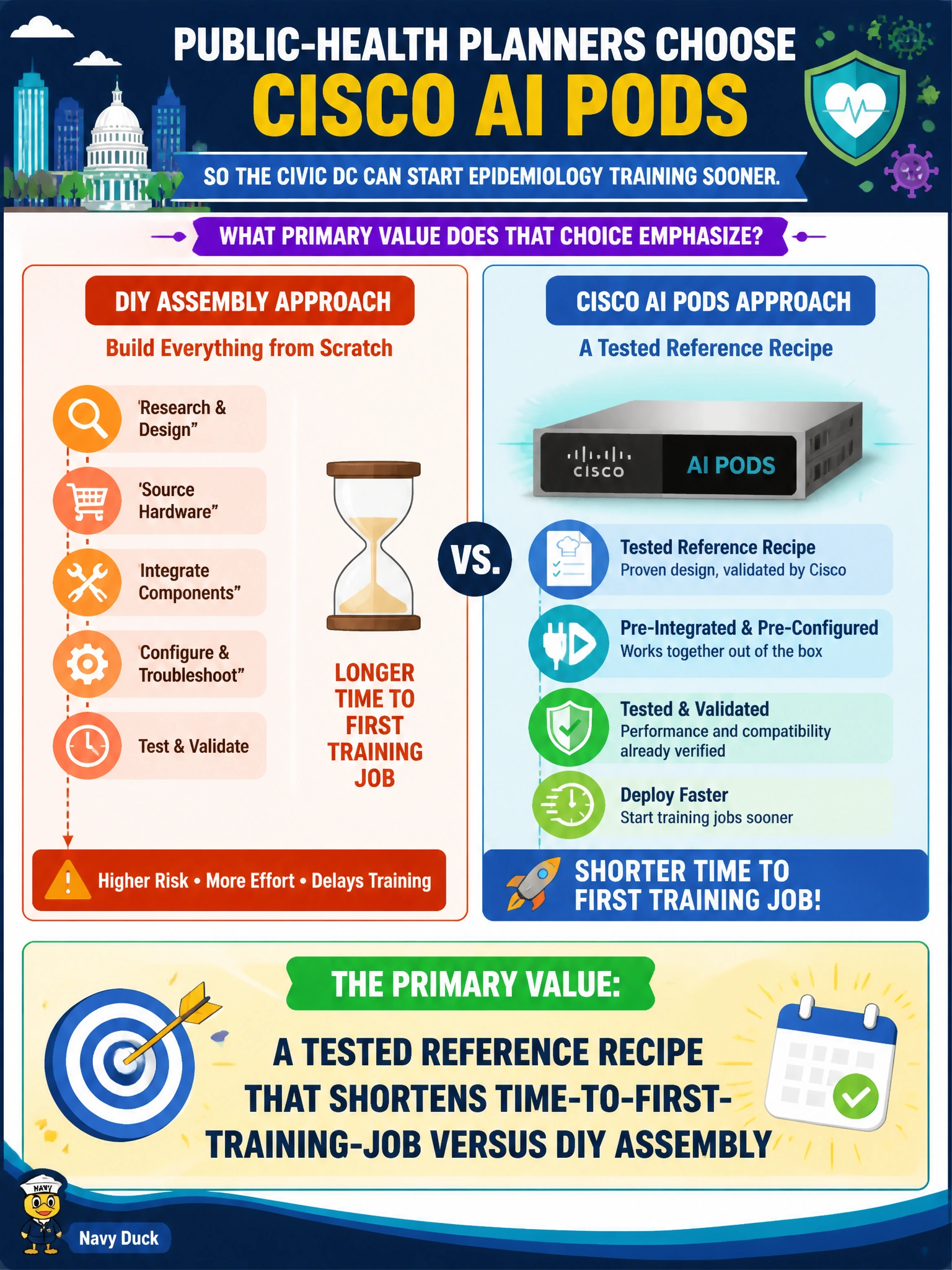
PODs are about getting the first real training job running without months of parts wrestling. Validated recipes cut the DIY delay so public-health models can ship sooner. You're not choosing it for a pre-sized power and cooling blueprint for sustained dense racks, an NVMe fabric tiering hot datasets, or a workload scheduler balancing shared queues.
Full Explanation
Public-health planners who choose Cisco AI PODs so the civic DC can start epidemiology training sooner are emphasizing a tested reference recipe that shortens time-to-first-training-job versus DIY assembly. Validated packaging collapses months of parts selection, cabling debates, and interoperability surprises into a known-good starting point, which matters when outbreak models need GPU capacity on a civic calendar rather than an open-ended lab project.
A pre-sized power and cooling blueprint rated for sustained dense GPU racks under load overreaches: a POD validates the AI compute stack; it does not deliver a facility-specific power and cooling blueprint for sustained dense GPU racks under load.
A validated storage fabric that tiers hot epidemiology datasets to NVMe flash pools misstates the emphasis: a POD may include storage, but the primary value here is faster time-to-first-training-job, not NVMe tiering performance for hot datasets.
A workload scheduler that balances epidemiology jobs evenly across shared tenant queues is not a POD feature; a POD is a validated infrastructure stack, not a multi-tenant scheduling policy.
Exam caveat: The primary business value of AI PODs in blueprint terms is faster, lower-risk path to a working training environment via validated reference design—not pre-sized power and cooling blueprint, storage fabric tiering to NVMe, or tenant workload scheduling, which are not the time-to-first-job value emphasized here.
Operational check: track time from PO approval to first successful epidemiology training job against a prior DIY baseline, and document which integration risks the POD reference removed so future civic AI builds reuse that lesson.
Prefer to study offline? Printable PDF study book + test engine ($7.50, unofficial). These questions stay free here.