
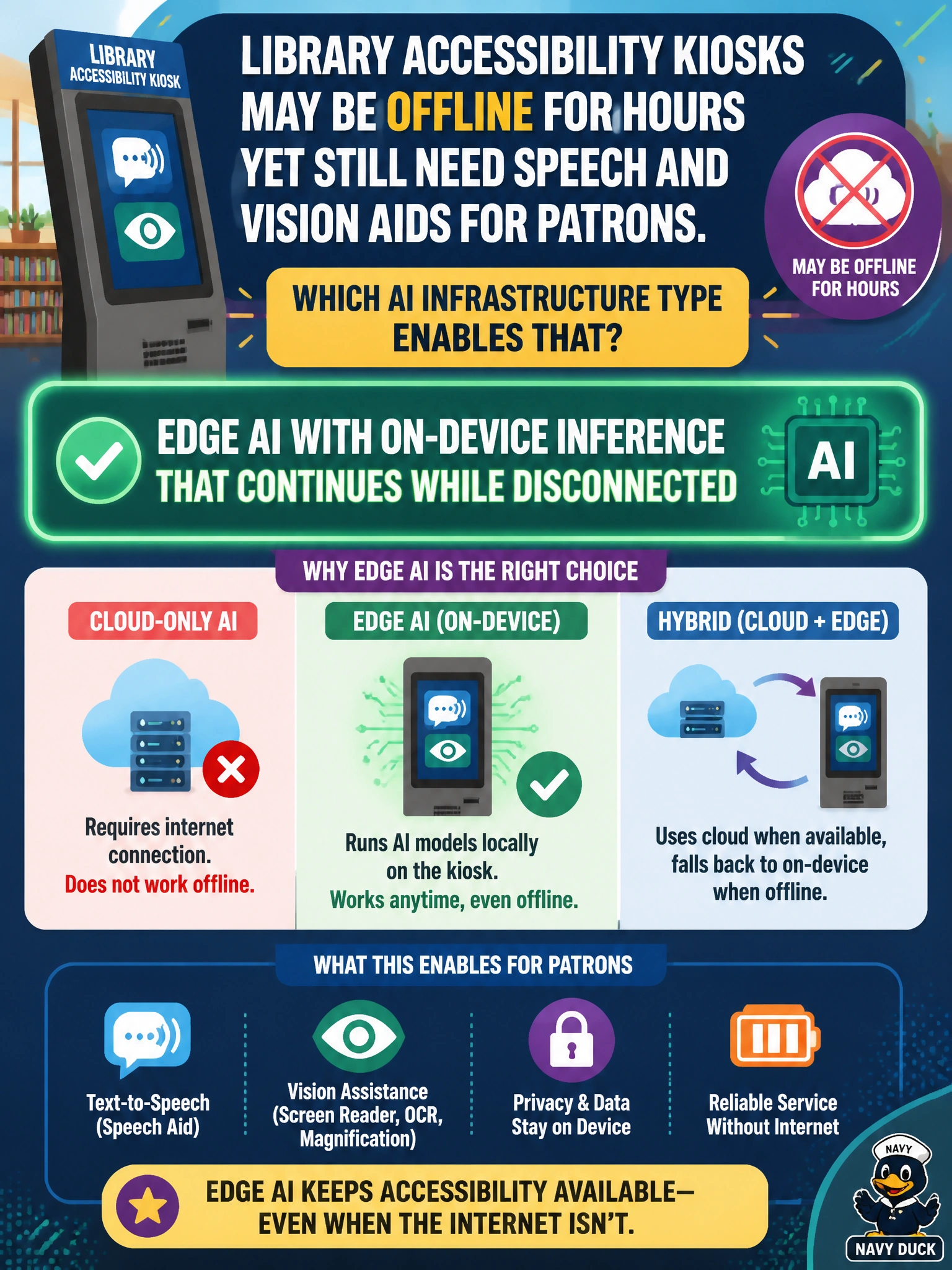
Library accessibility kiosks may be offline for hours yet still need speech and vision aids for patrons. Which AI infrastructure type enables that?
Select an answer to reveal the explanation.
Short Explanation
A patron walks up to the kiosk and needs speech or vision help right now — it can't tell them to come back once the network's fixed. Running the models on the kiosk itself keeps it working through an outage that lasts hours. Edge cache with on-device storage just keeps files, local trainer with on-device tuning just adjusts models, and federated buffer with local logs just queues updates, so they won't give your kiosk live speech and vision help when it's offline.
Full Explanation
Library accessibility kiosks that may sit offline for hours still need to keep serving speech and vision aids to patrons the moment someone walks up — that rules out any design that depends on a live round trip to the cloud for every request. Edge AI with on-device inference keeps the kiosk's vision and speech models running locally, so service continues through a WAN outage instead of going dark.
Edge cache with on-device storage that retains media while disconnected only keeps stored files and media available locally, it doesn't run the speech and vision models themselves, so it can't generate live captions, descriptions, or spoken responses for a patron standing at the kiosk right now. A local trainer with on-device tuning that tunes models while disconnected is about adjusting model weights in the background, not serving live requests, so it cannot help a patron standing at the kiosk right now; accessibility aids need to respond in the moment, not after tuning finishes. A federated buffer with local logs that queues updates while disconnected only holds updates to send later when connectivity returns, it doesn't serve live requests, so it still leaves the kiosk without speech and vision aids when the WAN is down.
Exam caveat: edge inference can still sync updated models or usage telemetry back to the cloud when connectivity returns; the distinction tested here is whether the real-time serving path itself requires that connection. Operational check: confirm the kiosk's speech and vision models run fully on local hardware, measure response latency with the WAN link pulled, and schedule model updates as background syncs that never block a patron's request.
Prefer to study offline? Printable PDF study book + test engine ($7.50, unofficial). These questions stay free here.