
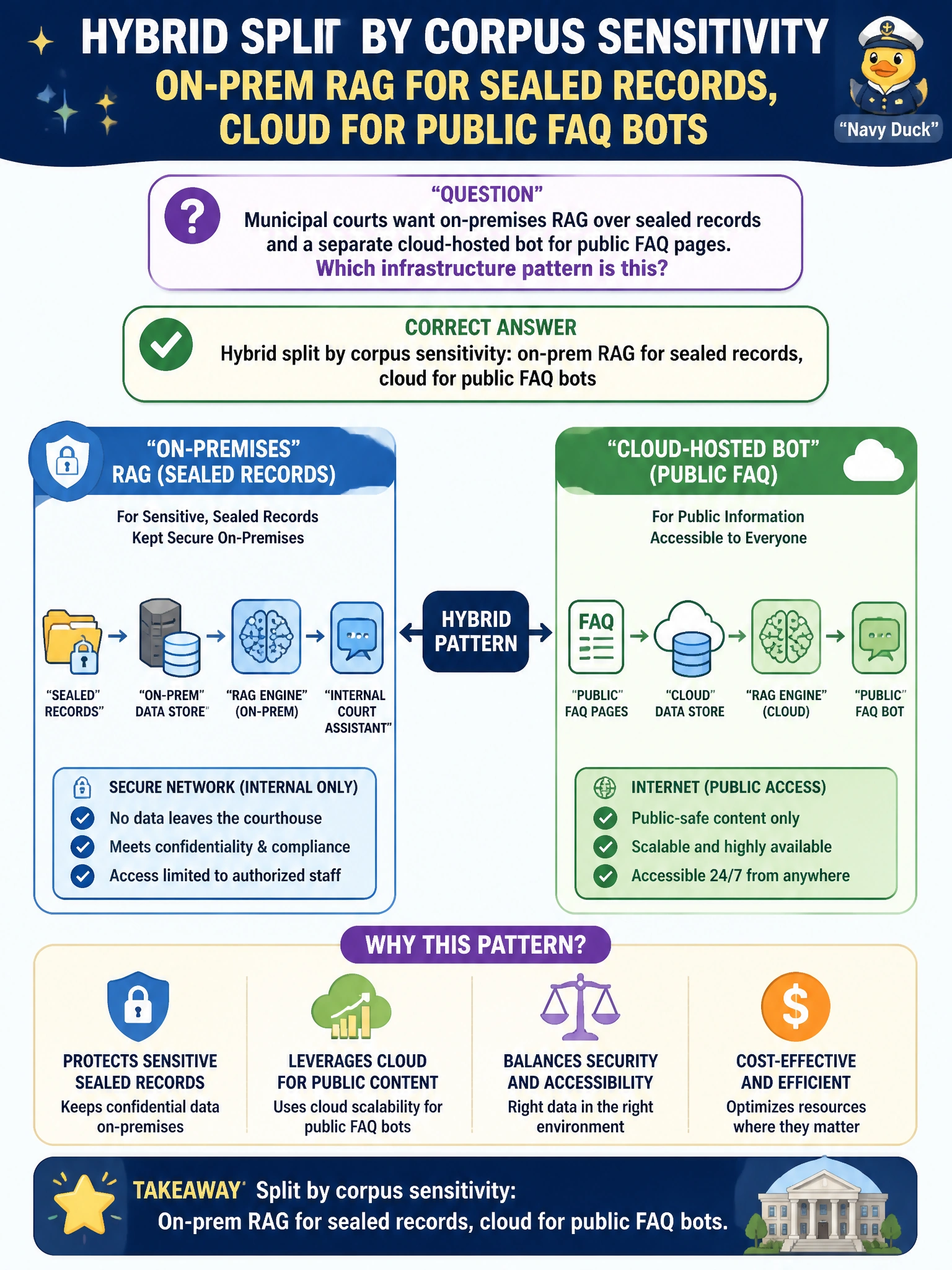
Municipal courts want on-premises RAG over sealed records and a separate cloud-hosted bot for public FAQ pages. Which infrastructure pattern is this?
Select an answer to reveal the explanation.
Short Explanation
Sealed dockets stay in the courthouse vault with on-prem RAG; the 'where do I pay a ticket' bot can live in the cloud. Sensitivity of the corpus drives the split — that is hybrid done right. Do not dump sealed records into a public FAQ tenant.
Full Explanation
A hybrid split by corpus sensitivity—on-premises RAG over sealed court records plus a separate cloud-hosted bot for public FAQ pages—is the correct municipal infrastructure pattern. It works because sealed dockets and confidential court corpora stay under on-prem retrieval controls, while non-sensitive public FAQ content can safely use cloud hosting. Sensitivity of the corpus, not convenience alone, drives placement.
Edge-only offline models with no RAG and no cloud FAQ path fail because they omit both the sealed-record RAG requirement and the cloud public-FAQ path the courts want. Cloud-only storage of all sealed court corpora in a public region fails conceptually because placing sealed records in unmanaged public cloud contradicts the on-prem RAG requirement for sealed material. Training-only GPUs with no inference or retrieval path at all fail because RAG and FAQ bots are inference/retrieval workloads; training GPUs alone do not implement the pattern.
Exam caveat: public FAQ bots must be isolated from sealed indexes so prompts or logs cannot bridge corpora. Operational check: verify sealed indexes never leave the courthouse/on-prem boundary, confirm the FAQ bot uses only public content, test that retrieval paths do not cross sensitivity tiers, and treat cloud-all-sealed or training-only options as pattern violations.
Prefer to study offline? Printable PDF study book + test engine ($7.50, unofficial). These questions stay free here.