
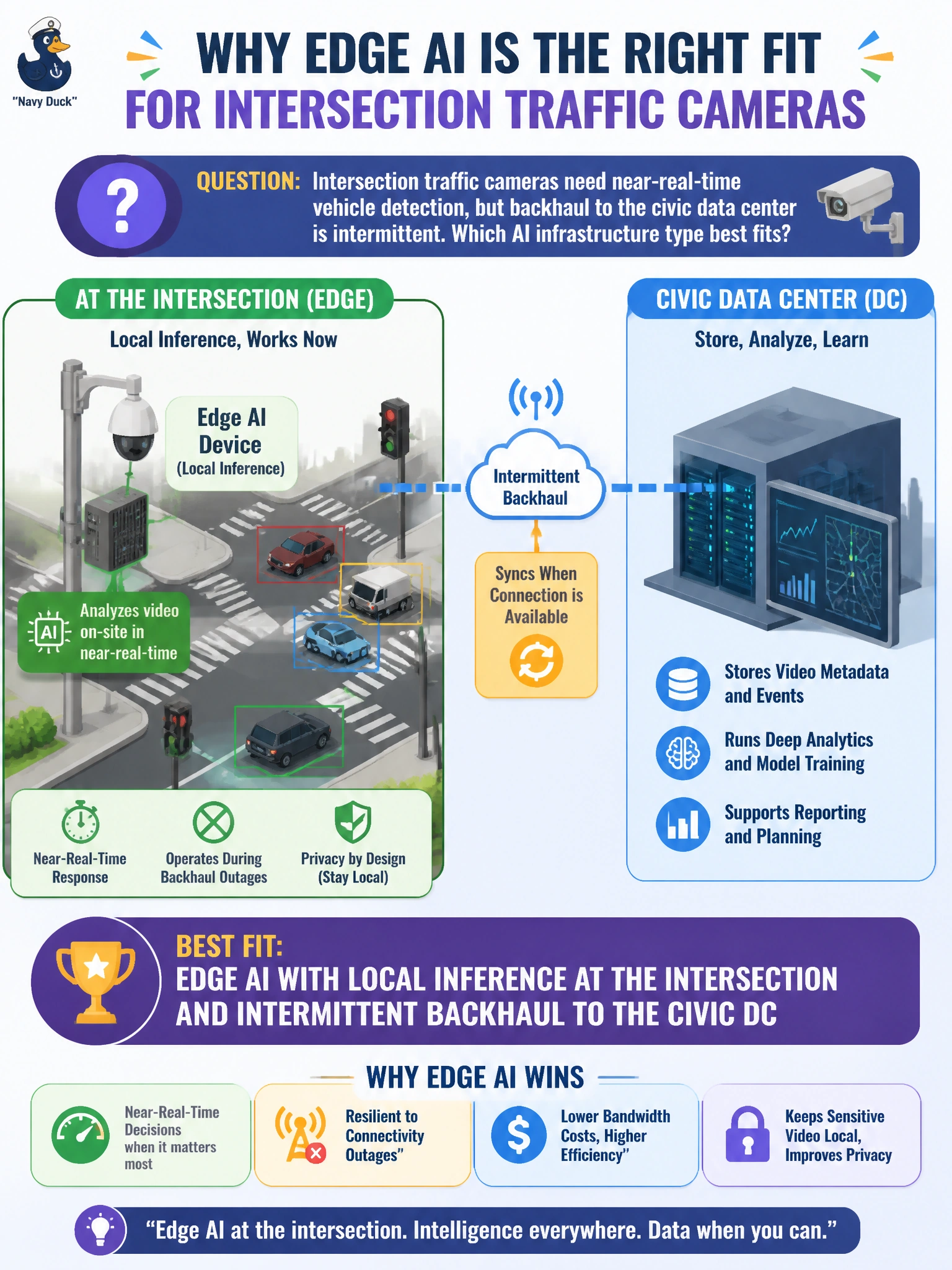
Intersection traffic cameras need near-real-time vehicle detection, but backhaul to the civic data center is intermittent. Which AI infrastructure type best fits?
Select an answer to reveal the explanation.
Short Explanation
The smarts have to live next to the camera when the WAN flakes out — like a security guard who does not wait for HQ on every car. Edge inference boxes decide locally, then sync when the pipe is up. Low latency plus limited backhaul equals Edge AI.
Full Explanation
Edge AI with local inference at the intersection and intermittent backhaul to the civic data center fits near-real-time vehicle detection when WAN connectivity is unreliable. The correct infrastructure works because detection must continue next to the camera when the pipe to the civic DC drops; local models produce timely detections, then sync telemetry or clips when backhaul returns. Edge is the right type when latency and availability dominate over centralizing every frame. Cloud inference with hosted detectors at the civic DC and intermittent sync to the intersection fails because detection still runs centrally at the civic DC; when the intermittent link drops, the intersection has no local decision capability and live results stall, while intermittent sync only moves data or updates rather than enabling near-real-time detection on-site. Civic DC training cluster with nightly retraining and model push to the intersection fails because retraining refines models rather than performing live inference; it cannot detect vehicles in real time at the intersection, and pushed models still require local edge inference to keep working when backhaul is intermittent. Metro fog inference at the district hub with cached models and store-and-forward to the civic DC fails because inference still sits off-site at the hub and depends on the intermittent link from the intersection; cached models and store-and-forward tolerate loss to the civic DC but not loss from the camera, so hub-side inference cannot support near-real-time detection when that access link drops. Exam caveat: edge models still need secure update paths and monitoring so stale detectors or compromised appliances do not silently degrade safety. Operational check: validate offline detection continues during WAN loss, measure detection latency on-box, schedule backhaul sync windows, and treat civic-DC-hosted-detector-only or district-hub-with-cached-models-only designs as non-compliant with near-real-time intermittent-backhaul requirements.
Prefer to study offline? Printable PDF study book + test engine ($7.50, unofficial). These questions stay free here.