
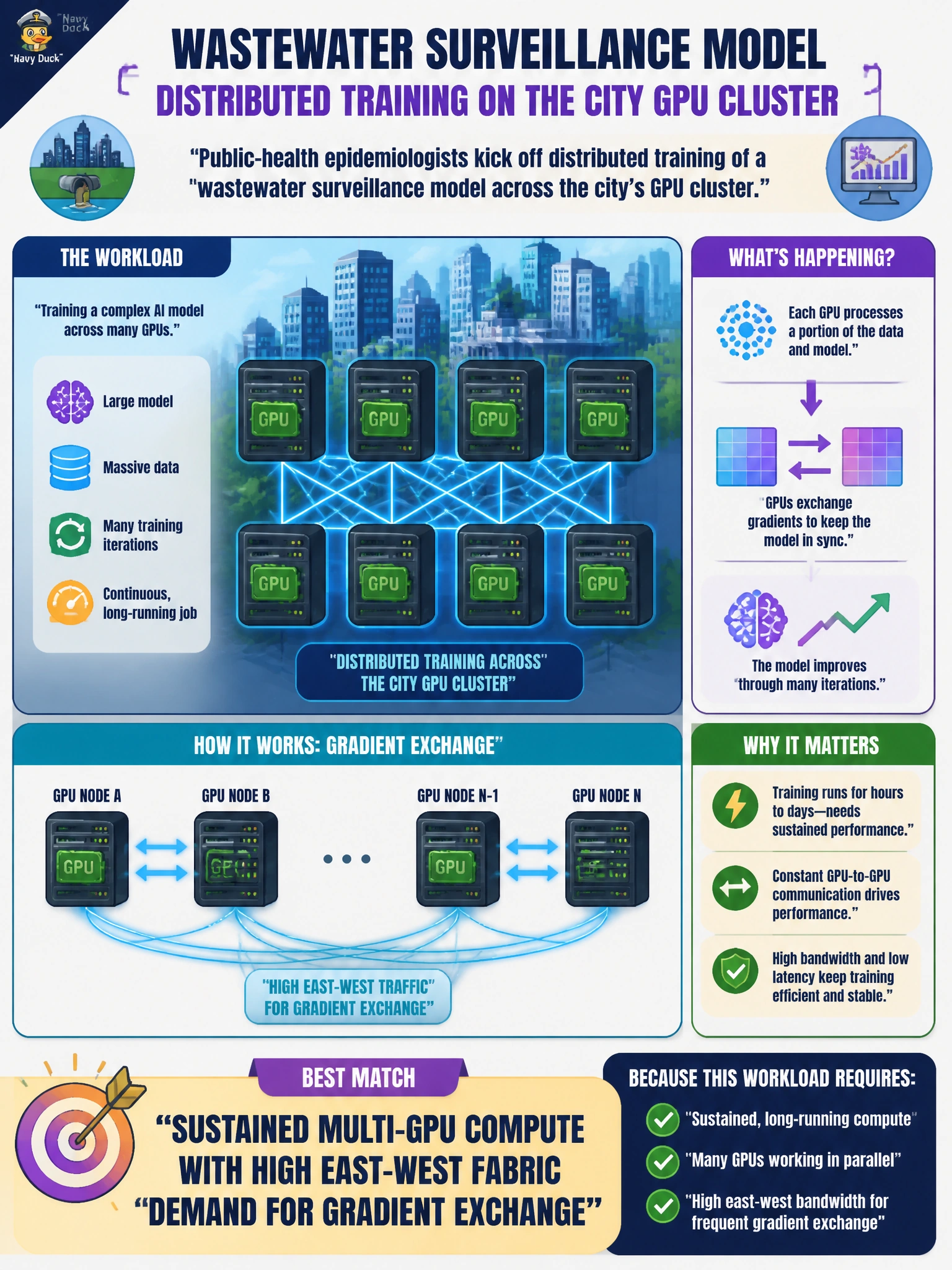
Public-health epidemiologists kick off distributed training of a wastewater surveillance model across the city’s GPU cluster. What infrastructure characteristic best matches this training workload?
Select an answer to reveal the explanation.
Short Explanation
Distributed training is a busy kitchen with every cook shouting gradients across the room. Expect GPUs humming for a long stretch and the east-west fabric carrying a lot of chatter.
Full Explanation
Distributed training of a wastewater surveillance model across the city's GPU cluster is a sustained multi-GPU compute pattern with high east-west fabric demand for gradient (and often activation) exchange. Epidemiologists should expect long-running accelerator utilization, synchronized or asynchronous communication among workers, and fabric pressure that dwarfs typical request-response inference chatter. Sustained multi-GPU compute with high north-south fabric demand for dataset ingestion is not the defining pattern here: the critical fabric pressure is east-west gradient exchange, not north-south dataset ingestion. Sustained multi-GPU compute with high storage throughput for frequent checkpoint archiving describes a storage-bound profile, but distributed training is defined by sustained GPU communication rather than checkpoint write throughput. Sustained multi-GPU compute with high storage throughput for gradient exchange gets the exchange path wrong: gradient exchange stresses east-west fabric, not storage throughput. Exam caveat: fabric demand varies with parallelism strategy (data parallel, model parallel, pipeline parallel) and collective libraries, but the exam-level distinction still holds: distributed training stresses east-west gradient exchange far more than north-south ingestion, checkpoint archiving, or storage throughput for gradient exchange. Operational check: before kickoff, validate cluster topology, congestion control, and storage throughput for the training job; monitor east-west utilization and job completion against the surveillance model's training schedule rather than treating the run like a dataset-ingestion, checkpoint-archiving, or storage-throughput-for-gradient-exchange job.
Prefer to study offline? Printable PDF study book + test engine ($7.50, unofficial). These questions stay free here.