
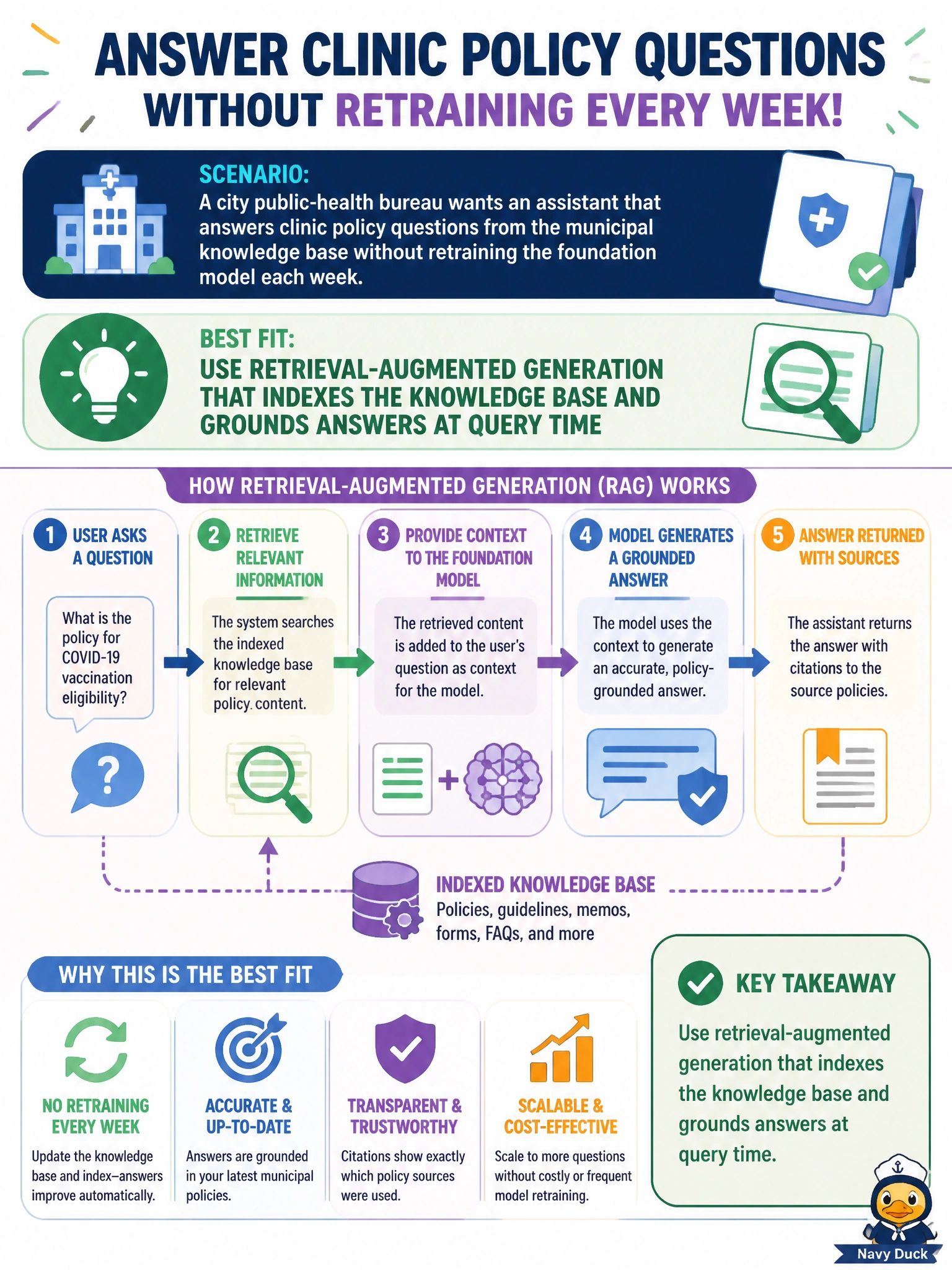
A city public-health bureau wants an assistant that answers clinic policy questions from the municipal knowledge base without retraining the foundation model each week. Which AI/ML workload pattern best fits this requirement?
Select an answer to reveal the explanation.
Short Explanation
Think of the policy library like a filing cabinet the assistant can open each time someone asks. RAG pulls the right pages and answers from them, while you'll still have to retrain the model every week if you extend continuous pre-training on municipal text. Running nightly batch inference over policy documents to pre-generate answers won't let you retrieve fresh passages when you've got a new or updated question.
Full Explanation
The public-health bureau needs clinic-policy answers grounded in a living municipal knowledge base while leaving the foundation model weights alone between policy updates. Retrieval-augmented generation (RAG) matches that pattern: documents are indexed (and re-indexed when policies change), relevant passages are retrieved at query time, and generation is conditioned on those passages. Extending continuous pre-training on municipal text to refresh general clinic dialogue fluency weekly still requires updating the foundation-model weights each week. It does not index passages for retrieval at query time, violates the requirement to avoid retraining the foundation model each week, and treats routine document freshness as a model-capability change. Running nightly batch inference over policy documents to pre-generate answers for common clinic questions pre-computes static answers rather than retrieving at query time, so it cannot reliably answer novel or changed questions and leaves gaps between batch runs. Fine-tuning the foundation model on policy PDFs to embed updated guidance in model weights weekly still requires retraining whenever policies change and does not support real-time updates to the knowledge base without full model redeployment. Exam caveat: RAG still needs retrieval quality, chunking, access control, and citation discipline—it does not magically eliminate wrong answers if the wrong passage is retrieved or permissions are ignored. Operational check: confirm the index refresh cadence tracks policy publication, that answers cite municipal sources, and that foundation-model retraining is reserved for true capability changes rather than routine document updates.
Prefer to study offline? Printable PDF study book + test engine ($7.50, unofficial). These questions stay free here.