
A hospital campus sees Monday morning latency that matches every other Monday and sits inside the usual weekly pattern. What should the team do before treating that latency as an incident?
Select an answer to reveal the explanation.
Short Explanation
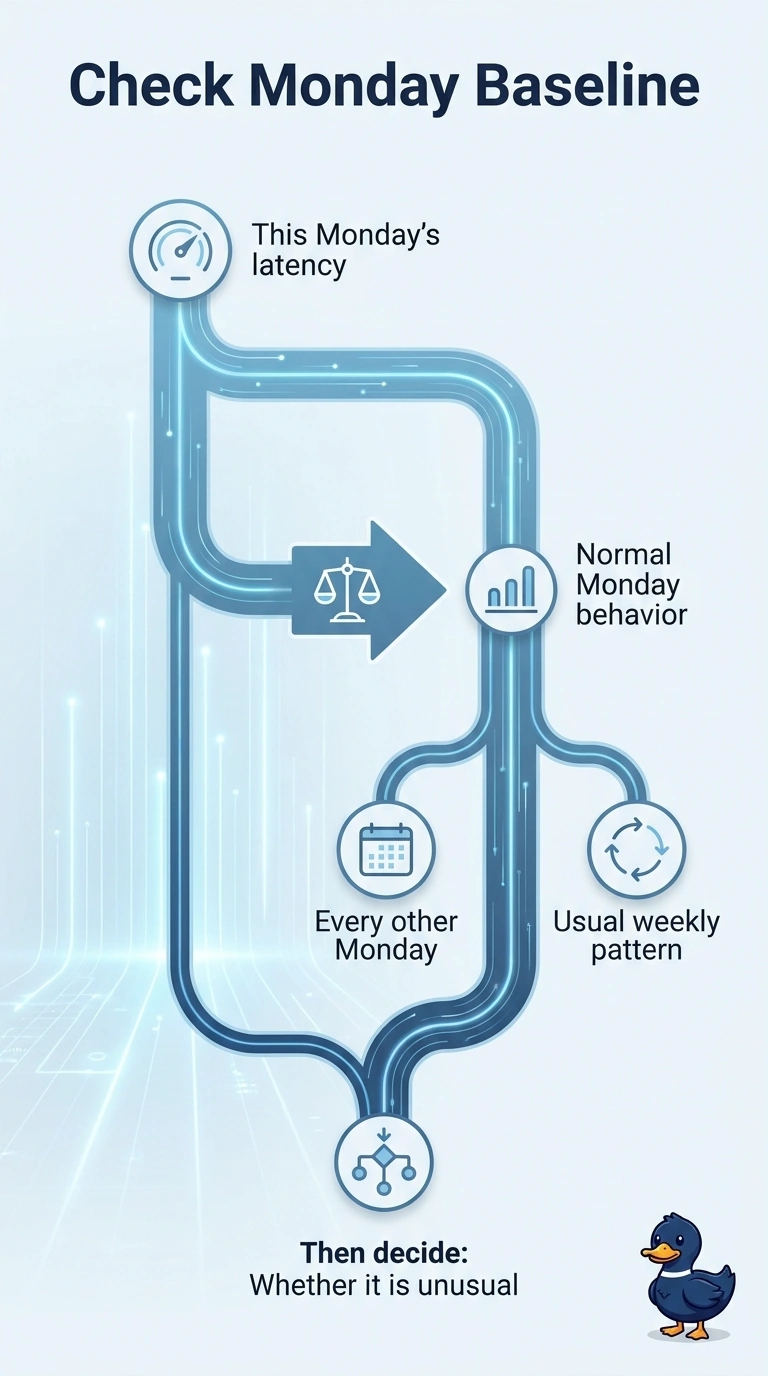
Monday rush at the clinic looks like an emergency only if you forget that every Monday looks like this. You compare the latency with a baseline of normal Monday behavior before anyone calls it an incident. Alerting on the earliest sample, quieting the chart by raising the threshold, or swapping in a ticket count skips that comparison.
Full Explanation
A baseline is the record of normal behavior, including patterns that repeat every Monday, and an incident is a departure from that record rather than the record itself. Comparing Monday latency with a baseline of normal Monday behavior is the step required before this morning is called an incident, because the observation already matches prior Mondays and sits inside the usual weekly pattern. Alerting on the earliest Monday sample before the usual weekly pattern is known treats one expected rise as a fault and skips the comparison that would show it is typical. Raising the threshold until the usual Monday rise no longer shows on the latency chart hides the pattern instead of learning it, and it also hides a future Monday that actually breaks the pattern. Replacing the latency metric with a count of tickets opened on Monday mornings changes the subject. Ticket volume is a workload measure, not a substitute for the latency baseline the campus is reading. Exam caveat: a recurring peak that matches the baseline is normal behavior, and it becomes an incident only when it departs from that baseline. Operational check: overlay this Monday's latency on prior Mondays for the same hours and confirm it tracks them before an incident is opened.