
On event days at a stadium, an alert rule matches the condition, but the notification goes to a mailbox nobody monitors. What should the team prove before relying on that rule?
Select an answer to reveal the explanation.
Short Explanation
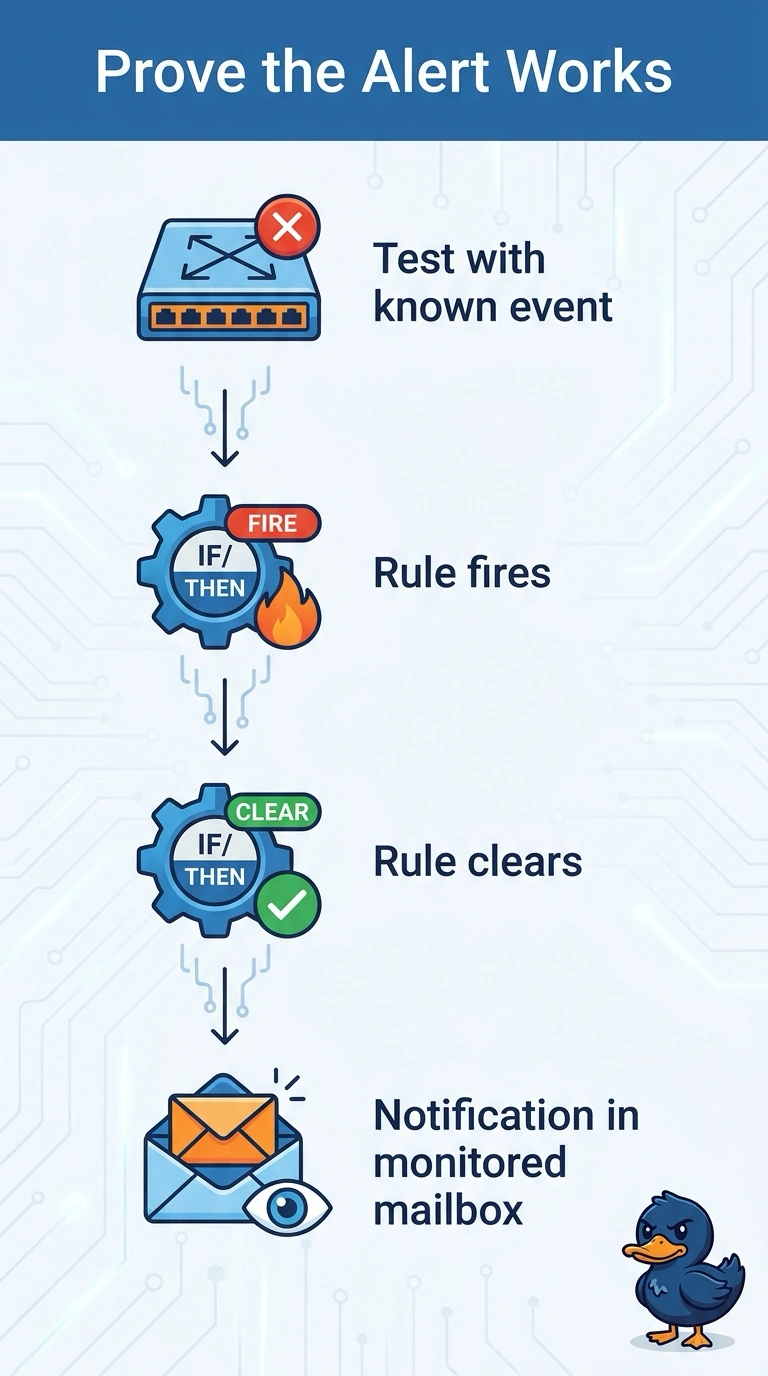
An alarm bell inside a locked closet does not warn the people in the stands. You prove the stadium rule fires and clears on a known event and that the notification reaches a mailbox someone reads. The trap is lowering every threshold, deleting the rule after one page, or trusting it because the rule was saved.
Full Explanation
A stadium rule that matches the condition and then delivers the page to a mailbox nobody monitors has not completed a usable alert, even though the match itself occurred. Before anyone relies on it for event day, the team has to prove the rule fires on a known event, clears when that event ends, and lands the notification in a mailbox someone actually monitors. That single proof covers the detection and the delivery, which is where this rule is failing. Lowering every event-day threshold only changes how often a message is created and still sends it to the unattended mailbox. Deleting the rule after one unread page removes the control without ever showing that a known event can fire, clear, and reach a person. Trusting the rule because it was saved and the condition matched stops at the comparison and never checks that the clear happens or that a human receives the page. Exam caveat: fire and clear include the notification path, and a match that dies in an unmonitored mailbox is not a validated rule. Operational check: raise a known event, confirm the page arrives in a monitored mailbox, end the event, and confirm the rule clears and that the same mailbox shows the clear.