
A manufacturer's machine-vision feed, carried as UDP real-time media, shows loss and jitter, while camera name lookups succeed. Which test fits the failure?
Select an answer to reveal the explanation.
Short Explanation
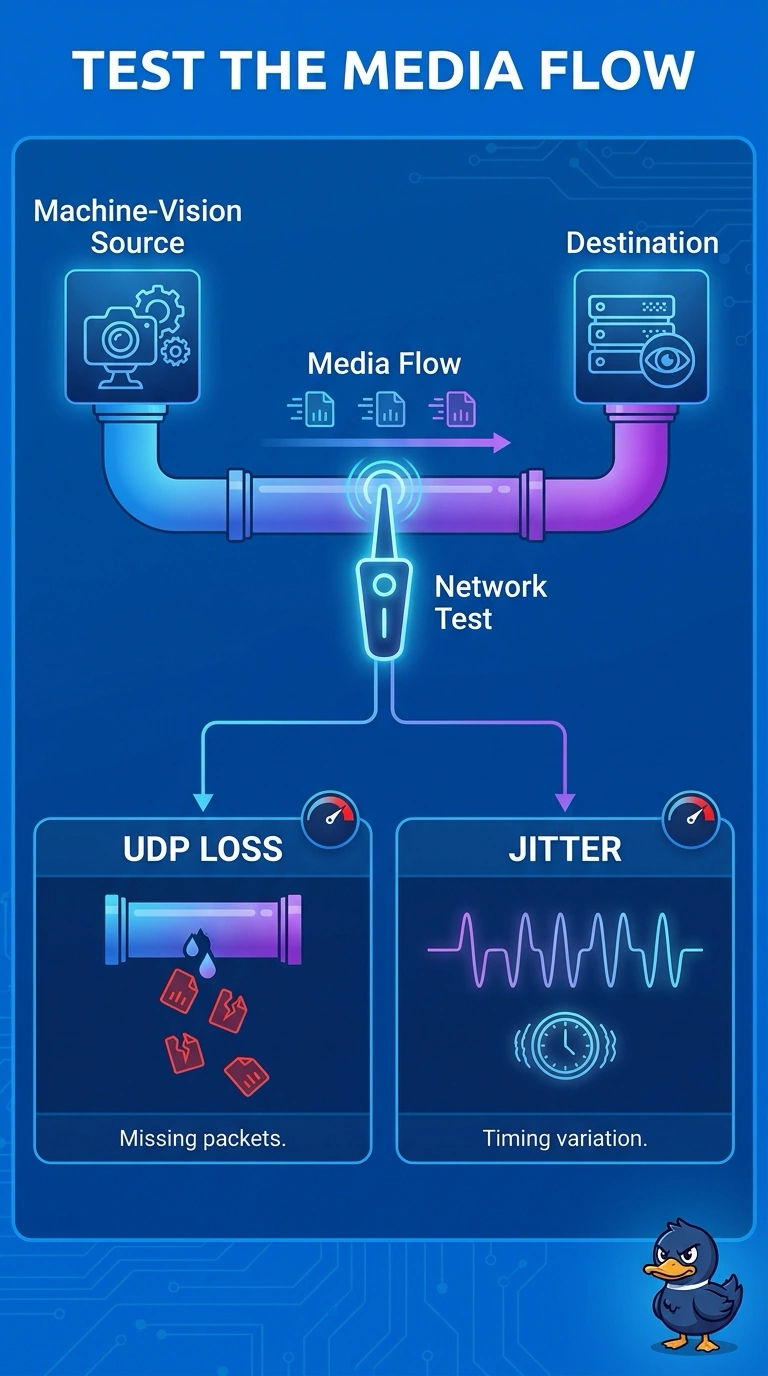
A live UDP stream falls apart in gaps, like a radio broadcast that keeps dropping words. You measure this camera flow with a network test that covers UDP loss and jitter. The name already resolves, and a phone-quality score or a web page is a different application than the vision feed.
Full Explanation
The failing application is a machine-vision feed carried as UDP real-time media, and the symptoms are loss and jitter. A network test that measures UDP loss and jitter on that flow matches both the transport and the complaint. Camera name lookups already succeed, so a DNS test of the hostname checks a step that is not failing. A voice test scores telephone call quality on the plant phones, which are a different media application than the vision feed even though both are real-time. A web test loads a status page and times objects, and a page load does not describe UDP loss and jitter on the camera flow. Telephone scoring and page timing remain the right tools for phones and web screens, and they leave the UDP loss on the vision feed unmeasured. Exam caveat: real-time media is not automatically a voice test; match the test to UDP loss and jitter when that is the flow that is breaking. Operational check: run the network test against the vision flow while the picture is degrading and compare UDP loss and jitter with a DNS lookup that still succeeds for the same camera.