
A hotel chain has a branch with no server of its own, only a router that can host an agent. The team needs a ThousandEyes probing point on that branch LAN for tests toward the reservation service. Which placement meets that need?
Select an answer to reveal the explanation.
Short Explanation
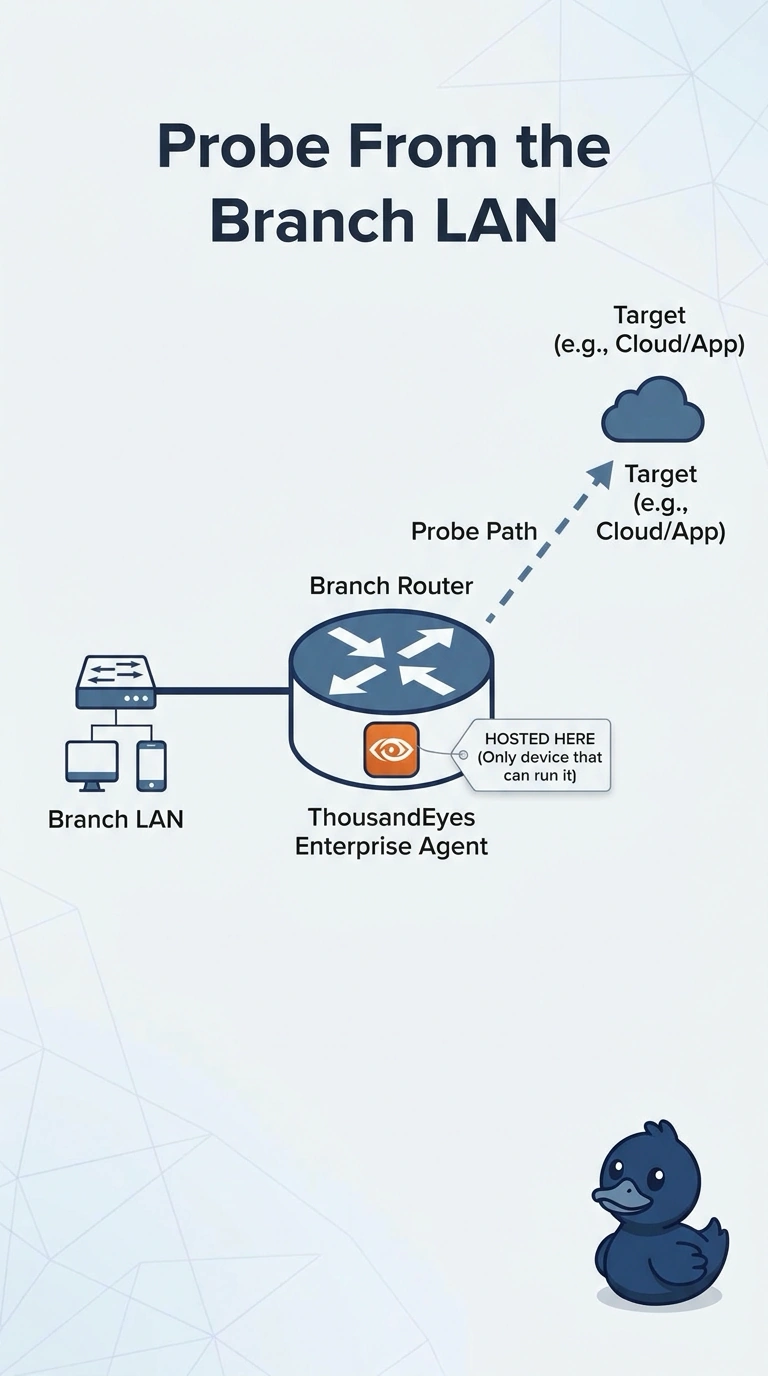
A branch with one working outlet is like a kitchen with a single plug. You put the Enterprise Agent on that router so the reservation test starts on the LAN guests actually use. A front-desk laptop, a cloud probe, or a SPAN session is a different tool than the site agent you need.
Full Explanation
The branch has no server, and the router is the network device that can host the probing software, so an Enterprise Agent on that router is the vantage that actually sits on the branch LAN. Tests toward the reservation service then start inside the hotel, which means the path can include the internal hop instead of beginning somewhere else. An Endpoint Agent on one front-desk laptop follows a single user device: it leaves with the employee, it can sleep, and it never becomes the branch probing point this reservation test is asking for. A cloud agent sits outside the branch, so the hop between the LAN and the router stays invisible and a failure there can look like a healthy external path. A SPAN session mirrors frames for a capture tool; it does not run the Enterprise Agent test and cannot produce the scheduled path view toward the reservation service. On the exam, a router-hosted probing point still counts as an Enterprise Agent when that device is what can see the site, and a mirror of packets is not a substitute for it. In production, confirm the router-hosted agent is up, that its test target is the reservation service, and that the hop list includes the branch LAN rather than starting outside the hotel.