
A government agency must test an application that lives only on an isolated VLAN, and probes from outside that VLAN cannot reach the target. Where should the Enterprise Agent sit?
Select an answer to reveal the explanation.
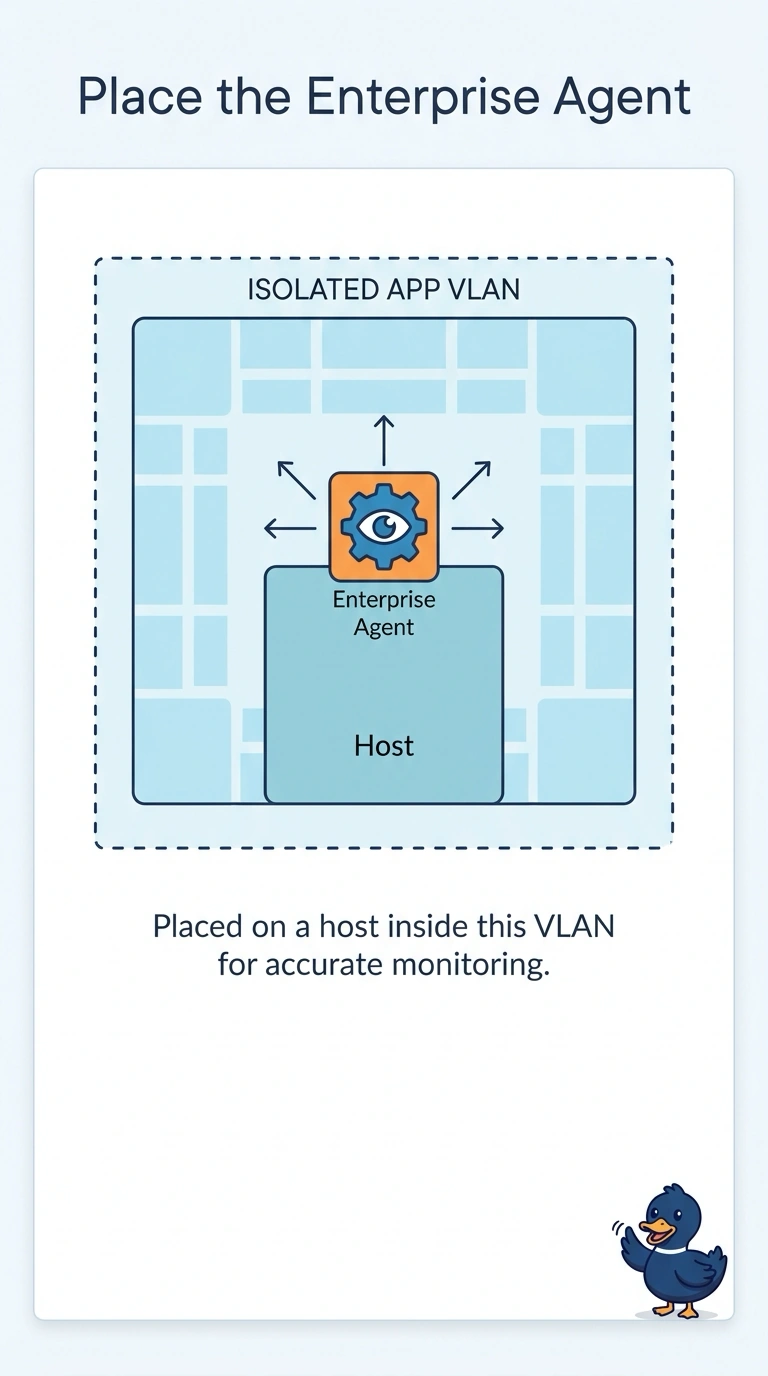
Short Explanation
A guard has to stand inside the locked room to see what is stored there. You place the Enterprise Agent in the isolated application VLAN, because probes from outside cannot reach the target. A laptop agent, a cloud probe, or a SPAN session does not give you that vantage.
Full Explanation
The application lives only on an isolated VLAN, and probes from outside that VLAN cannot reach the target, so the Enterprise Agent has to sit inside the VLAN where the target can actually be tested. From that placement the path starts on the same isolated segment the application uses. An Endpoint Agent on one analyst laptop reports the experience of that single device and is not the probing point placed in the VLAN for this application test. A cloud agent cannot see or reach the internal application hop, so the isolated VLAN stays outside its view and a failure there never appears as a hop it can test. A SPAN session on a core switch copies frames for inspection, but it is not an Enterprise Agent and it does not run the scheduled test against the isolated application. On the exam, reachability decides Enterprise Agent placement: if outside probes cannot touch the target, the agent belongs on the segment that can. In production, from the agent in that VLAN confirm the test reaches the application, and confirm an agent kept outside the VLAN still cannot, so the placement is doing the job the isolation requires.