
At a logistics hub, the application owner will not install software on the warehouse servers, but tests must still start beside those servers. What placement fits?
Select an answer to reveal the explanation.
Short Explanation
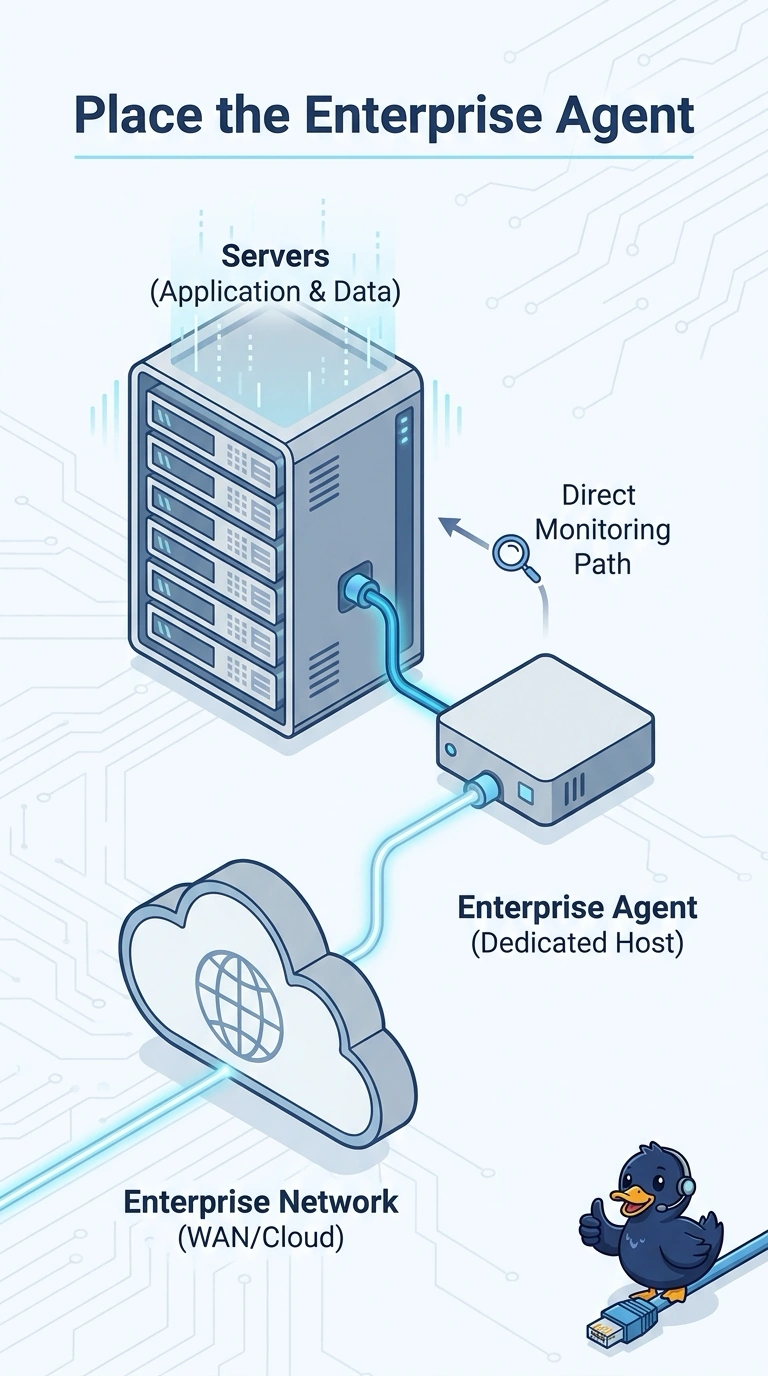
If you cannot nail a shelf into someone else's wall, you bring your own stand and set it beside the wall. You place a dedicated Enterprise Agent on its own host next to the servers when those servers cannot take the software. A dock laptop, a cloud agent, or a span session does not give you that neighboring probe.
Full Explanation
The application owner will not allow agent software on the warehouse servers, so the probing point has to be a neighbor rather than the server itself. A dedicated Enterprise Agent on its own host next to the servers gives the hub a test source beside those servers without an install on them. An Endpoint Agent running on one laptop at the loading dock depends on that laptop. It is not a standing probe next to the servers, and it stops when the laptop is closed. A cloud agent outside the hub that cannot see the warehouse hops starts off the site. Refusing the server install does not make an outside cloud agent able to see those hops. A span session that copies packets and is not an Enterprise Agent mirrors traffic. It does not run an Enterprise Agent beside the servers. Exam caveat: when the server cannot host the agent, a dedicated Enterprise Agent next to it keeps a nearby vantage point without breaking the owner's rule. Operational check: confirm no agent software was added to the warehouse servers and that tests from the dedicated host still include the hops beside those servers.