
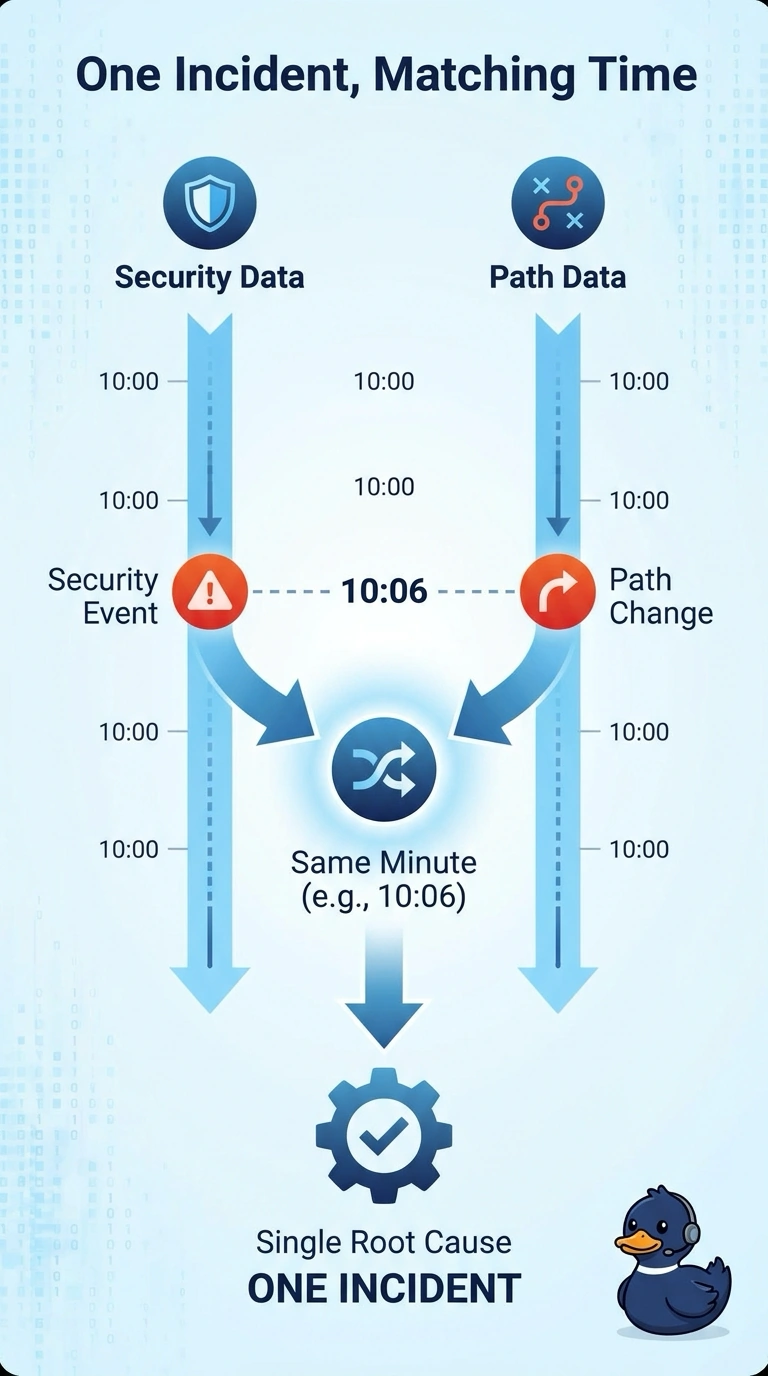
At a hospital, the security log and the network path data both change in the same minute, when traffic moves onto an unexpected route. Two teams want two root-cause projects. Which response fits the timestamps?
Select an answer to reveal the explanation.
Short Explanation
Two clocks striking in the same minute are telling you about one event, not about two unrelated fires. Security data and path data at the hospital moved together, so the timestamps support one incident. The trap is a bandwidth project, a QoS retune, or a laptop swap that pretends the path change had a separate cause.
Full Explanation
The security log and the network path data change in the same minute, and that minute is when traffic moves onto an unexpected route. Agreement at that granularity means one incident: the path change and the security event are the same story. Opening two root-cause projects splits one timeline into two causes the timestamps do not support. A bandwidth upgrade, because a path move means the hospital circuit is too small, invents a capacity conclusion from a route change. A QoS retune, because a path move is only a marking problem on the edge, confuses a forwarding change with packet marking. A laptop replacement for the clinician who happened to be online that minute selects a bystander. The clinician did not move the route, and the security log moved with the path, not with one device login. Exam caveat: when two data sets share a minute and a path change, resist a second project that ignores the shared timestamp. Operational check: place the security event time next to the path-change time, confirm they match, and keep a single incident record instead of a bandwidth order, a QoS edit, or an endpoint replacement.