
A hospital campus sees packet loss on a path test only while the matching circuit is completely full, and the loss fades when that circuit has spare capacity again. What is the cause?
Select an answer to reveal the explanation.
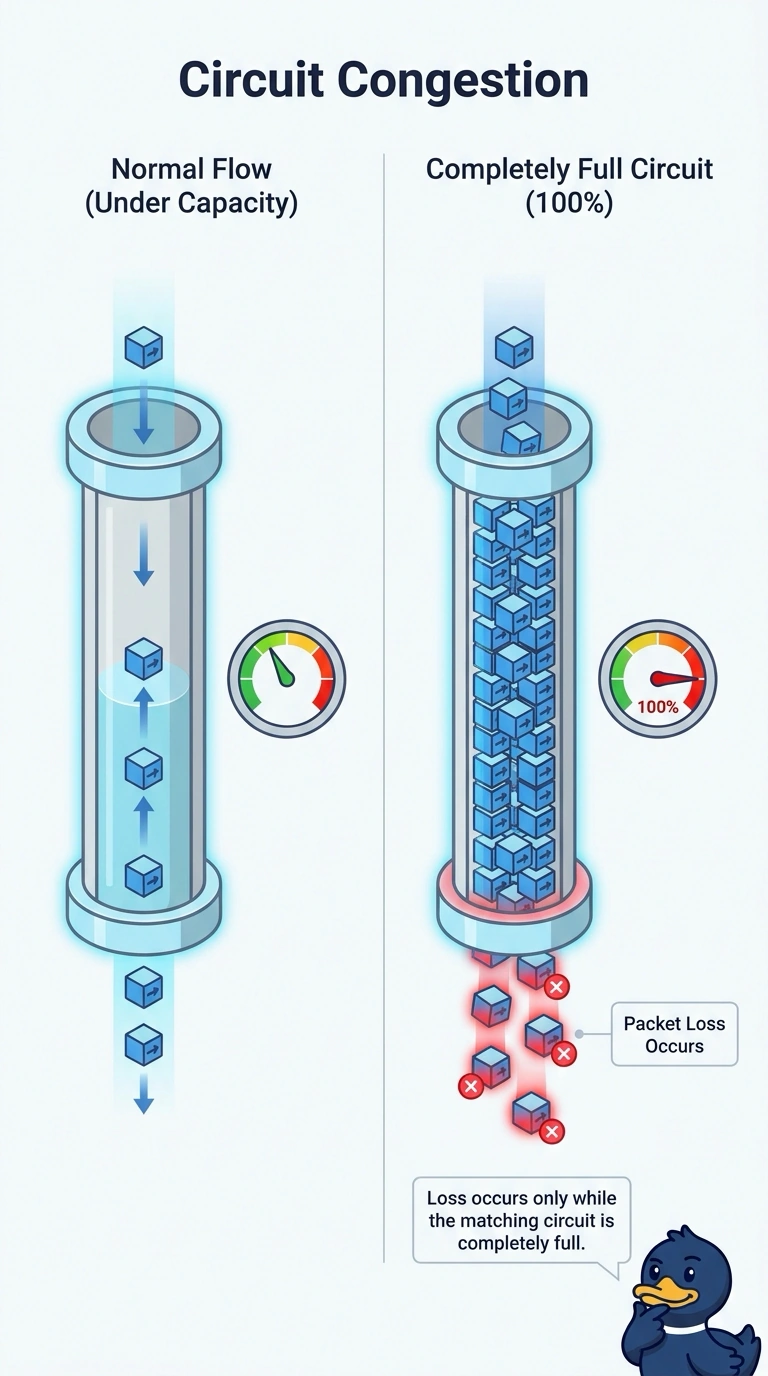
Short Explanation
A garden hose that only bursts when the main valve is wide open is a pressure problem. You call the loss congestion on that circuit, because it appears when the circuit is full and fades when capacity returns. The browser, DNS, and wireless don't rise and fall with that circuit.
Full Explanation
Packet loss appears only while the matching circuit is completely full and fades when that circuit has spare capacity again, which is congestion on that circuit. The loss follows the fullness of the circuit, so the cause is the circuit filling rather than an unrelated client symptom. A slow browser on the clinical workstation would be a page-render issue, and it would not turn on and off with the circuit. DNS only would describe a name lookup that fails, and loss that tracks a full circuit is not a resolver symptom. A wireless ticket for the ward would be a local radio fault, and the evidence follows the circuit rather than the radio. The browser, the resolver, and the ward radio do not share the circuit's full and spare-capacity pattern. Exam caveat: a completely full circuit is a congestion finding when loss rises and falls with it, and that pattern is not a browser, DNS, or wireless story. Operational check: overlay path loss with how full the circuit is and confirm the loss appears with the full circuit and fades when spare capacity returns.