
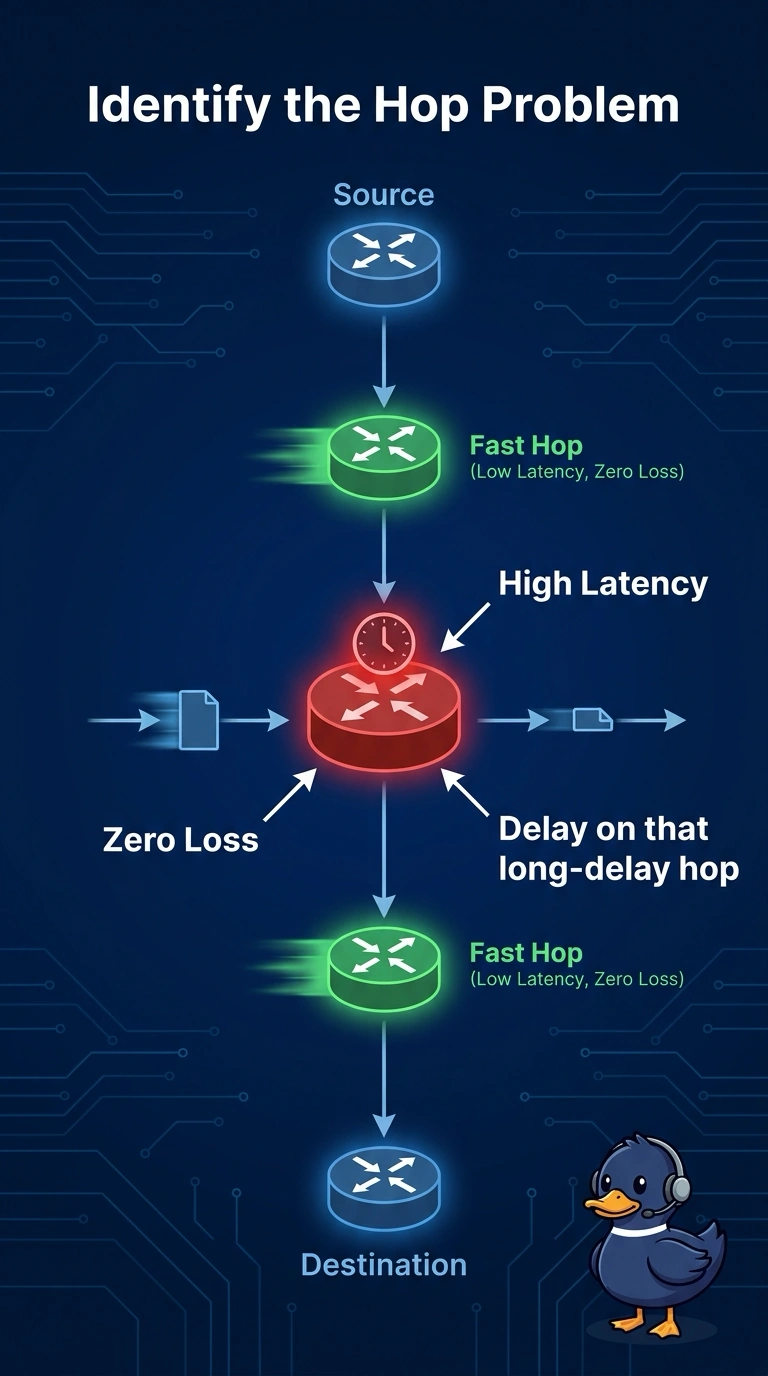
A government agency's path test shows high latency and zero loss on one long-delay hop, while the other hops look ordinary. What should the analyst call the problem on that hop?
Select an answer to reveal the explanation.
Short Explanation
A long gravel driveway is slow even when you drop nothing along the way. You call this delay on that hop, because latency is high there and loss on the hop is zero. A browser problem, a DNS-only failure, and a wireless ticket describe different faults than a single slow hop with no loss.
Full Explanation
The path shows high latency and zero loss on one long-delay hop, with the other hops ordinary, so the problem on that hop is delay rather than loss. A long-delay hop can add time while still forwarding every packet, and that is what the per-hop data shows. A browser rendering delay would show up as page-paint time with a clean path, and here a single hop in the path is the slow part. A DNS-only failure would be a name that does not resolve, not a hop that adds time after the path is already visible hop by hop. A wireless fault on the local radio would sit at the user edge, not on one long-delay hop in the middle of an otherwise ordinary path. Zero loss does not move the finding onto the browser, the resolver, or the radio. The hop is still forwarding every packet, and the time it adds is the problem the path test recorded. Exam caveat: high delay with zero loss is still a performance problem, and the name for it is delay on that hop. Operational check: read per-hop latency and loss, and confirm the extra delay sits on that hop while loss on it stays at zero.