
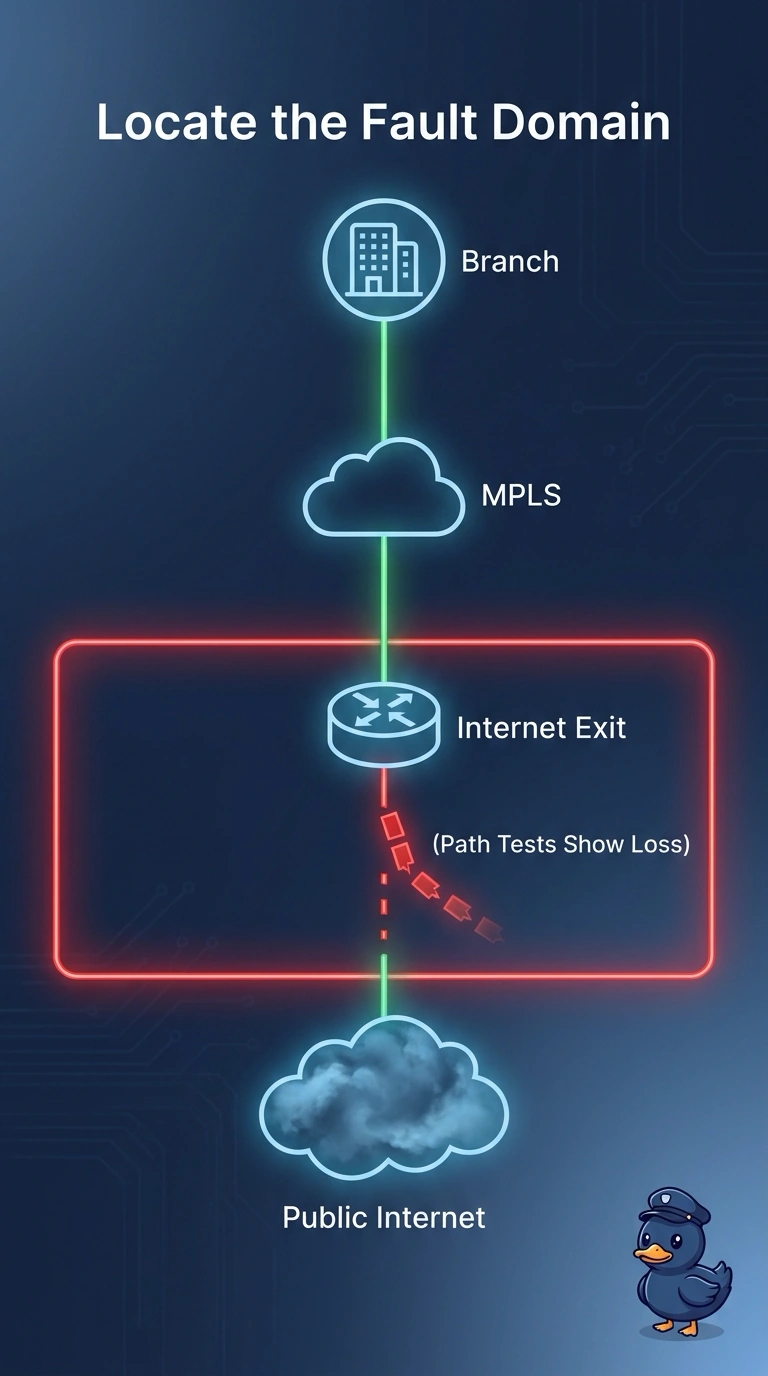
A hospital campus runs path tests in which every MPLS hop stays clean and loss appears only at the internet exit. What should the analyst treat as the fault domain?
Select an answer to reveal the explanation.
Short Explanation
If the hallway is clear and people only get stuck at the exit door, you work on the door. You treat the internet exit as the fault domain, because that is where the hospital path tests show loss while MPLS stays clean. The browser, DNS alone, or the ward wireless network is the wrong door.
Full Explanation
Every MPLS hop on the path test stays clean, and loss appears only at the internet exit, so the fault domain is that exit. Loss shows up on the internet-exit hop after every MPLS hop on the same test stayed clean, so that exit is the place the measurement goes bad. The clinician browser can make a chart page feel slow, but a browser fault would not show up as loss isolated to the internet-exit hop of a path test while every earlier MPLS hop stays clean. DNS only does not explain this pattern either: the test has a full path through MPLS to the exit, so name lookup has already succeeded far enough to measure those hops, and a pure DNS fault would not drop packets at one exit hop. The ward wireless network is a common ticket in a hospital, yet the measured loss is on the tested path at the internet exit, not on a wireless segment, so that ticket sends the work to the wrong layer. On the exam, put the fault on the hop that is lossy when the hops before it are clean. In production, compare the internet-exit hop with the MPLS hops on the same test and work the exit before you reopen browser, DNS, or wireless cases.