
A clinic wants voice to a cloud contact center on the MPLS color and bulk data on the internet color. Voice was placed in an SLA that prefers MPLS. Bulk data matches no SLA. Which outcome is correct?
Select an answer to reveal the explanation.
Short Explanation
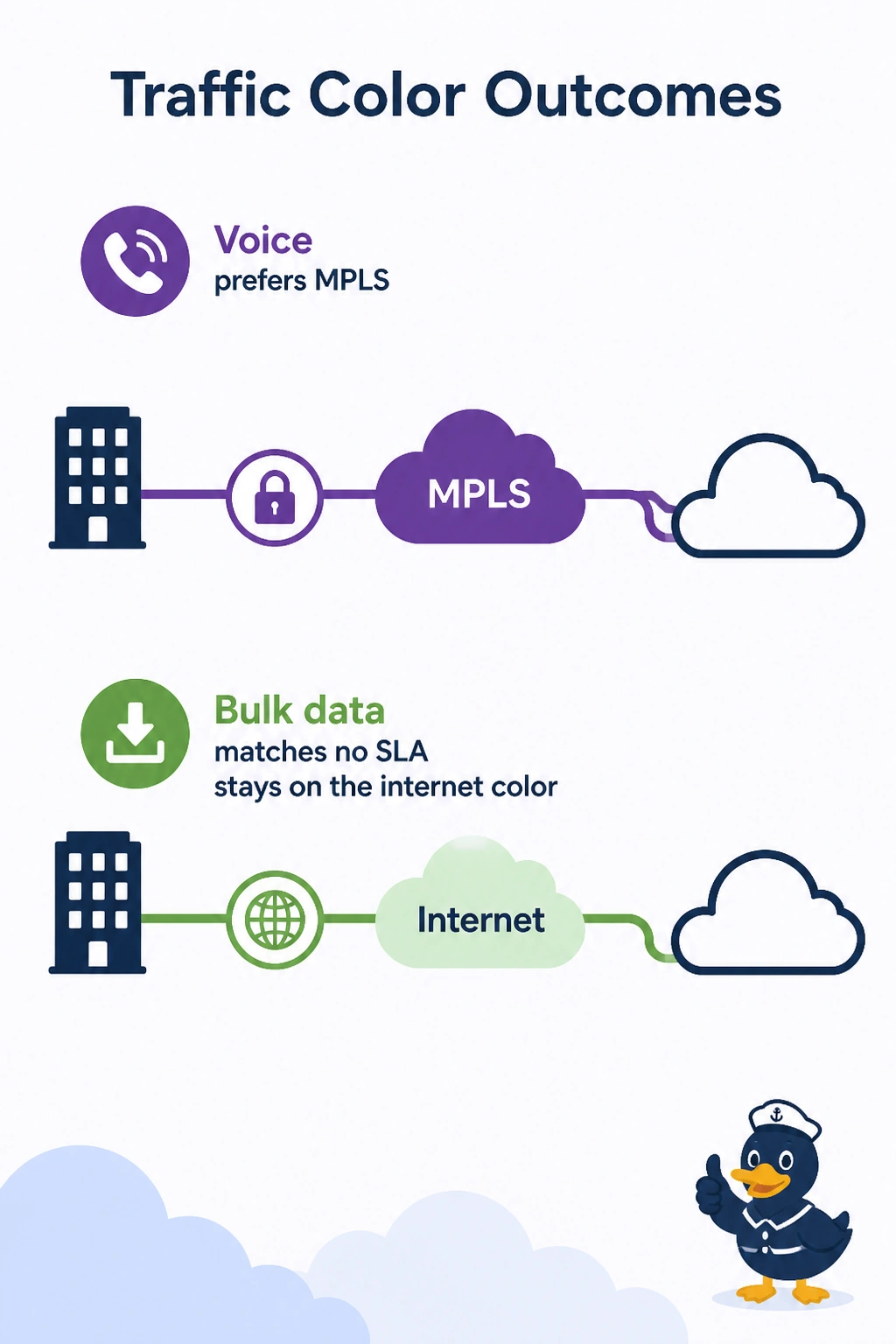
You’ve preferred MPLS for voice, and bulk data matches no SLA, so it keeps the internet path. Application-aware routing applies the preference only to matching traffic, not everything else.
Full Explanation
Application-aware routing acts on the applications that match. Voice matches an SLA that prefers MPLS, so voice uses that color when the path meets the class. Bulk data matches no SLA, so it follows ordinary routing onto the internet color—the split the clinic asked for. The claim that any voice SLA also covers unmarked data is incorrect: the voice preference does not pull bulk data onto MPLS. The claim that voice is forced onto the internet because bulk data has no SLA is also incorrect: unmatched bulk data does not change the route selected for voice. The claim that both flows are dropped until every application has the same strict SLA is incorrect because a shared strict policy is not required; strict treatment would drop voice if MPLS missed the class, which is a different design. Exam caveat: a data policy that pins both applications to one color overrides this split, so the stated outcome assumes no such pin exists. Practical check: verify that a voice flow shows the MPLS color while a bulk transfer shows the internet color at the same time.