
A branch data policy uses a local TLOC action to send a payroll application out a specific transport. An application-aware routing policy for the same application prefers a different color. Which path does the application take?
Select an answer to reveal the explanation.
Short Explanation
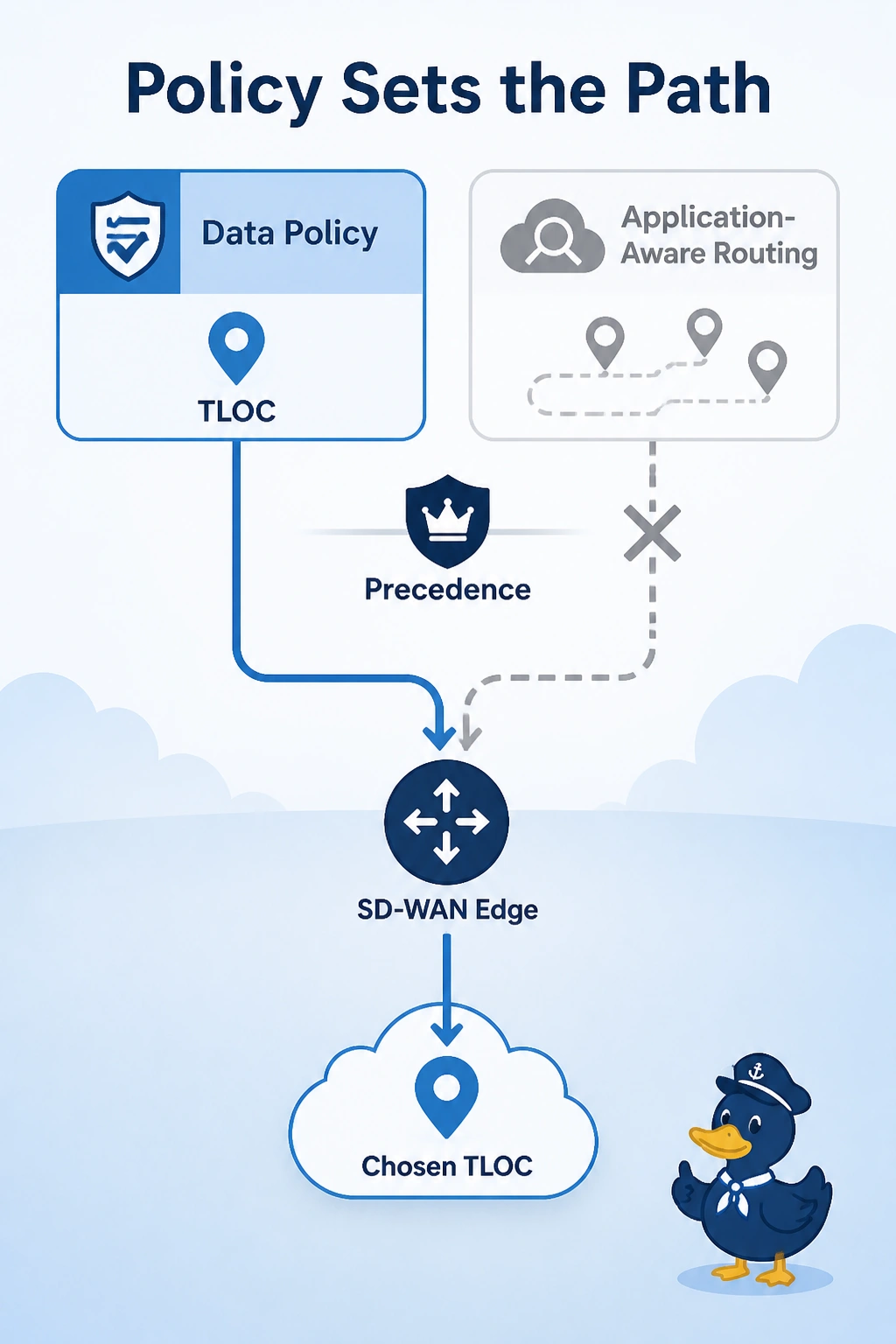
When two policies argue, the data policy is the one that already picked the door. You set a TLOC in the data policy, and that choice wins over the color application-aware routing would have preferred. Jitter does not get a vote once the data policy has named the TLOC.
Full Explanation
Cisco documents that when a data policy local TLOC action matches the same flow as an application-aware routing policy, the AAR preferred-color and backup-preferred-color actions are ignored and the data policy TLOC takes precedence (the AAR SLA class is still retained). Preferred colors from AAR only combine with data-policy colors when the data policy uses color preferences instead of a local TLOC. The payroll application follows the cloud TLOC the data policy named, even if the SLA policy prefers a different color. Application-aware routing does not override that TLOC. It would matter for flows the data policy does not pin. Neither policy is ignored in favor of raw jitter. Jitter is an input to the SLA policy, and that policy is not the one that wins here. A SIG tunnel is used only when a policy steers traffic to it. Two overlapping policies do not automatically mean inspection. Exam caveat: this precedence is why a forgotten data policy can make an SLA change look like it did nothing. Check for a TLOC action before you retune the SLA. Operational check: a payroll flow should leave on the data-policy TLOC, and removing that action should let the application follow the SLA color instead.