
A stadium sends voice to a cloud contact center with Catalyst SD-WAN. When both internet paths miss the loss target, voice is dropped even though the OMP route is present and firewall counters stay at zero. What explains the drops?
Select an answer to reveal the explanation.
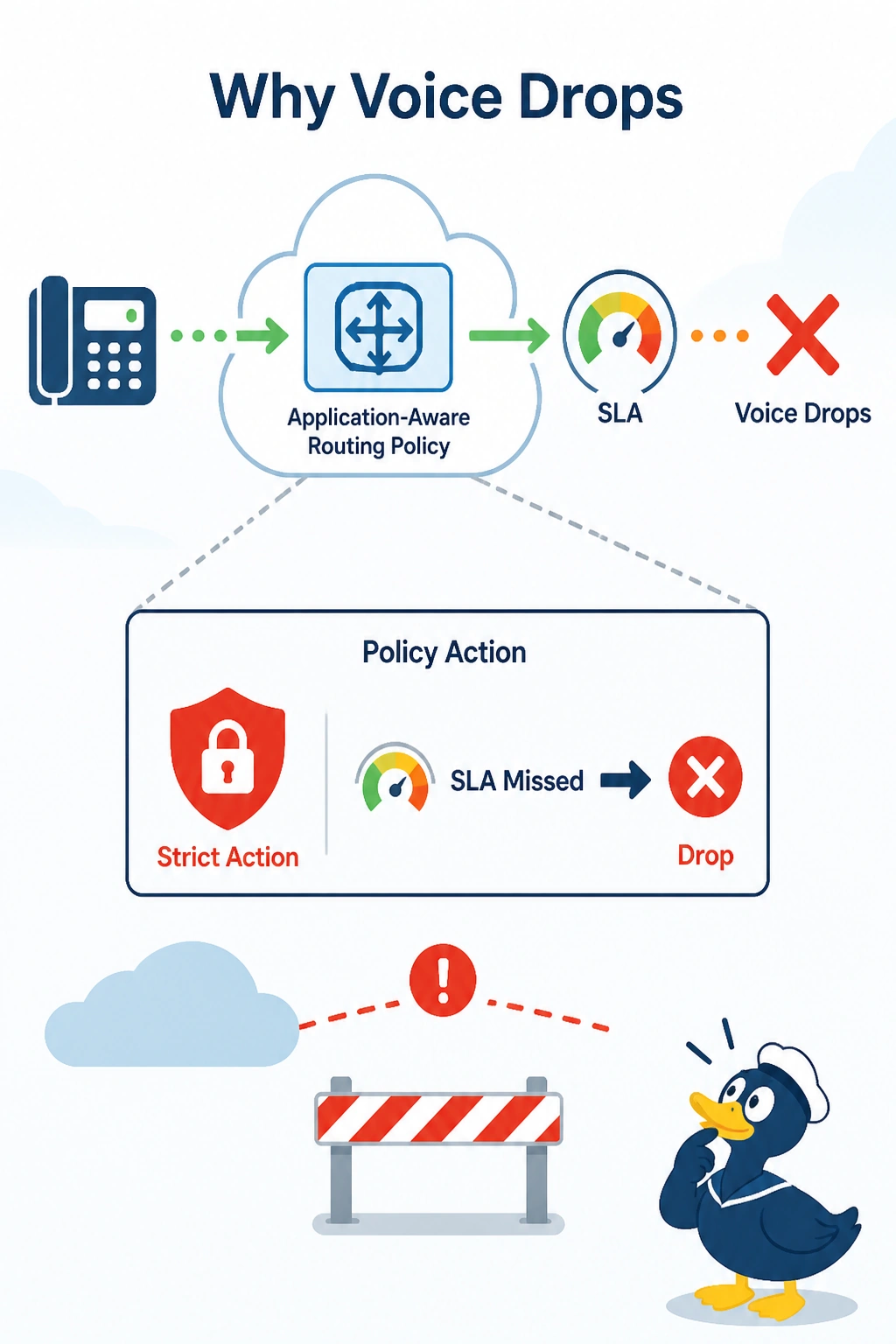
Short Explanation
You still have the contact-center route, and the firewall counters are quiet. The strict action tells Catalyst SD-WAN to drop your voice traffic when no tunnel meets the loss target; without strict, it forwards on the best available path.
Full Explanation
On Catalyst SD-WAN, application-aware routing sends an application over a tunnel that meets its SLA class. If no tunnel meets the class, the default behavior is to forward over an available tunnel anyway. The strict action changes that behavior: when both internet paths miss the loss target, it drops the voice traffic even though the OMP route remains installed. This explains the drops. The zone-based firewall is not the cause indicated by the evidence: if it were discarding the voice ports, its counters would move. OMP has not withdrawn the contact-center prefix; the stem confirms that the route is present, so the edge still has a route to use. An expired Secure Internet Gateway credential would affect traffic steered through the SIG, not explain both internet paths remaining up while only SLA-classified voice is dropped. Exam caveat: strict is appropriate when sending voice over a path with unacceptable loss is worse than sending no voice; if the contact center should accept a lossy path, strict may not suit that goal. Practical check: inspect the application-aware policy for the voice list and confirm that its SLA action is strict. Then verify that voice forwards when a path meets the loss target or when strict is cleared.