
A cloud IOS XE router and a campus router run OSPF on a tunnel. Network type and MTU match. One interface is in area 2 and the other is in area 3. Neither side is area 0. Hellos arrive and no adjacency forms. What must be true?
Select an answer to reveal the explanation.
Short Explanation
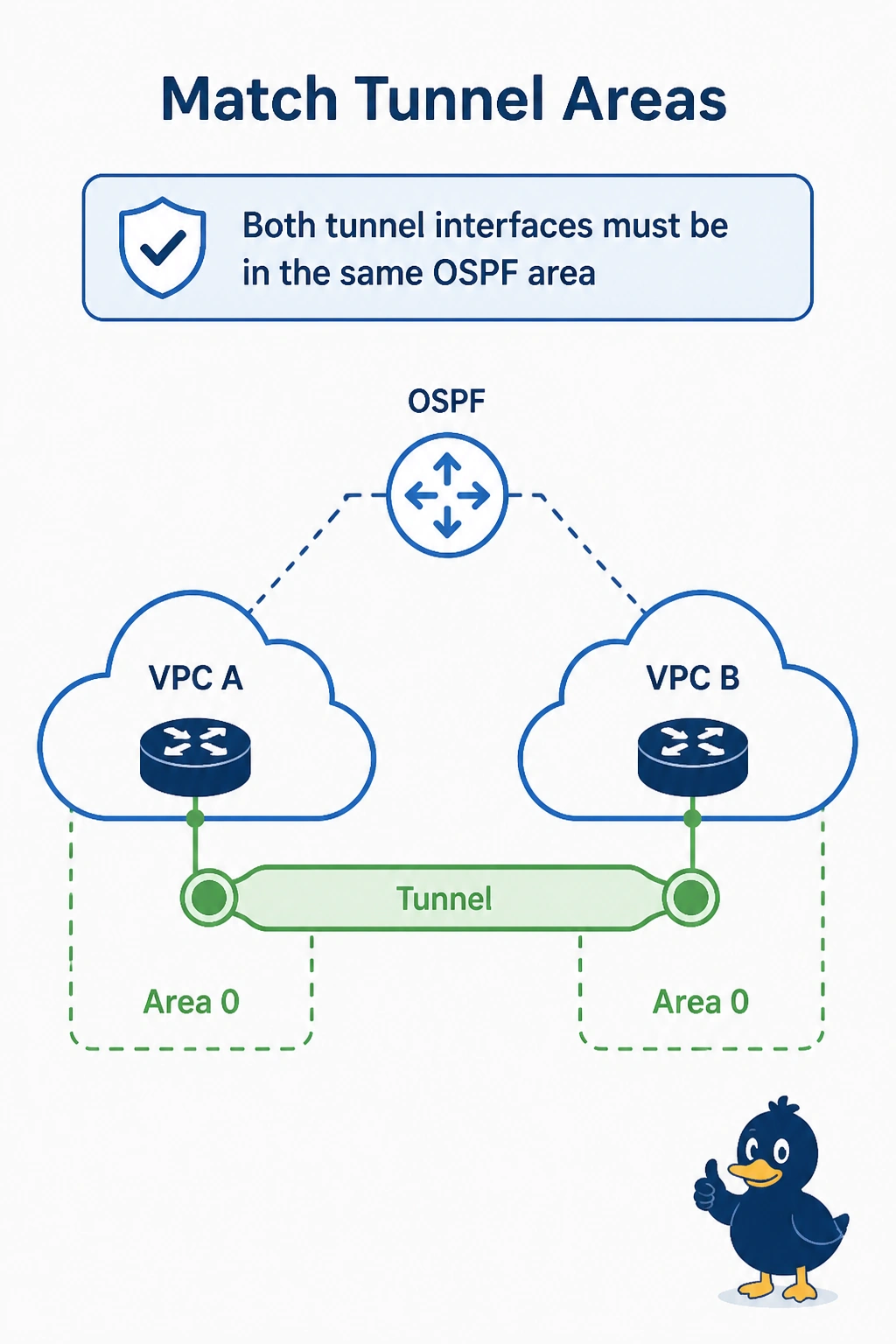
You drew two different area numbers on one wire, and neither end is the backbone that could join them. You put both tunnel interfaces in the same area. Hellos are arriving and the network type already matches, so the area number is the mismatch.
Full Explanation
OSPF neighbors must share the area ID in their hellos. Area 2 and area 3 on the two ends of one tunnel will not form an adjacency, and there is no area 0 router between them that could connect two non-backbone areas. Put both tunnel interfaces in the same area. The virtual private gateway is not an OSPF router and cannot be inserted as area 0 for this adjacency. The speakers are the two IOS XE routers. BGP does not have to be disabled for OSPF to honor a matching area. The IKE lifetime is unrelated to the area field in an OSPF hello. Exam caveat: if this tunnel is supposed to be the backbone, both ends belong in area 0. Matching them in area 2 is fine only when both routers' other area 0 connections, if they need the backbone, still exist. Operational check: show ip ospf interface tunnel should list the same area on both routers, and show ip ospf neighbor should then come up.