
A stadium has two internet providers and must keep AWS transit-gateway VPN paths independent, so one provider failure withdraws only that provider's routes. Which design fits?
Select an answer to reveal the explanation.
Short Explanation
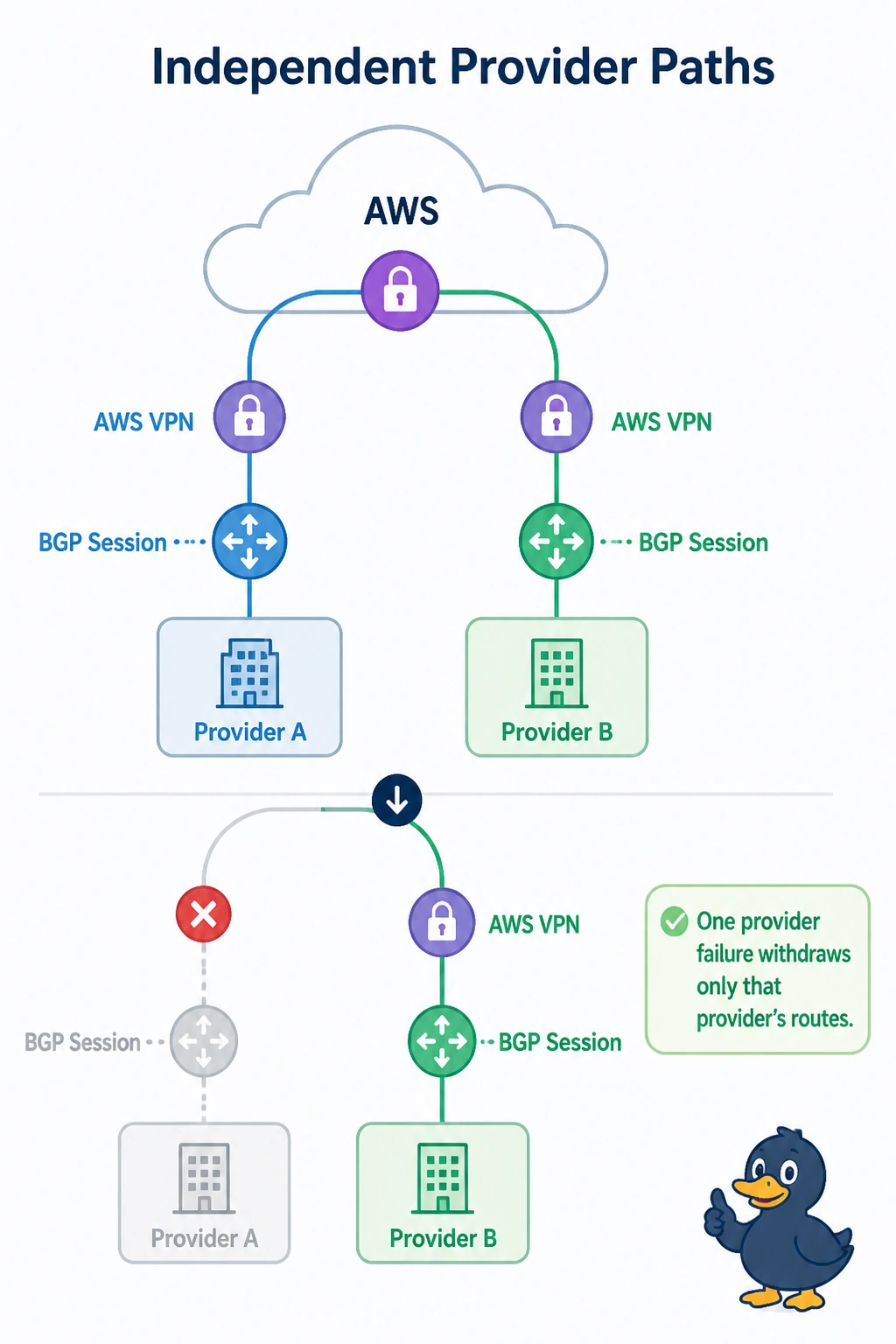
Two driveways help only if each one actually reaches the highway. You give each internet provider its own AWS VPN connection and its own BGP session, so one provider failure withdraws only that path. Two statics on one provider do not.
Full Explanation
Multi-homing to AWS over the internet means each provider carries its own Site-to-Site VPN connection, and BGP advertises the routes over that connection. If one provider fails, only that BGP session drops and its routes are withdrawn. The other provider's session keeps forwarding. Two static default routes toward a single tunnel on one provider share the same failure. There is no second VPN connection for the other provider to withdraw or to keep. Using the second provider only for management SSH means production VPN traffic never moves to it when the first provider fails. OSPF is not how an AWS transit gateway learns routes from a customer VPN. The transit gateway VPN uses BGP or static routing. Exam caveat: each AWS VPN connection still has its own pair of tunnels. Multi-homing across providers is an additional connection, not a replacement for those two tunnels inside one connection. Operational check: show ip bgp summary should list a neighbor for each provider, and shutting one provider's uplink should remove only that neighbor's routes.