
A NOC enables model-driven telemetry on IOS XE and needs link-down events delivered within a few seconds while no recurring telemetry updates are sent during hours of stable operation on the subscribed interfaces. Which telemetry publication model fits both requirements, and what triggers each message?
Select an answer to reveal the explanation.
Short Explanation
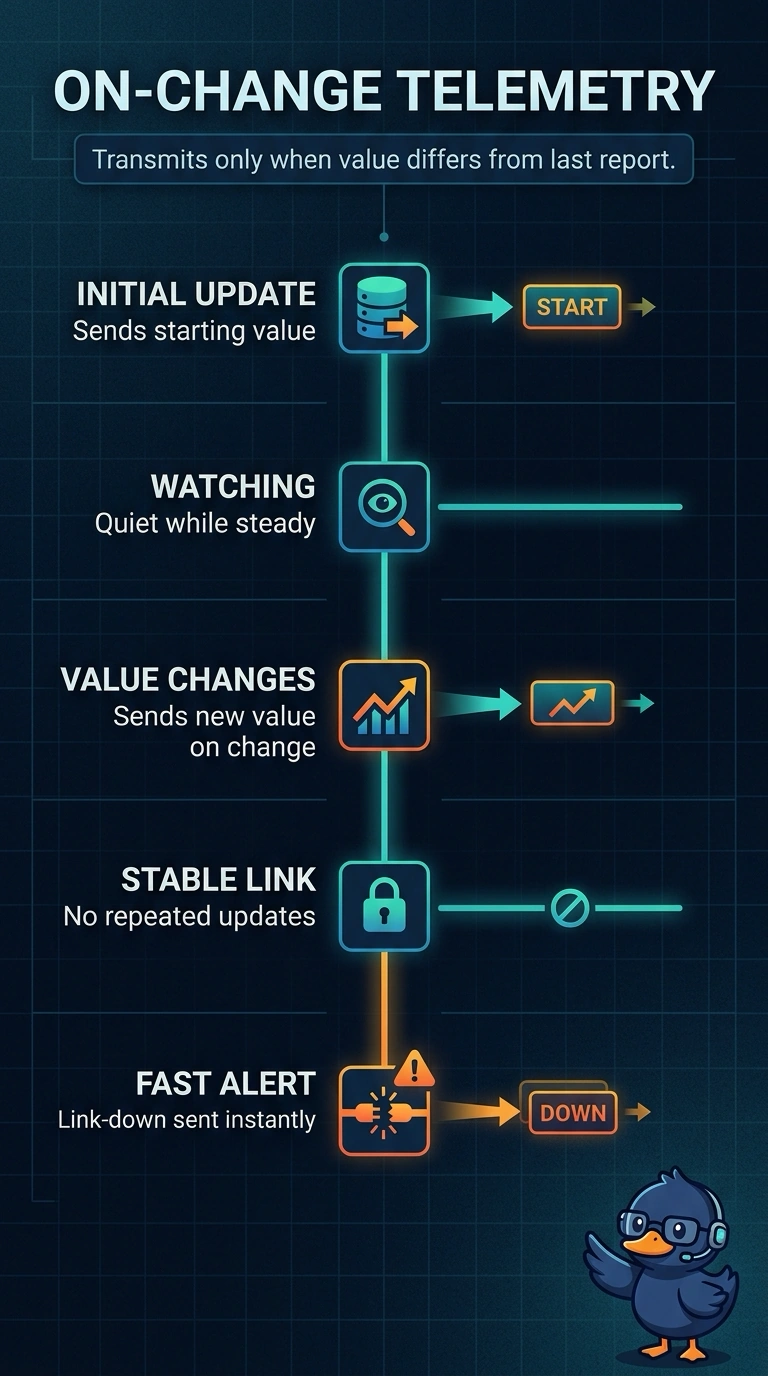
Choose on-change publication: after the initial update, you get another message only when a subscribed value differs from its last report—like a doorbell that rings only when someone arrives. Periodic publication sends updates on a timer even when nothing changes, so it wouldn’t keep stable interfaces quiet.
Full Explanation
On-change publication is the fit because it sends an initial update and then reports a subscribed value when that value differs from its last reported value. A link-down transition can therefore be delivered promptly, while unchanged interface values do not generate recurring updates. A one-second periodic cadence can meet the response-time goal, but its timer continues to send updates even when interfaces remain stable; the failure is unnecessary recurring traffic. Adding a 30-second debounce to on-change reporting avoids routine stable-state updates, but it may hold back a link-down notification beyond the required few seconds; the failure is latency. A hybrid on-change subscription with periodic refreshes reports transitions promptly, but its refresh timer still produces updates during stable operation; the failure is the prohibition on recurring updates. Exam caveat: “on-change” describes the publication trigger, not a guarantee of end-to-end delivery time; device support, configuration, and transport behavior can affect actual latency. Practical check: verify the IOS XE subscription’s encoding, filters, and update policy, then observe a controlled interface transition and a stable interval to confirm prompt event delivery and no periodic refreshes.