
An operations engineer has built a template in Catalyst Center that renders interface descriptions and a banner for access switches. Twelve newly discovered switches are waiting, and the template must be applied through the API with each switch's own hostname and location values, followed by an API check that the job completed. Which API workflow delivers both the deployment and the status confirmation?
Select an answer to reveal the explanation.
Short Explanation
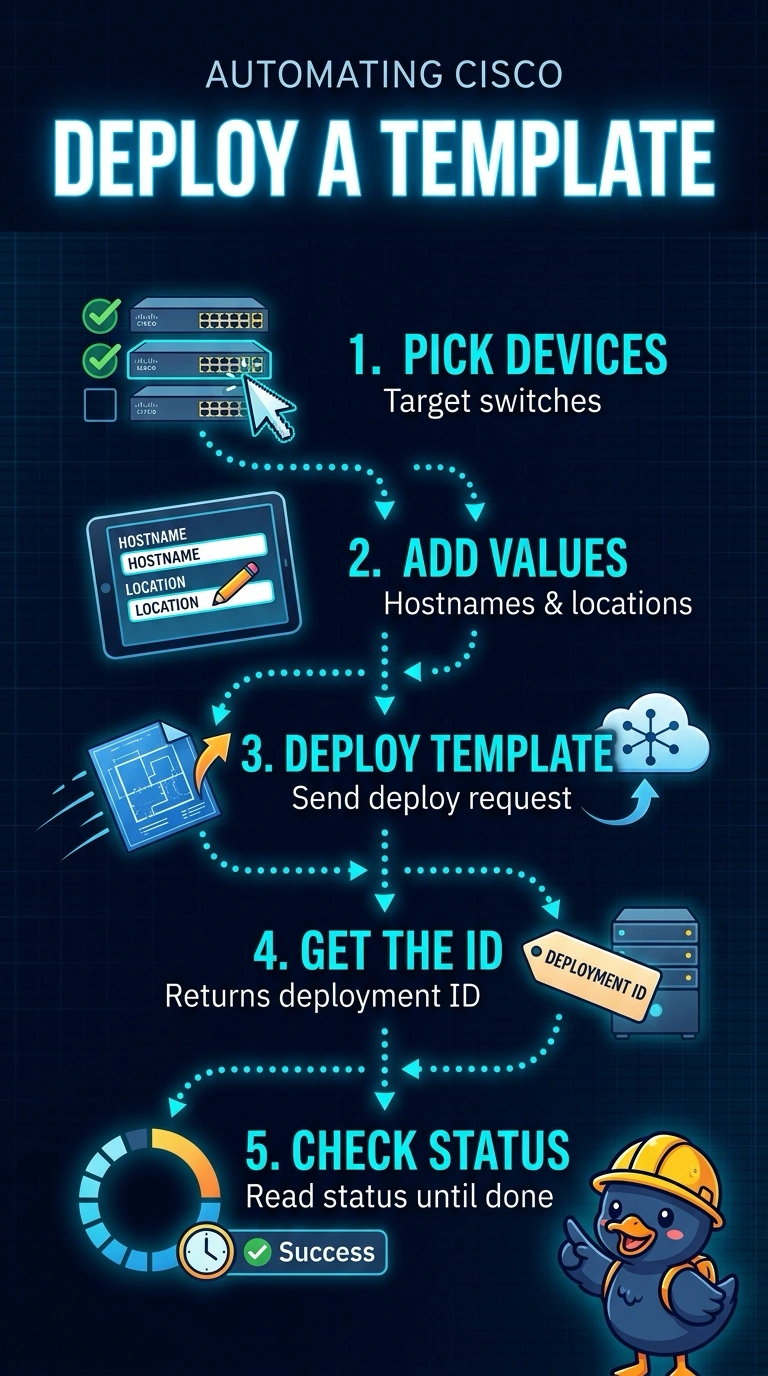
You’ve got it: deploy the template with each switch’s device ID and its own hostname and location values. Then use the returned deployment ID like a tracking number to check whether the job finished—an accepted request or discovery task alone won’t confirm deployment.
Full Explanation
Catalyst Center separates filling in a template from running it, and the deploy request performs the deployment. Include each target device identifier and its device-specific parameter values, such as hostname and location; the platform renders the template, pushes the result to the switches and returns a deployment identifier. Use that identifier to check whether the job succeeded or failed. Sending one shared parameter set to all twelve switches fails the per-device requirement because every switch would receive the same hostname and location values. Treating the deploy response as proof of completion fails the status requirement because the job may still be running or may fail. Triggering discovery and watching its task response also fails: discovery is an inventory scan, not a template deployment. Intent API paths differ between releases, so match the deploy and status endpoints to your version's documentation.