
A campus team currently logs into 40 access switches during each change window and hand-types identical VLAN and port settings, then verifies every device one at a time. Leadership wants the same change applied consistently, with policy defined once and compliance confirmed centrally. Which operational difference of a controller-based network best delivers that outcome?
Select an answer to reveal the explanation.
Short Explanation
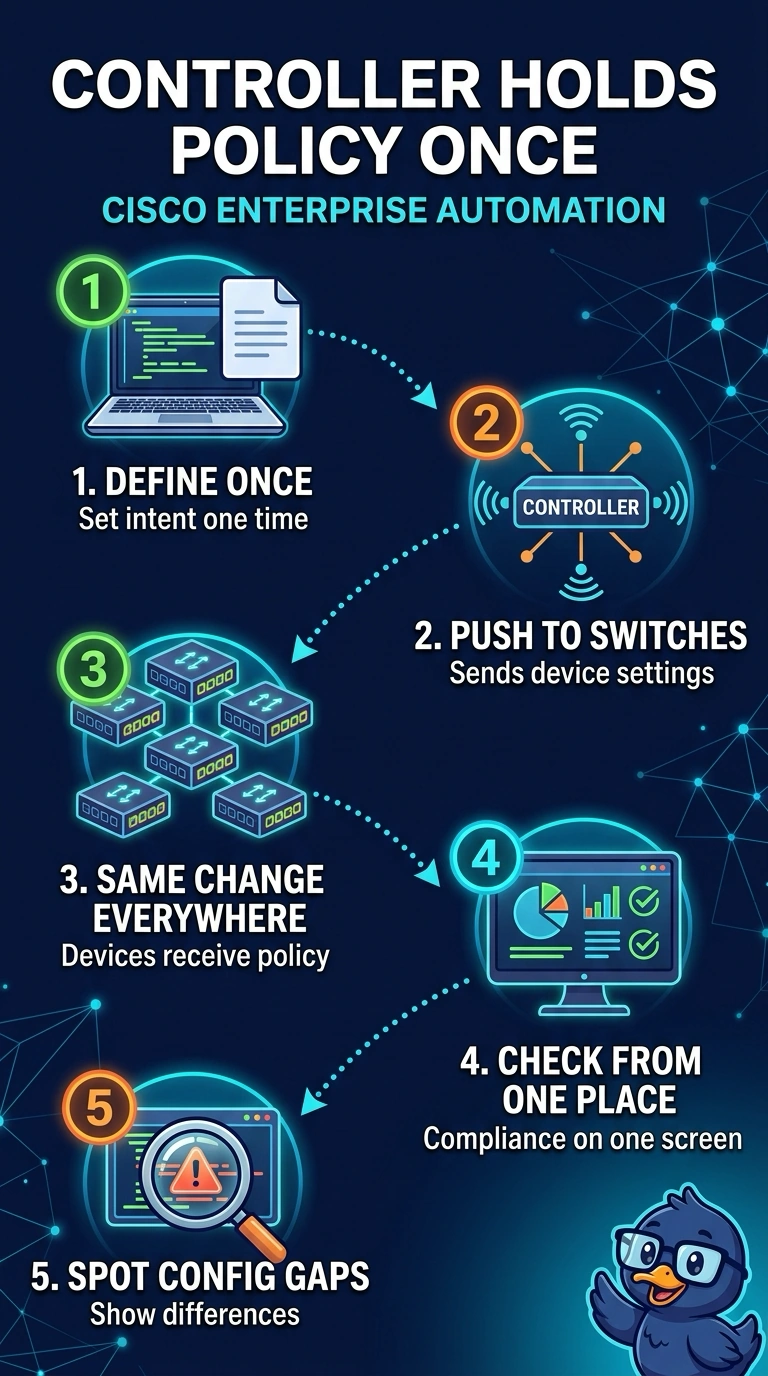
You're removing repetition, so the answer has to describe one place holding the policy and one place reporting compliance. A controller can store intent and deploy it across switches, then provide a central view of compliance. That's the centralized intent the question is really testing.
Full Explanation
A controller-based workflow can separate the intent layer from device configuration: you define policy centrally, and the controller deploys supported settings to managed devices. Where supported, compliance tools can report device status centrally, rather than requiring an engineer to verify each device by hand. This addresses both pain points: repeated typing and device-by-device verification. Managing every switch independently fails the consistency requirement, because it relies on repeated manual changes. Using the controller only for inventory and statistics fails the delivery requirement, since engineers still change configuration on each switch directly. Having switches pull configuration from a repository does not provide the central controller-based compliance view described in the scenario. The controller may also expose APIs for custom workflows; the distinction is where policy is managed and how compliance is checked. Practical check: ask where desired state is managed and where drift is reported; if the answers are per-switch configuration and manual checking, the workflow is not providing centralized policy management and compliance reporting.