
A university is rolling out SD-Access fabric across four buildings and repeats the same design each year as labs move. The team wants to model the site hierarchy, assign switches and routers to fabric roles, and create a guest virtual network without typing CLIs per device. Which Catalyst Center capability should drive this rollout?
Select an answer to reveal the explanation.
Short Explanation
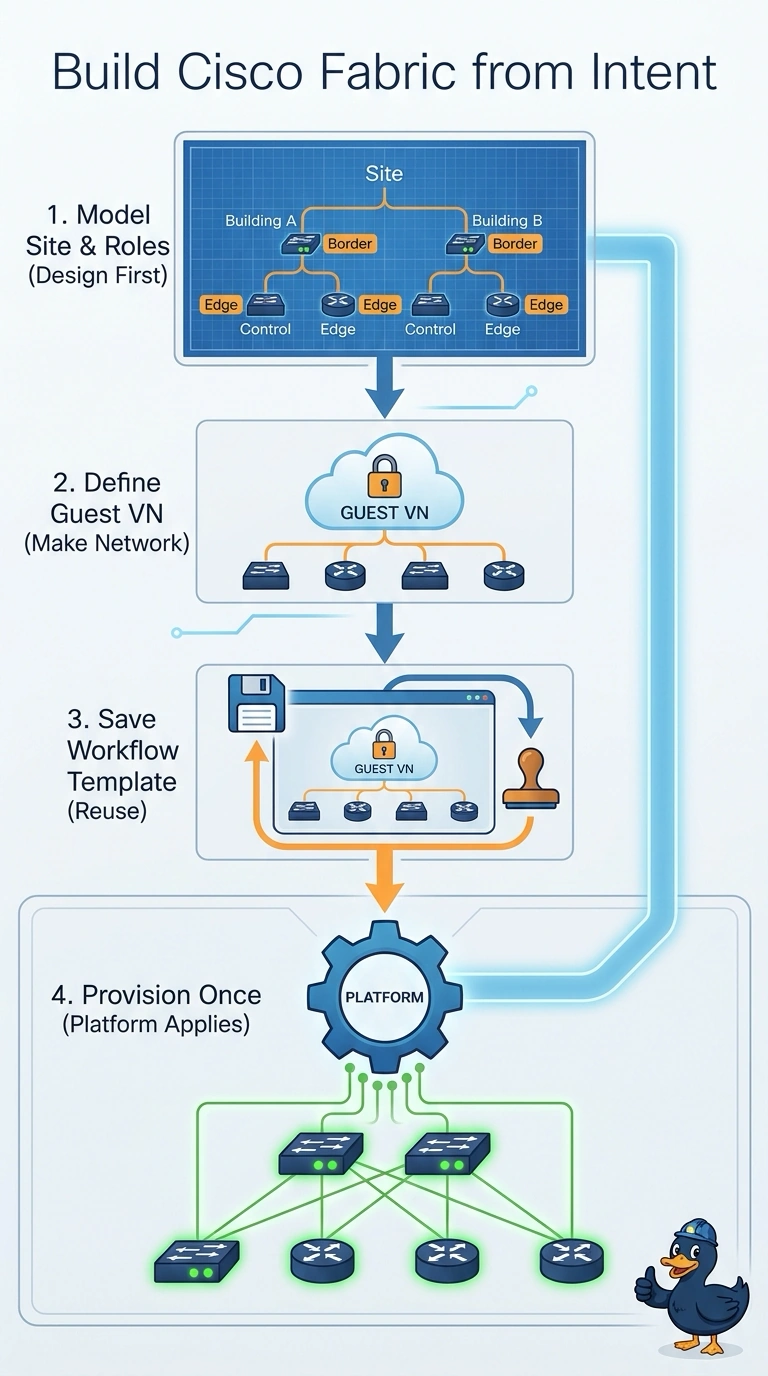
Intent-based automation lets you describe the outcome—your site hierarchy, fabric roles and guest virtual network—and Catalyst Center turns that intent into the needed configuration. Because you can reuse the workflow as labs move, next year’s rollout feels like repeating a recipe, not starting from scratch.
Full Explanation
Intent-based automation fits because you need to model a recurring fabric design, not just push isolated device changes. You can represent the site hierarchy, assign switches and routers their fabric roles, and define the guest virtual network together in one repeatable workflow, avoiding per-device CLI entry as labs move. Configuration templates can standardize and deploy settings, but managing the site hierarchy separately in documentation leaves part of the requested design outside the automated workflow. Fabric provisioning can model the hierarchy and roles, while a shared wireless SSID and centralized policy can provide guest access; however, that approach does not define the requested guest virtual network as part of the fabric design. Templates can also be saved and reused, but deploying device-level settings does not by itself create an integrated model of the hierarchy, fabric roles and guest virtual network. Exam caveat: Catalyst Center capabilities can overlap, so distinguish fabric intent from configuration templates, which primarily apply settings. Practical check: confirm the workflow represents the hierarchy, device roles and guest virtual network together and can be applied again when a lab moves.